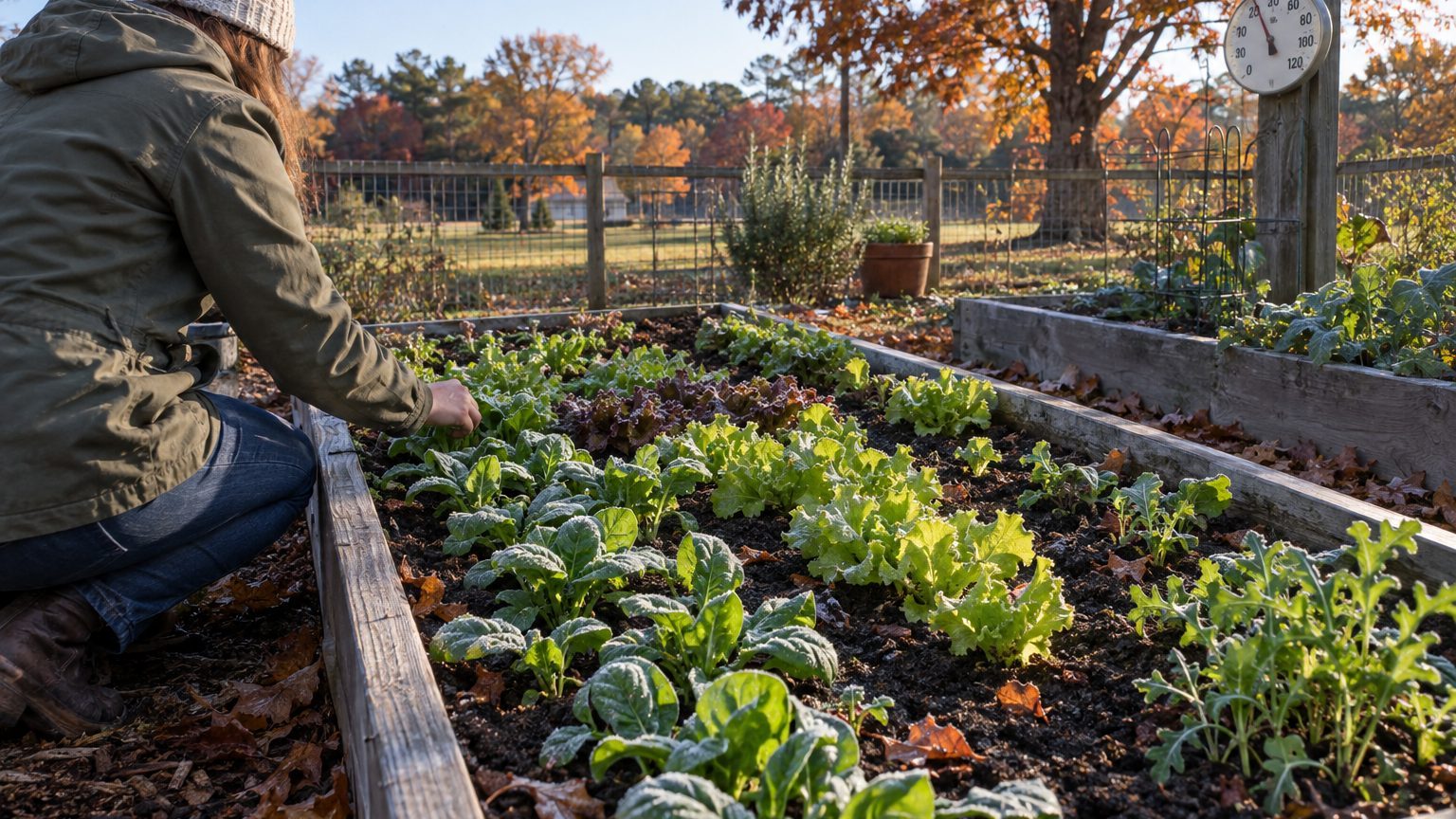

Sow Massachusetts winter salads from late summer into early fall, counting backward from the first fall frost. NOAA’s 1991-2020 Climate Normals put that frost between November 3 and November 14 at Boston’s Logan Airport, the mildest station in the state. Inland and hill gardens should start earlier. The exact day depends on the crop’s days to maturity and on your own patch, and this page shows how to work it out.
The short answer for Massachusetts
The sowing window closes well before frost does. A winter salad needs to be close to full size by the first fall frost, because growth slows to a crawl as days shorten and nights chill. A sowing made on the frost date itself will sit as a tiny seedling all winter.
The frost dates come from NOAA NCEI’s 1991-2020 Climate Normals for Logan Airport, the Boston station. They are a probability of a 32°F freeze, not a calendar promise. The range given is the 30-70% band, the stretch of dates where a freeze at or below 32°F goes from unlikely to likely.
| Measure (Boston reference station) | Value |
|---|---|
| Last spring frost (32°F, 30-70% band) | April 1 to April 8 |
| First fall frost (32°F, 30-70% band) | November 3 to November 14 |
| Coldest month, mean daily minimum | 23.1°F |
To turn those dates into a sowing date, take the days to maturity printed on the seed packet and count back from November 3. Take a hypothetical green rated at 45 days. Counting back from November 3 lands on about September 19, and from November 14 on about September 30. That is the latest possible date, before any cushion for slowing growth. In practice you sow earlier, which puts most winter salad sowings in late August through September. Fast baby greens can run later, especially under cover.
The spring dates matter too. April 1 to April 8 marks when a freeze becomes unlikely again, and it is when plants that overwintered resume real growth. Which crops suit a given sowing slot is covered in The Best Winter Salads for Massachusetts, and the wider picture is in Winter Salads for Massachusetts Gardens.
One caution runs through everything here. Logan is a waterfront urban station. Inland suburbs and the Berkshires frost noticeably earlier in fall and later in spring, so treat the Boston dates as the most generous version of the calendar.
What will not work here
Sowing in November fails. If frost arrives between November 3 and November 14 even at the warmest reference point, seed sown that week germinates, if at all, into shortening days with no time to size up. Gardeners who sow “before the frost” and stop there often end up with a bed of seedlings that never gets past the seed-leaf stage.
Slow, long-season crops fail for the same reason. Anything with a long days-to-maturity figure needs to be started in summer, and by the time it should go in, the soil is often too warm for good germination. Lettuce seed in particular tends to sulk in hot soil, so late-summer sowings do better in the shade of taller plants or started indoors.
Tender lettuce left in the open fails in deep winter. The mean daily minimum of the coldest month at the Boston reference station is 23.1°F. That is an average of nightly lows, not the record. Individual nights run colder, and the wind and inland sites run colder still. At that average, hardy leaves such as spinach and mâche can hold on outdoors, but delicate heading lettuce will not make it without cover.
Counting on outdoor sowing in January fails too. Soil in a Massachusetts bed in midwinter is not just cold, it is often frozen or sodden. Seed that rots in cold wet ground does not come back. The workable alternatives are sowing under cover or in a cold frame, or sowing early enough that plants overwinter at a size they can survive.
The last trap is quieter. Using Logan’s dates for a garden in Worcester County or the Berkshires. The coastal station is the mildest in the state, so its November 3 to November 14 band overstates how long an inland bed stays frost-free. A sowing date that works in Boston can leave an inland gardener a week or more short, and the page does not have county-level frost dates to say exactly how much.
What changes across Massachusetts
The USDA Plant Hardiness Zone Map (2023, built on 1991-2020 normals) places Massachusetts in zones 5a to 7b. That is six half-zone steps, so there is no single answer for the state. The system is built on one variable, the average annual extreme minimum temperature, which tells you whether a plant survives the coldest night, not when to sow it.
Boston is the reference city for the dated advice on this page. Other parts of the state differ, and the difference runs one way. The more inland or elevated the garden, the earlier the first fall frost and the later the last spring one. A reader in the Berkshires or the higher hills of the north should shift fall sowings earlier, lean harder on row cover, a cold frame or a low tunnel, and expect the spring restart to come later than April 1 to April 8.
A reader on the coast, by contrast, may find the Boston dates close to reality, though a waterfront site can be milder than the town a mile inland. Even within a single town, a south-facing bed against a wall can run ahead of an open lawn, and a frost pocket at the bottom of a slope can run well behind it.
Which zone you are in is not something this page can tell you. Look your location up on the USDA Plant Hardiness Zone Map, which lets you search by ZIP code. Use the result as a guide to winter survival, then use your frost observations for sowing dates, since the two answer different questions.
Where to check this for your own county
A county recommendation beats a state one. This page is the state one, built from a single reference station in Boston, and it cannot see the difference between Barnstable and Berkshire County.
Your best next stop is UMass Extension, the state’s land-grant extension service. Once there, look for two things. The first is a local planting calendar for fall and winter vegetables, ideally one that gives dates for your part of the state rather than one set for everyone. The second is the list of varieties trialled in your county or a similar one, since a variety that thrives on the coast can bolt or stall in the hills.
Be ready for the format. Extension calendars are often written crop by crop rather than for “winter salads” as a group, so search for spinach, lettuce, kale and similar crops one at a time. The page does not have a Massachusetts extension calendar for winter salads in its sources, so it does not quote one here.
When you find a county date that differs from the Boston-based window above, trust the county date. Local frost records, local trial results and local extension staff know your soil and your elevation in a way a statewide page cannot.
Checking this against your own garden
Your own observations outrank every date here. Three things are worth watching, and none needs an instrument.
Soil warmth by feel. Push your hand a few inches into the bed in the morning in late summer. Warm soil that feels like bathwater means lettuce seed may not germinate well, and it also tells you which beds hold heat. Later in fall, soil that feels cold in the same spot means growth has nearly stopped.
The first flush of male flowers. On summer squash and cucumbers, male flowers open before female ones. Note the date they first appear each year. If your vines flower earlier than a neighbor’s, your garden runs warm, and your fall window probably stretches a bit later than theirs.
The first true leaves. The first pair of leaves a seedling shows are seed leaves. The true leaves come next, and their arrival shows the plant is genuinely growing. If a September sowing has reached true leaves within a couple of weeks, you are on pace. If it is still at seed leaves as nights cool, cover it and expect a small, slow crop.
Common questions
Can I still sow winter salads in October?
It depends on where you garden and how much cover you have. At the mildest reference point, the first fall frost falls between November 3 and November 14, which leaves little growing time. Fast baby greens under a cold frame or tunnel can still work. Outdoors and unprotected, an October sowing is a gamble, and inland it is a longer one.
Are the Boston frost dates right for my town?
Probably not exactly. Logan is a waterfront station and the mildest in the state, so inland suburbs and the Berkshires frost noticeably earlier in fall and later in spring. Use the Boston dates as the outer limit and move earlier the farther inland or higher you go.
Does the 23.1°F figure mean everything outside will die?
No. That is the mean daily minimum in the coldest month at the Boston reference station, an average of nightly lows. Hardy greens can handle it, and tender lettuce usually cannot without cover. Single nights will be colder than the average, and inland ones colder again.
Is the hardiness zone the same as a sowing calendar?
No. The USDA zone rests on one number, the average annual extreme minimum temperature, so it speaks to winter survival rather than timing. Massachusetts spans zones 5a to 7b, so check the USDA map for your location and then rely on frost dates and your own observations to schedule sowing.