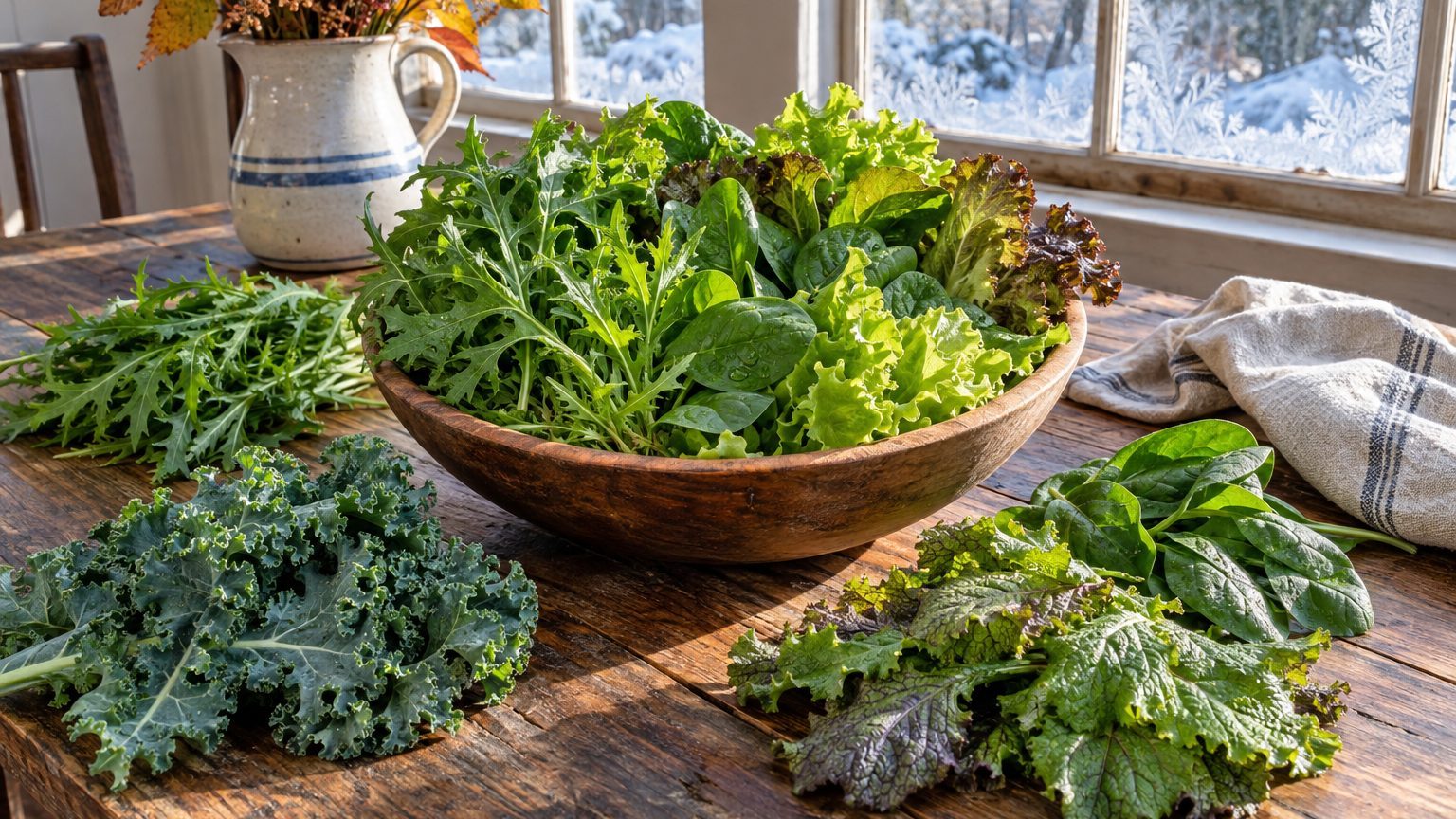

The best winter salads for Vermont are the cold-hardy greens: spinach, mâche, claytonia, kale, and tough Asian greens such as tatsoi and mizuna. Sow them in late summer or early fall and shelter them from the worst weather. Full heads of lettuce and anything slow to mature are poor bets here. Burlington’s numbers explain why, and they get harsher the farther you drive from Lake Champlain.
The short answer for Vermont
Choose by type, not by cultivar name. In Vermont, the types that earn their space are leafy greens that are small, quick to size up, and tolerant of freezing: spinach, mâche (also sold as corn salad), claytonia (miner’s lettuce), kale, and the mustard-family salad greens. Hardy lettuce can join them where you have a tunnel or cold frame, but it is the least forgiving of the group. Look for seed labeled for fall, winter, or overwintering use, because those lines were selected to keep working in low light and cold.
The reason is the shape of the season. At the Burlington reference station, the last spring frost falls between April 30 and May 10, and the first fall frost between October 3 and October 13. Both ranges come from NOAA’s 1991-2020 Climate Normals, and they are probabilities. They mark the span of dates over which the chance of a 32°F freeze sits in the 30 to 70 percent band. They are not promises that frost arrives on a given day, and a freeze outside those windows is entirely possible.
Then there is winter itself. The mean daily minimum of Burlington’s coldest month is 12.9°F, and that is an average of nightly lows, not the record. Plenty of nights run colder. A plant that sits outdoors through that month needs real cold tolerance, and even the hardiest greens do better with a layer of fabric, a low tunnel, or a cold frame over them.
Which type does which job
The table sorts the main candidates by what they do best here. These are general horticultural tendencies, not trial results, so treat them as a starting point for your own plot.
| Type | Cold tolerance | Best role in Vermont |
|---|---|---|
| Spinach | High | Backbone crop; sown in fall, it can sit through winter and resume growth in early spring |
| Mâche | High | Slow but very hardy; suits cold frames and unheated tunnels |
| Claytonia | High | Tender, mild-flavored leaves that keep coming in cold, dim conditions |
| Kale | High | Sturdy and forgiving; baby leaves work as salad, and cold sweetens them |
| Tatsoi, mizuna, mustard greens | Moderate to high | Fast growers for early fall; best with cover once hard freezes arrive |
| Hardy lettuce | Moderate | Only under cover, and only for a gardener willing to vent and monitor |
If you are reading this in early October, Burlington’s first-frost window is open right now, which means the sowing question has partly moved on. The When to Sow Winter Salads in Vermont page covers timing in detail, and the broader Winter Salads for Vermont Gardens hub ties the pieces together.
What will not work here
Slow crops fail first. A head lettuce that needs a long stretch of mild weather to fill out will not finish before the cold arrives, and the same goes for anything you would normally grow to full size. With a first fall frost as early as October 3 even in the mildest corner of the state, there is little room to wait for a plant to mature. Choose varieties you can harvest young, as baby leaves.
Open-bed lettuce through the winter is the second casualty. A coldest-month average low of 12.9°F will flatten tender lettuce left uncovered, and a single bare, windy night can finish it.
Growth stops in deep winter, too, and that surprises people. In an unheated tunnel or frame, the plants don’t keep growing through the darkest weeks. They hold, more or less in suspended animation, and you harvest what already grew in the fall. That is why sowing late is the most common mistake: a seedling that has not reached good size before the days shorten may never get there. Plan for a standing crop to pick from, not a continuous harvest from seed.
Another failure is treating a covered bed as a set-and-forget project. A low tunnel on a bright January day can overheat, and then freeze hard the same night. Venting on sunny afternoons matters as much as the cover itself. Snow load matters too, so a flimsy hoop that is fine in October can collapse under a heavy storm. Brush it off, or build sturdier.
What changes across Vermont
Vermont is not one garden. The USDA Plant Hardiness Zone Map (2023, based on 1991-2020 normals) places the state across zones 3b to 5b. That is a spread of several zones inside one set of borders, so no single answer fits everyone. The zone system rests on one variable only, the average annual extreme minimum temperature, which makes it a good measure of whether a perennial will survive and a rougher guide to a fast-growing salad crop.
A gardener on the lake side of the state and one in the Northeast Kingdom are working with different winters, not just different dates on the same winter. The reference-city figures on this page, Burlington’s frost windows and its 12.9°F coldest-month mean minimum, describe the mild end. Lake Champlain moderates that station, while the Green Mountains and the Northeast Kingdom run substantially shorter seasons, and the first freeze can come noticeably earlier there.
What should a reader in the north or at altitude shift? Three things, mainly. Sow earlier than the Burlington-based advice implies, because the autumn growing window closes sooner. Lean harder on the hardiest types, such as spinach, mâche, claytonia, and kale, and treat tatsoi, mizuna, and lettuce as bonuses. And add protection earlier and more of it, since a single layer of fabric that works near the lake may not be enough on a hillside. Elevation, cold-air pooling in valley bottoms, and wind exposure can all push a site colder than its town suggests.
For your own zone, do not guess from a neighbor or from this page. The USDA’s online Plant Hardiness Zone Map lets you look up your location by ZIP code. Use that, then read the result as a rough guide to winter cold, not as a planting date.
Where to check this for your own county
The best next stop is University of Vermont Extension, the state’s land-grant extension service. Staff and publications there are built around Vermont conditions, and they know the difference between a Champlain Valley garden and one on a ridge.
Two things are worth looking for there. First, a local planting calendar, which gives sowing and transplanting windows tied to frost data for your area rather than for Burlington alone. Second, any varieties trialled in your county or a similar one. A trial result, meaning a named variety grown side by side with others in real Vermont conditions, is worth more than any general ranking of types, including the one on this page.
Be plain about what this page is. It is a state-level guide built on one reference station, and the figures describe Burlington, not every town in Vermont. A county recommendation beats a state one, because it accounts for the local frost pattern, soil, and elevation that a statewide page has to flatten. When the two disagree, go with the county advice. You can also ask the extension service directly: a short note describing your elevation and exposure can get you a more specific answer than any website.
Checking this against your own garden
Your own observations outrank every date on this page. A frost window is a probability, and your yard is one specific place. Three things are worth watching, and none of them needs equipment.
- Soil warmth by feel. Push your hand a few inches into the bed in the morning. If it feels cool and damp rather than chilly and stiff, seeds will still germinate. A bed that goes cold early tells you your microclimate closes sooner than the regional numbers suggest.
- The first true leaves. Seedlings show two rounded seed leaves first, then the leaves that look like the adult plant. If your sowings reach true leaves quickly, the site holds warmth well. If they stall, you are short on heat or light, and the next sowing should go in earlier.
- Where frost shows first. Walk the yard at dawn after the first cold night. White grass in one corner and green in another shows you where cold air collects and where it drains away. Put your hardiest crops and your covers in the low, frosty spots.
Common questions
What is the most reliable winter salad green for Vermont?
Spinach is the usual first pick. It tolerates freezing, sows easily in early fall, and can stand through winter under cover to resume growth in early spring. Mâche and claytonia are close behind and better suited to very cold, low-light conditions.
Can I grow lettuce through a Vermont winter?
Only with protection, and with limited expectations. Burlington’s coldest month averages a daily minimum of 12.9°F, and many nights run colder. Uncovered lettuce will not last, while a cold frame or tunnel gives hardy types a chance. Even then, lettuce is less dependable than spinach or mâche.
Do the frost dates on this page apply to my town?
They apply to Burlington, the reference station, where the last spring frost falls April 30 to May 10 and the first fall frost October 3 to October 13. Those are probabilities of a 32°F freeze, not guarantees. Higher and more northern parts of Vermont run substantially shorter seasons, so check local figures.
Which USDA zone is Vermont?
Vermont spans USDA zones 3b to 5b, so there is no single zone for the state. Look up your own location on the USDA Plant Hardiness Zone Map. Keep in mind that zones reflect the average annual extreme minimum temperature, which says little about frost dates or growing-season length.