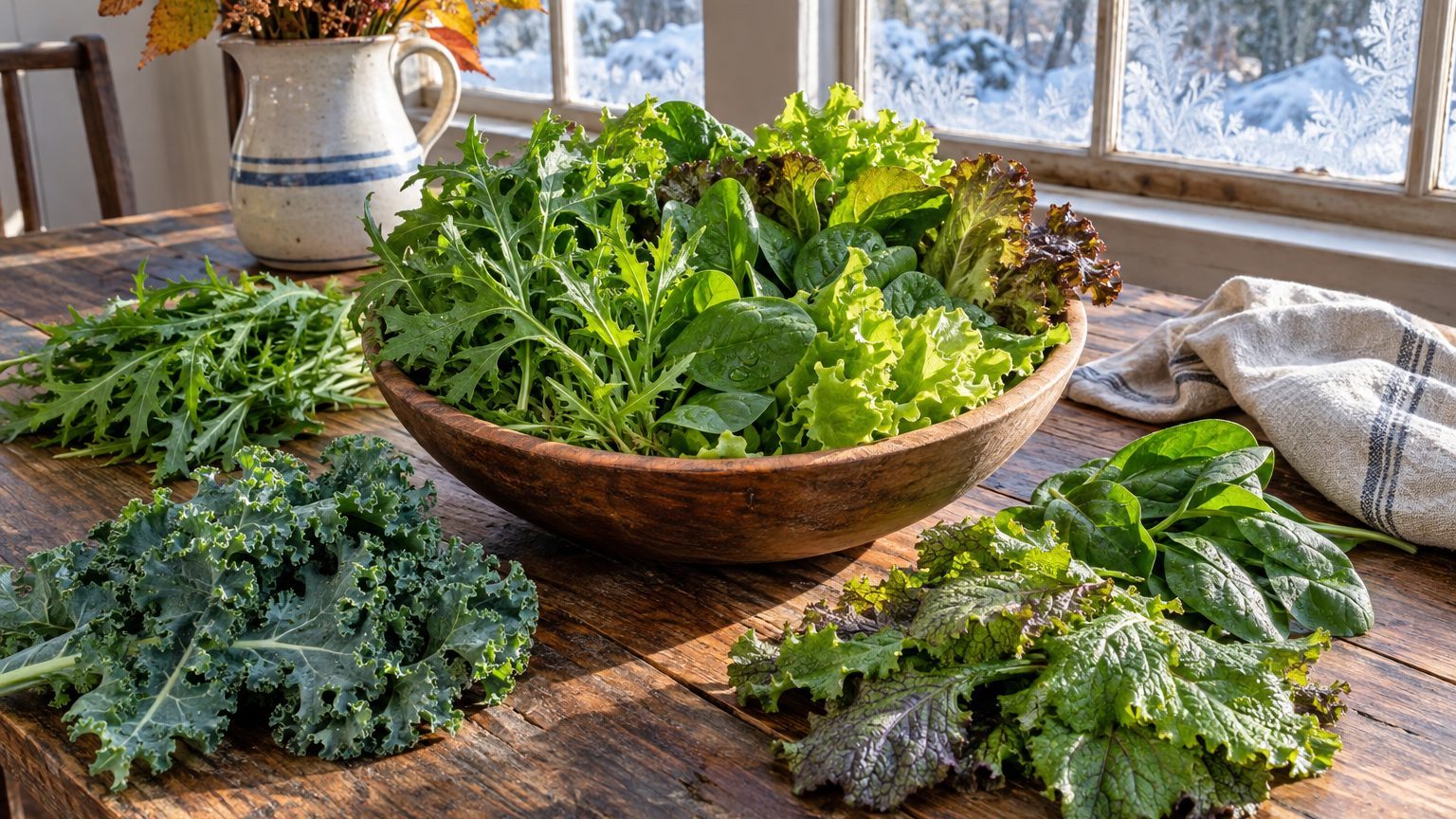

For most Virginia gardens, the best winter salads are the cold-hardy leaf crops: spinach, mâche, claytonia, arugula, mustards, and chicories such as escarole and radicchio. Loose-leaf lettuce joins them on the milder coast or under a cover. Type matters more than the exact variety here. Virginia spans USDA zones 5a to 8b, so a pick that thrives near Virginia Beach can fail in the mountains.
The short answer for Virginia
Choose by type, then by variety. Hardy leaf crops carry the winter, quick mustards and arugula fill gaps, chicories give you bitter, crunchy salad bowl material, and lettuce is the one to protect. That order follows the numbers this page has, which come from the coast. At the NAS Oceana station in Virginia Beach, NOAA’s 1991-2020 Climate Normals put the last spring frost at March 20 to April 3 and the first fall frost at November 10 to November 24.
Those dates are probabilities of a 32F freeze, specifically the span where the chance sits between 30% and 70%. They are not promises. A freeze can land before the window opens or after it closes, and a salad bed planted on the early edge of the range takes the risk with it. The same source gives 31.6F as the mean daily minimum of the coldest month. That is an average of the lows, not the record low, but it tells you winter on the coast hovers right around freezing. Spinach, mâche, kale and claytonia handle that without complaint.
Sorting the types by job
| Type | Role in a winter bed | Where it fits best |
|---|---|---|
| Spinach, mâche, claytonia | Backbone crops that keep standing through freezes | Statewide, including colder areas |
| Kale and collard (as baby leaf) | Sturdy salad base, sweeter after cold | Statewide |
| Arugula and mustards | Fast, peppery fill-ins | Coast and mild areas outdoors; elsewhere under cover |
| Escarole, endive, radicchio | Bitter, crisp texture | Mild areas; cover in colder ones |
| Loose-leaf lettuce | Soft salad leaves | Coast, or any site with a cover |
This page does not have county variety trial results, so it cannot name a single best cultivar. In seed catalogs, look for descriptions that say cold-hardy, winter, or overwintering. Those are the varieties bred to hold up. For the wider picture, see Winter Salads for Virginia Gardens, and for timing, When to Sow Winter Salads in Virginia.
What will not work here
Sowing at the fall frost date. On the coast that date runs November 10 to November 24, and by then the growing is nearly over. Winter salad crops need size before cold sets in, because a seedling does little in the dead of winter. Sow after the first frost and you will harvest a handful of thumbnail leaves in February. The frost date is the end of the growing runway, not the start.
Trusting 31.6F too literally is another trap. It is an average of daily lows in the coldest month. Plenty of nights will sit below it, especially clear, calm ones when heat radiates straight up. An unprotected bed of lettuce that survives the average can still lose its outer leaves to a single hard night. Hardy crops shrug this off. Tender ones do not.
Head lettuce and soft butterheads fall in the second group. In the colder parts of the state, they will not make it through winter without a cover. The zone range runs from 5a to 8b, and the cold end of it bears no resemblance to the coastal numbers above. This page does not have a figure for the mountains, so it will not borrow one. It is enough to say that a coastal planting guide used as-is in the Blue Ridge will fail.
Humidity punishes close spacing. Virginia’s air is damp through the cool months, and leaves in a dense baby-leaf patch dry slowly on short days. Mildew and rot follow. Thin seedlings early, give chicories and kale room, and water the soil rather than the foliage. A bed that looks wasteful in November looks sensible in January.
Late spring sowing fails too. With the last frost between March 20 and April 3 on the coast, warm weather arrives quickly, and spinach, arugula and many lettuces bolt and turn bitter. Spring sowings in a Virginia garden are a short window, not a long one, and anything planted late goes to seed before it reaches a useful size.
One more error is easy to miss: treating a single recommendation as universal. A winter salad plan that ignores where in the state you garden is guessing, whatever the seed packet says.
What changes across Virginia
There is no single answer for Virginia. The USDA Plant Hardiness Zone Map (2023 edition, built on 1991-2020 normals) runs from zone 5a to 8b across the state, eight half-zone steps from the coldest mountain pockets to the warmest coast. A gardener in Virginia Beach and one at altitude in the southwest are growing in different climates under the same state name.
The coastal dates quoted on this page sit at the mild end. The Blue Ridge and southwest Virginia run weeks later in spring and earlier in fall. For a reader in the north or at altitude, that shifts three things. Sowing moves earlier, because the autumn runway is shorter. Spinach, mâche, claytonia and kale become the reliable core, while arugula, chicories and especially lettuce shift under row cover, a low tunnel, or a cold frame. And spring crops can go in later, since the cold lingers.
The hardiness zone measures one thing: the average annual extreme minimum temperature. It says nothing about when frost arrives, how long a bed stays workable, or how hot the summer was. Use it to judge whether a perennial or overwintering crop survives the cold at all, then use frost dates for timing. Two gardens in the same zone can have quite different sowing windows.
To find which zone applies to your own address, use the USDA Plant Hardiness Zone Map and enter your ZIP code. Do not guess from a county name, and do not assume the zone of the nearest city. Elevation, a hillside, or a valley can move a garden a half zone or more away from the town next door.
Where to check this for your own county
Your state extension service is the next stop. Virginia Cooperative Extension runs local offices across the state, and the agents there know which crops actually succeed in your county’s soil and weather. Two things to look for: a local planting calendar for fall and winter vegetables, and the varieties that have been trialled or recommended for your area. If a county office publishes a vegetable planting guide, it will beat anything written for the whole state.
That is a plain fact, not modesty. A county recommendation beats a state one, and this page is the state one. It gives you the types that suit Virginia’s range of conditions and a coastal reference for dates. It cannot tell you whether your valley holds frost until mid-April or whether your clay drains in a wet January.
When you reach out, take specifics. Say which crops you want to grow, whether you can use a cover, and roughly where your garden sits (valley floor, hilltop, near water). Ask which cultivars have done well locally and when the office suggests the last safe sowing for fall salads. Master Gardener volunteers attached to local extension offices often field exactly these questions. The answers will be shorter and more useful than anything general.
Checking this against your own garden
Your own observation outranks every date on this page. Three things to watch will tell you more about your plot than a statewide table.
First, soil warmth by feel. Push your fingers a few inches into the bed in the morning. If it feels distinctly cool, growth is slowing and late sowings will stall. If it still feels mild, you have more room than the calendar suggests. A bed beside a south-facing wall will stay warmer than an open lawn plot, and that difference is your microclimate.
Second, the first true leaves. Seedlings first show a pair of seed leaves, then the true leaves that look like the mature plant. Note how quickly they appear after sowing and how fast the next ones follow. If a sowing is still bare after weeks, the bed is too cool or too shaded for that date, and next year you should sow sooner.
Third, where the morning frost sits. Walk the garden at dawn after the first white morning. Frost that coats the low corner but spares the bed near the house shows you where tender crops are safe and where only the hardy ones belong. Cold air pools like water, so a dip in the ground can run a half zone colder than the slope above it.
Keep a few notes in a notebook or on your phone, with the sowing date, the first frost, and what survived. After two seasons, you will have a calendar that fits your own garden.
Common questions
Can I grow salad outdoors all winter in Virginia?
On the coast, often yes with hardy types, since the coldest month’s mean daily minimum is 31.6F. In the mountains and other colder zones, plan on cover for anything beyond spinach, mâche, claytonia and kale.
Which winter salad crops handle cold best?
Spinach, mâche, claytonia and kale are the sturdy core. Chicories sit in the middle, and lettuce is the most tender of the group.
Do I need row cover in Virginia?
It depends on where you are. Gardeners near the coast can get by without it for hardy greens, though a light cover helps on hard nights. In colder parts of the state, cover is what lets arugula, chicories and lettuce last through winter.
When should I stop sowing in fall?
Well before the first fall frost, which on the coast falls between November 10 and November 24. Exact sowing windows are laid out in When to Sow Winter Salads in Virginia, and colder areas should shift earlier.