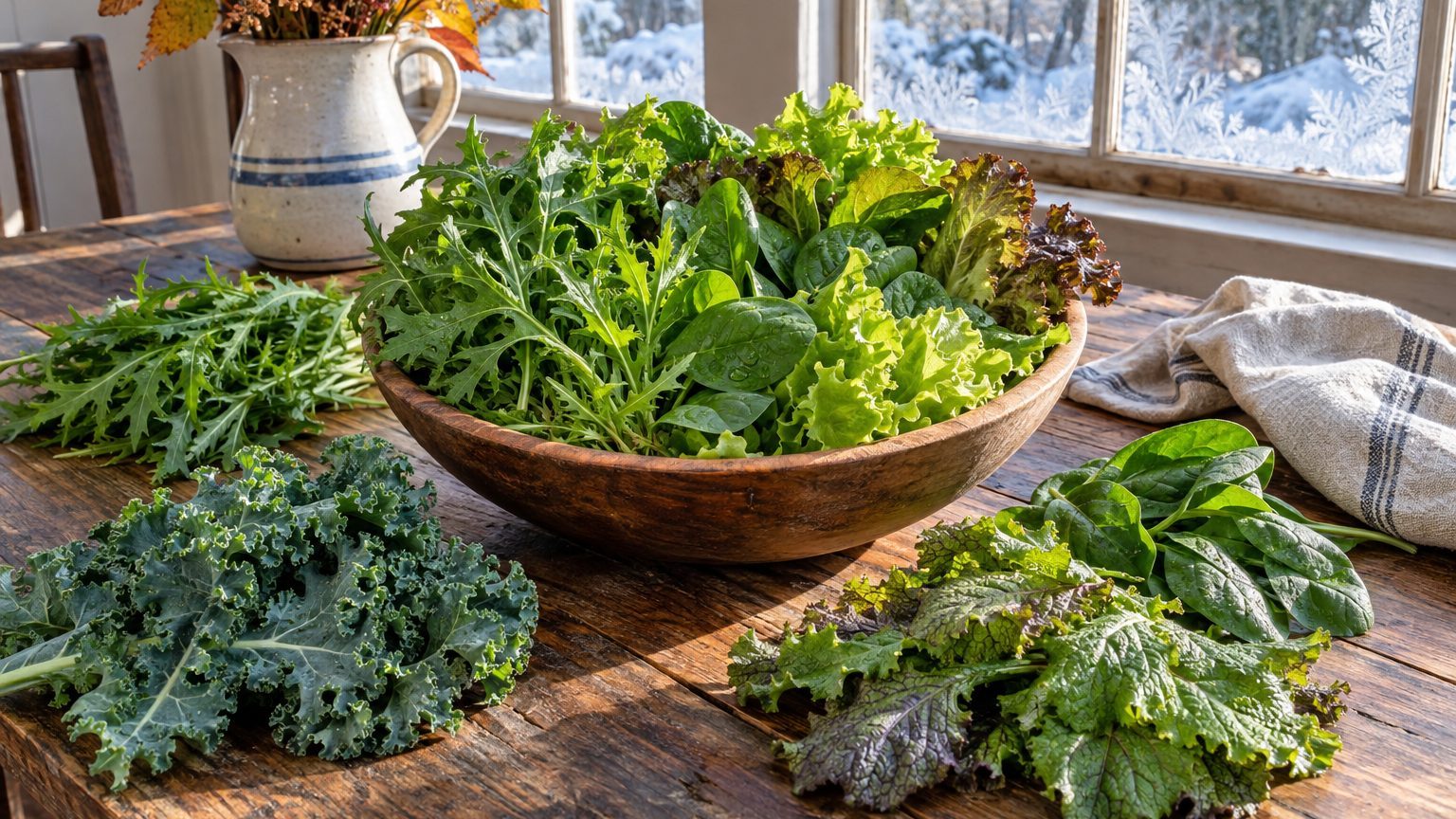

The best winter salads for Wyoming are small, fast, cold-tolerant leaves: spinach, mâche, claytonia, kale, and hardy mustards such as mizuna and tatsoi, grown under cover. The frost-free stretch is roughly 130 days at 6,000 feet, and frost is possible in any month at higher elevations. Big heading lettuces are the gamble here. Leaves that can be cut young and protected are the safer bet.
The short answer for Wyoming
Start with the calendar, because it sets the rules. NOAA’s 1991-2020 Climate Normals put the last spring frost between May 7 and May 18, and the first fall frost between September 24 and October 5. Those dates are not guarantees. They mark the band where the chance of a 32F freeze runs between 30 and 70 percent. Outside the band the odds are lower or higher, and a freeze after May 18 or before September 24 is still possible.
The cold itself is the second number. At the Cheyenne reference station, the mean daily minimum of the coldest month is 18.1F. That is a typical night, not a record low, and colder nights sit on the other side of that average. Hardy greens can live through a typical night under a cover. They will not do well on bare, windswept ground through the worst of it.
So the decision comes down to type. With a short season, favor crops that reach harvest size quickly and then simply hold in the cold. For a deeper look at the broader picture, see Winter Salads for Wyoming Gardens. For timing, When to Sow Winter Salads in Wyoming turns the frost dates into sowing windows.
| Type | Why it suits Wyoming | What to watch |
|---|---|---|
| Spinach | Cold-tolerant, quick to cut as baby leaves | Bolts as days lengthen in spring |
| Mâche (corn salad) | Low, tough rosettes that tolerate cold | Slow to start, so sow on time |
| Claytonia (miner’s lettuce) | Very cold-hardy, grows in low light | Small leaves, so sow a generous patch |
| Kale | Sturdy leaves that handle frost | Needs space, and wind can shred leaves |
| Mizuna, tatsoi, arugula | Fast, cut young before the cold sets in | Best with cover once nights drop |
| Heading lettuce | Possible in a cold frame or tunnel | The most likely to fail unprotected |
This page does not have a summer heat figure for Wyoming, so it makes no claim about July temperatures. The choices above rest on season length and winter cold alone.
What will not work here
Slow, warmth-hungry crops lose to the calendar. A head of lettuce or a Chinese cabbage that needs weeks of mild weather to fill out will be caught half-grown when the fall window opens on September 24. After that, growth stalls and plants mostly hold what size they have. Whatever you sow has to be near harvest size by the time that window opens.
Treating May 7 as a safe date is another common failure. That date is the early edge of a band where a 32F freeze is still a 30 percent chance, and it runs to May 18 at the other end. Tender seedlings set out the day the band opens are a coin-flip bet. Hardy greens shrug off a late freeze. Warm-season starts do not.
Bare ground in January is the third trap. A coldest-month minimum of 18.1F is an average, which means plenty of nights fall below it. Winter greens left uncovered through that stretch often survive, but they come out leathery, damaged, or dead on the colder nights. At 6,000 feet, the page’s own frost data says season extension is not optional. A row cover, a low tunnel, or a cold frame is part of the plan, not an upgrade.
Higher elevations make everything worse. Frost is possible in any month there, so even a late-summer sowing can take a hit before it gets going. If your garden sits well above 6,000 feet, treat the 130-day figure as a ceiling, not a promise.
Last, assuming one date fits the whole state. The dates on this page come from one NOAA station. A garden in a cold valley, on a ridge, or on the north side of a house will not match them, and the gap can be large enough to turn a good sowing into a failed one.
What changes across Wyoming
Wyoming does not have one answer. The USDA Plant Hardiness Zone Map (2023, built on 1991-2020 normals) places the state in zones 3a to 6a. That is a wide spread, and it means gardeners in different parts of the state are working with very different winters. The zone is built on one variable only, the average annual extreme minimum temperature, so it says how cold the worst nights get. It says nothing about season length, wind, or how fast the soil warms in spring.
The figures on this page, including the 18.1F coldest-month minimum, come from Cheyenne as the reference city. Other parts of Wyoming differ, sometimes by a lot. Use Cheyenne as a baseline, not as a prediction for your yard.
If you garden in the north or at altitude
Shift everything toward caution. Sow earlier in the late-summer window so plants reach size before the cold arrives. Lean harder on the hardiest types, such as mâche, claytonia, and spinach, and rely on tunnels or frames rather than open beds. Expect a shorter outdoor season than the 130-day figure suggests, because frost can appear in any month at higher elevations.
Do not take a zone number from this page. To find yours, look up your location on the USDA Plant Hardiness Zone Map, which takes a ZIP code. Then compare it with the 3a-6a spread here to see where you fall.
Where to check this for your own county
The next stop is University of Wyoming Extension. County offices there know the local frost patterns, the soils, and the wind. A county recommendation beats a state one, and this page is the state one. It cannot account for a cold canyon, a high plateau, or a sheltered town.
When you get there, look for two things. First, a local planting calendar that gives sowing and harvest windows for your area, ideally with frost dates for a station near you. Second, the varieties that have been trialled in your county, meaning grown there and compared, not just recommended in general. A cultivar that thrives in one county can sulk in another, and extension trials are where that shows up.
Be aware of what this page does not have. It has no University of Wyoming planting calendar in its sources, so it does not quote one. If you find one from your county office, follow it over anything here. Calendars from other states are no substitute, because they are written for different frost dates, different winters, and often different crops.
Checking this against your own garden
Your own observations outrank every date above. Three are worth watching, and none needs a gadget.
- Soil warmth by feel. In the morning, push your fingers a few inches into the bed. Cold, stiff soil in a spot that gets sun tells you it is slow to warm, so sow later there. A bed that feels loose and mild early is a warm pocket, such as one beside a south-facing wall.
- The first flush of male flowers. Spinach is the clue. When the first flower stalks appear on spring plants, you have learned how fast your bed heats and how long you have for harvest before it turns bitter. Earlier stalks mean a hotter spot.
- The first true leaves. After the seed leaves, the first true leaves show a seedling is established. If late-summer sowings have not reached that stage by the time the fall window opens, they are behind, and cover is your fix.
Write the dates down for a season or two. Your notes will beat any state average.
Common questions
Can I harvest salad outdoors all winter in Wyoming?
With cover, hardy types can hold and give you pickings in the cold months. Without it, results are unreliable, because the coldest-month mean minimum is 18.1F at the reference station and many nights are colder.
Which type should a beginner try first?
Spinach is a sensible start, with mâche or claytonia as companions if you have a cold frame. They tolerate cold and are cut young, which suits a short season.
Is the state frost date my frost date?
No. May 7 to May 18 and September 24 to October 5 are a 30-70% band for a 32F freeze at one NOAA station. Your county and your elevation can shift both.
Do I really need a cold frame or row cover?
Yes, for most gardens. With roughly 130 frost-free days at 6,000 feet and frost possible in any month higher up, season extension is not optional here.