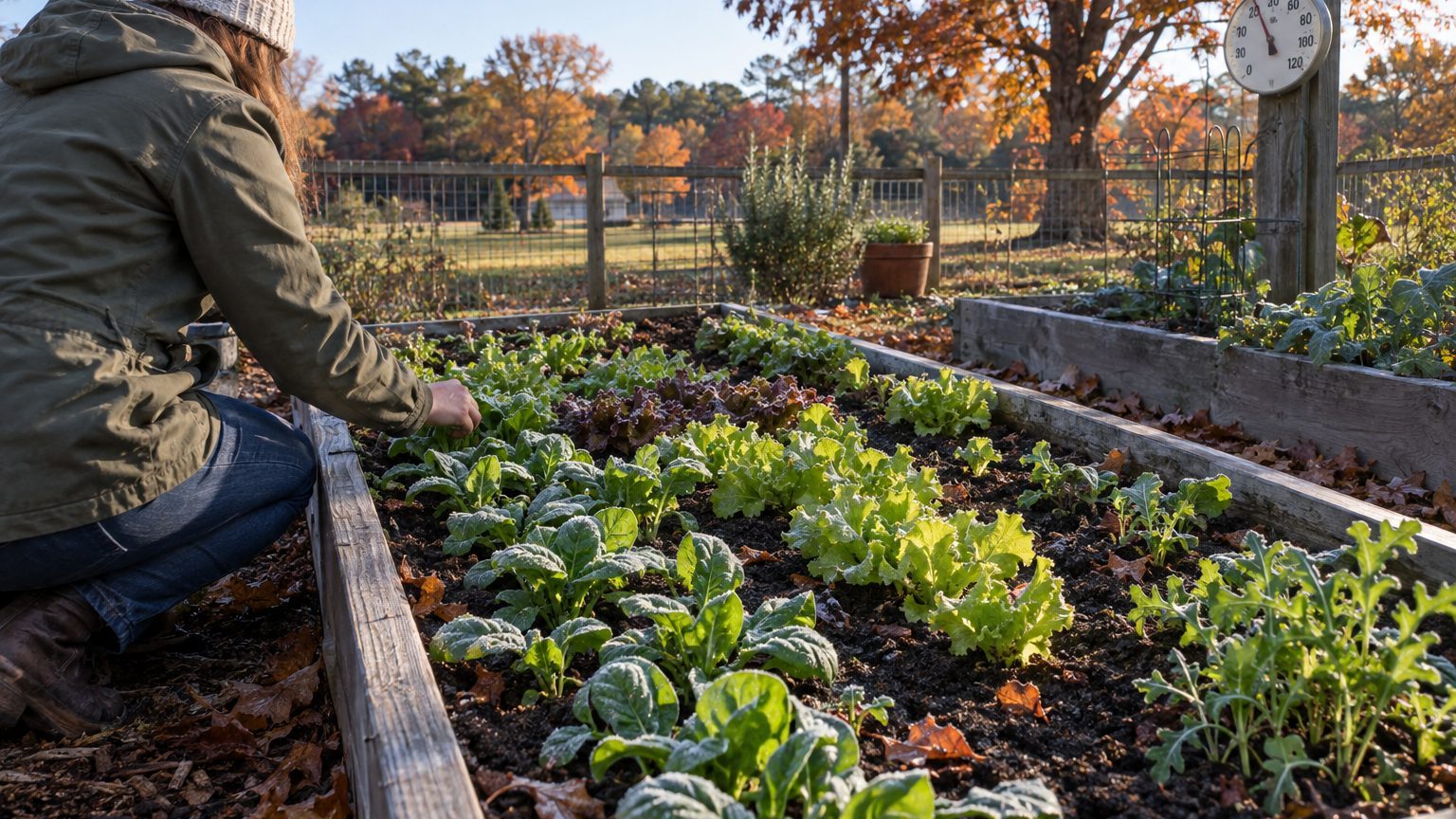

Sow winter salads in Wyoming in late summer, counting backward from a first fall frost that lands between September 24 and October 5. Spring dates matter much less, because the crop that carries you through winter is a fall crop. Those frost dates describe odds, not promises, and elevation can move them a long way. Treat the calendar below as a frame to adjust, not a date to obey.
The short answer for Wyoming
Sow in the weeks before the first fall frost window of September 24 to October 5, and sow early enough that plants are close to full size when it opens. The last spring frost window, May 7 to May 18, tells you when beds can be worked and when ordinary salad crops can go out, but it does not set the winter salad schedule.
Both windows come from NOAA’s 1991-2020 Climate Normals, which publish the odds of a 32°F freeze on any given date. The range covers the dates where that chance sits between 30 and 70 percent. Inside the band, a freeze is somewhere between a long shot and a coin flip. No date in it is a safe one.
| Marker | Wyoming reference value | What it is |
|---|---|---|
| Last spring frost | May 7 to May 18 | 30-70% band of 32°F freeze probability |
| First fall frost | September 24 to October 5 | 30-70% band of 32°F freeze probability |
| Coldest month, mean daily minimum | 18.1°F (Cheyenne) | Average night low, not the record low |
| Hardiness zone | 3a-6a (USDA system) | Range across the whole state |
To turn this into a sowing date, start at September 24, the early edge of the fall band. Subtract the days to maturity printed on the seed packet. Then add a cushion, because growth slows as days shorten and nights cool. For most salad greens that puts sowing in late summer, with the seedlings up and growing while the garden is still warm.
Season length is the reason for the tight schedule. At 6,000 feet you can expect roughly 130 frost-free days, and at higher elevations frost can show up in any month. Season extension (row cover, low tunnels, cold frames) is not optional here. Covers can stretch the sowing window later than the open-ground schedule, but this page does not have a verified cutoff date for covered sowings, so look to local extension guidance for that. For the wider picture, start with Winter Salads for Wyoming Gardens.
What will not work here
The slowest winter salads fail first. A head-forming green that needs most of the frost-free season to size up is poorly matched to a state with roughly 130 frost-free days at 6,000 feet. Many of the long-maturing chicories and heading types fall in this group. They arrive at the first fall freeze half-grown, and half-grown plants stall in cold, short days rather than catching up. Fast baby-leaf crops fit the calendar far better, and The Best Winter Salads for Wyoming sorts them by type.
Sowing in the open in late September fails too. By the time the fall band opens on September 24, a seed that has not yet sprouted has no realistic path to a harvestable plant outdoors. Some gardeners treat the frost date as the sowing date. In Wyoming it is closer to the deadline for having plants established.
Winter cold itself is the next filter. The mean daily minimum of the coldest month at Cheyenne is 18.1°F. That is an average of nightly lows, so some nights run well below it. Tender lettuces left bare in the open on those nights are likely to be lost. The hardiest greens can survive in an unprotected bed, but expect leaf damage and slow regrowth. Reliable winter picking here depends on covers, not on the plants’ toughness alone.
Watering is the quiet failure. Late summer sowing means germinating small seeds in warm, dry soil, and a weekly soak will not do it. The seedbed has to stay evenly damp until sprouting, which can mean a light watering every day during dry spells. Mulching the row lightly or shading it with a board or burlap until seedlings emerge helps. Many sowings that fail in this season fail because the top inch of soil dried out for a single afternoon.
Elevation breaks the calendar outright. If frost can occur in any month where you garden, a late-summer sowing can be hit before it has leaves to protect. In those places the practical answer is to sow directly under cover from the start, not to hope the open-ground schedule holds.
What changes across Wyoming
Wyoming is not one garden. The USDA Plant Hardiness Zone Map (2023, built on 1991-2020 normals) places the state in zones 3a through 6a. That is a spread of several full zones, so there is no single answer for the state. The frost dates and the 18.1°F figure on this page come from Cheyenne as the reference city. Other parts of Wyoming differ, sometimes a lot.
One caution about that zone number. The USDA system rests on one variable, the average annual extreme minimum temperature. It tells you what a perennial can survive in the coldest winter. It does not tell you how many frost-free days you have, and for a late-summer sowing, season length matters as much as winter cold. Two places in the same zone can have quite different fall frost dates.
If you garden in the north or at altitude, shift in one direction. Frost arrives earlier and the season is shorter, so count back from an earlier date than September 24, sow earlier in the late-summer window, and plan on covers from day one. Treat the Cheyenne dates as a ceiling on how late you can sow, not a target. If you garden in a lower, warmer pocket toward the milder end of the range, you may have more room, though a hard early frost can still arrive ahead of the band.
Nobody can tell you your zone from a distance, and this page will not guess. Look up your location on the USDA Plant Hardiness Zone Map and note both your zone and the nearest weather station’s frost data. Then compare your elevation and exposure with the 6,000-foot reference. A south-facing bed beside a wall can run noticeably warmer than a open lawn only a few yards away.
Where to check this for your own county
This page is the state version, and a county recommendation beats a state one every time. Wyoming’s elevations, wind and frost patterns vary too much for a single set of dates to fit every garden. Your state land-grant extension service is the right next stop: University of Wyoming Extension, which can point you to your county office.
When you get there, look for two things. The first is a local planting calendar, ideally one written for your county or for a nearby town at a similar elevation. Compare its fall frost dates with the September 24 to October 5 band here. If its dates are earlier, shift your sowing earlier by the same margin. The second is a list of varieties trialled in your county. A trial tells you what actually produced in local soil, wind and cold, which a general variety guide cannot.
Extension publications are often organized by crop, not by state, so you may need to search for lettuce, spinach or season extension separately. If no winter salad calendar exists for your county, ask the office directly. Staff can often tell you which sowing dates local gardeners have found workable, and that local knowledge is worth more than any average. Whatever the extension says for your county, use it over the dates on this page.
Checking this against your own garden
Your own observations outrank every date here. Three are worth tracking, and none needs an instrument.
- Soil warmth by feel. Press a hand flat into the bed in mid-morning. If it feels cool at that hour in late summer, germination will be slow. If it feels hot and dries to dust, you will need daily watering. Beds that behave differently from one another show you your microclimates.
- First true leaves. Note how many days pass from sowing to the first true leaves, the ones after the rounded seed leaves. Slow arrival in your garden means the packet’s days to maturity will run longer than printed, so sow earlier next year.
- First blackened leaf. Watch a tender plant such as basil or squash. When its leaves first blacken, that is your garden’s real frost, and it may come earlier than the band if your spot is low or open.
Write the dates down once a year. Three seasons of notes will tell you more about your own plot than any normals table.
Common questions
Is the first fall frost date a guarantee?
No. September 24 to October 5 is the band in which a 32°F freeze has a 30 to 70 percent chance of having arrived, based on NOAA’s 1991-2020 normals. A freeze can come earlier, and in some years later.
Can I sow winter salads in spring instead?
You can sow ordinary salad crops after the last spring frost window of May 7 to May 18, but that gives you a spring harvest, not a winter one. Crops meant to overwinter are sown in late summer.
Do I really need a cold frame or row cover?
For Wyoming, yes. With roughly 130 frost-free days at 6,000 feet and frost possible in any month at higher elevations, season extension is not optional if you want reliable winter picking.
Which varieties should I start with?
Favor fast, cold-tolerant types over slow heading ones. The breakdown by type is in The Best Winter Salads for Wyoming, and your county extension office can tell you which ones have been trialled locally.