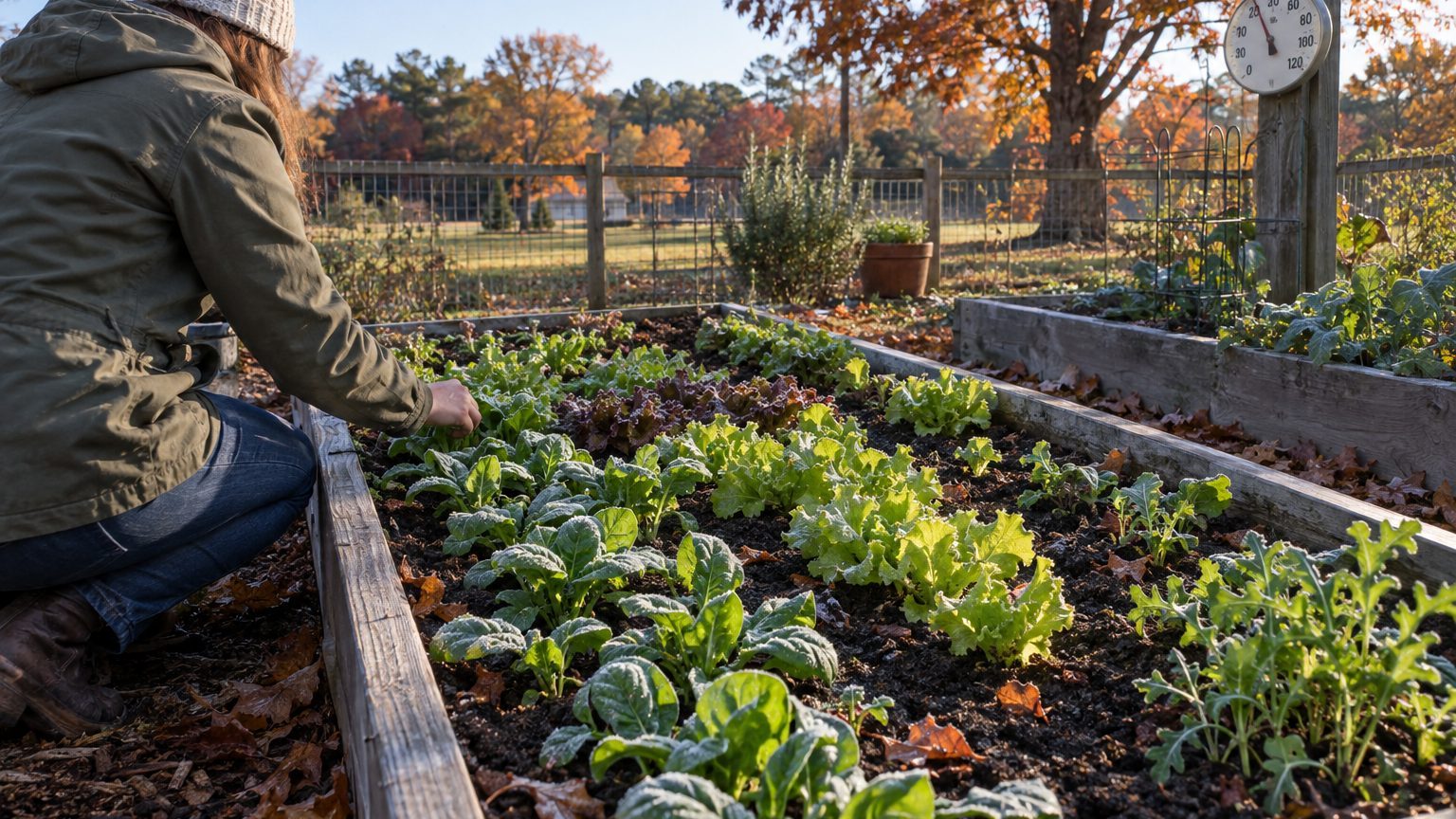

Sow winter salads in Yukon inside a short gap. Whitehorse’s average last spring frost is June 5 and its average first fall frost is August 25, about 81 days apart. Both are midpoints, not guarantees: in one year out of two, frost arrives later than the date shown. Plan several small sowings inside that gap instead of one circled date, then let the plants carry into the cold.
The short answer for Yukon
Sow winter salads in Yukon from early June onward and finish the last open-ground sowing well before August 25. Those two dates are the averages at the Whitehorse A station (Environment and Climate Change Canada, Canadian Climate Normals 1981-2010), and each is the middle of a window, not a safe date.
What the two dates actually measure
June 5 is the average date of the last spring frost. It is a 50/50 point: half of years see frost after it, half before. August 25 works the same way in fall, so in half of years the first frost comes earlier. Subtract one from the other and you get roughly 81 days between the averages. In a cold spring followed by an early fall, the real gap is shorter.
One more catch. Canadian normals cover 1981-2010, while the US figures elsewhere on this site cover 1991-2020. The two sets of dates are close cousins, not twins, so don’t line them up side by side and call it a comparison.
Placing your sowings inside the window
Start with the seed packet. Find the days to maturity for the green you want, count back from August 25, then pull the date earlier again for margin. A variety that eats most of an 81-day gap leaves nothing in reserve for an early frost. Hardy salad greens shrug off light frost, which is why harvest can run past August 25. Sowing in open ground cannot.
Staggering helps. Several small sowings spread across the window hedge against one bad week of weather in a way a single big sowing never will. This page has no tested sowing dates for cold frames or other covers, so treat any sowing after August 25 as an experiment, not a schedule. Which types suit such a short runway is covered in The Best Winter Salads for Yukon.
What will not work here
Several habits that work in milder states fail here, and the numbers explain each one.
Late-summer sowing for winter picking
In much of the US, August is when people sow salads for winter harvest. In Whitehorse, August 25 is already the average first-frost date. A sowing made in mid-August has days of growth before frost, not weeks, and seedlings that small have nothing to carry them through. If your plan depends on sowing after the season turns, rework it around sowing earlier.
Slow varieties fail for the same reason. A green that needs most of the roughly 81 days between the two averages is a gamble even in a good year. In the half of years when frost comes before August 25, it is a loss.
Leaving plants unprotected through winter
The mean daily minimum of the coldest month at Whitehorse is -19.2 °C (-2.6 °F). That is the average overnight low, not the record, so plenty of nights run colder. Open ground at those temperatures is a poor bet for tender salad leaves. The hardiness of a “hardy” green is measured against a few degrees of frost, not weeks of deep cold. Winter salads here mean fall harvests and protected growing, not a bed left uncovered on the hope it will stay green.
Treating June 5 as the green light
Setting out warm-season crops on June 5 because the average says so is a coin flip. Half of years see frost after that date. If your winter-salad bed shares space with tender plants, the bed’s schedule is only as safe as the most frost-sensitive thing in it.
This page does not have summer heat or rainfall figures for Yukon, so it makes no claim about watering schedules or spacing. The frost and cold numbers above are what it can stand behind.
What changes across Yukon
Whitehorse is one reference point in a very large territory, and the frost dates above belong to that one station. Northern and upland districts run weeks behind it, so every date on this page shifts later in spring and earlier in fall as you move north or climb.
The hardiness figure carries the same limit. Whitehorse sits in Canadian hardiness zone 1b, according to Natural Resources Canada’s 1991-2020 normals. That is the Canadian system, built from seven climate variables, and it does not convert to a USDA zone. NRCan itself says there are no simple conversions between the two. This page has the zone for the reference city only, so it cannot give you a spread for the rest of the territory. There is no single answer for Yukon, and anyone offering one is flattening real differences.
What should a gardener in the north or at altitude shift? The logic is simple even without a number:
- Start later in spring, since the last frost arrives later than it does at Whitehorse.
- End open-ground sowing earlier, since the first fall frost comes sooner.
- Count on a shorter gap than 81 days and choose faster greens accordingly.
- Lean harder on cover for the shoulders of the season.
Valley floors, where cold air pools on still nights, can run colder than a slope a short distance away. I can’t tell you which zone your garden falls in. Look up your own community on NRCan’s Plant Hardiness Zone by Municipality map and read the zone it gives. The broader picture for the territory sits in Winter Salads for Yukon Gardens.
Where to check this for your own county
A recommendation written for your own area beats one written for a whole territory, and this page is the territorial one. Yukon does not run on counties, so read “county” here as your community, valley or district.
The address the facts for this page give is Agriculture and Agri-Food Canada, the federal department. The territorial agriculture office is the closer source, but its own site refused our automated check, so we link only a page we could confirm loads. Use the federal site as a starting point and look for two things:
- A local planting calendar that names your community or a nearby one, with frost dates and the years they cover.
- Varieties trialled near you, meaning results from gardens or farms in comparable conditions, not a national list.
Check which years a calendar’s frost dates cover before you trust them. A table built on 1981-2010 normals and one built on 1991-2020 will differ, and neither is wrong. If you can’t find anything for your community, a calendar for the nearest one with similar elevation is the next best thing. Then add your own margin on top.
Checking this against your own garden
Every date above is an average for one airport station. What your own bed does outranks all of them, and three observations will tell you more than any table.
- Soil warmth by feel. In spring, push your hand into the bed in the morning. Soil that still feels cold and clammy while the neighbor’s has crumbled and warmed tells you your spot lags. Shift your first sowing later to match.
- The first male flowers. Watch for the male catkins opening on willows or aspens near you. If they open later than usual in your area, your season is running behind. Compare year to year and note the date.
- The first true leaves. After the seed leaves come the first true leaves. Record how many days that takes from sowing. A slow count points to a cool microclimate, which means your real days to maturity run longer than the packet says.
Write the dates in a notebook. After two or three seasons you will have a calendar for your own bed, which no state or territory table can match.
Common questions
Can I sow winter salads in Yukon in July?
Yes, July sits inside the gap between the average last frost (June 5) and the average first frost (August 25) at Whitehorse. The question is whether the variety can mature before frost. Count back from August 25 using the days to maturity on the packet and leave extra time.
Is June 5 a safe planting date?
No. It is the mean date of the last spring frost, so in one year out of two the frost falls later. Treat it as the middle of a window.
Do these dates apply outside Whitehorse?
They come from the Whitehorse A station only, and this page has no figures for other communities. Northern and upland districts run weeks behind, so push your spring start later and your last sowing earlier.
What does hardiness zone 1b mean for my garden?
Zone 1b is Whitehorse’s zone in the Canadian system, not a USDA zone, and it is not your garden’s zone unless you check the NRCan map. Canadian zone 4a, for example, overlaps nine USDA zones, from 3a to 7a, so numbers from the two systems should never be swapped.