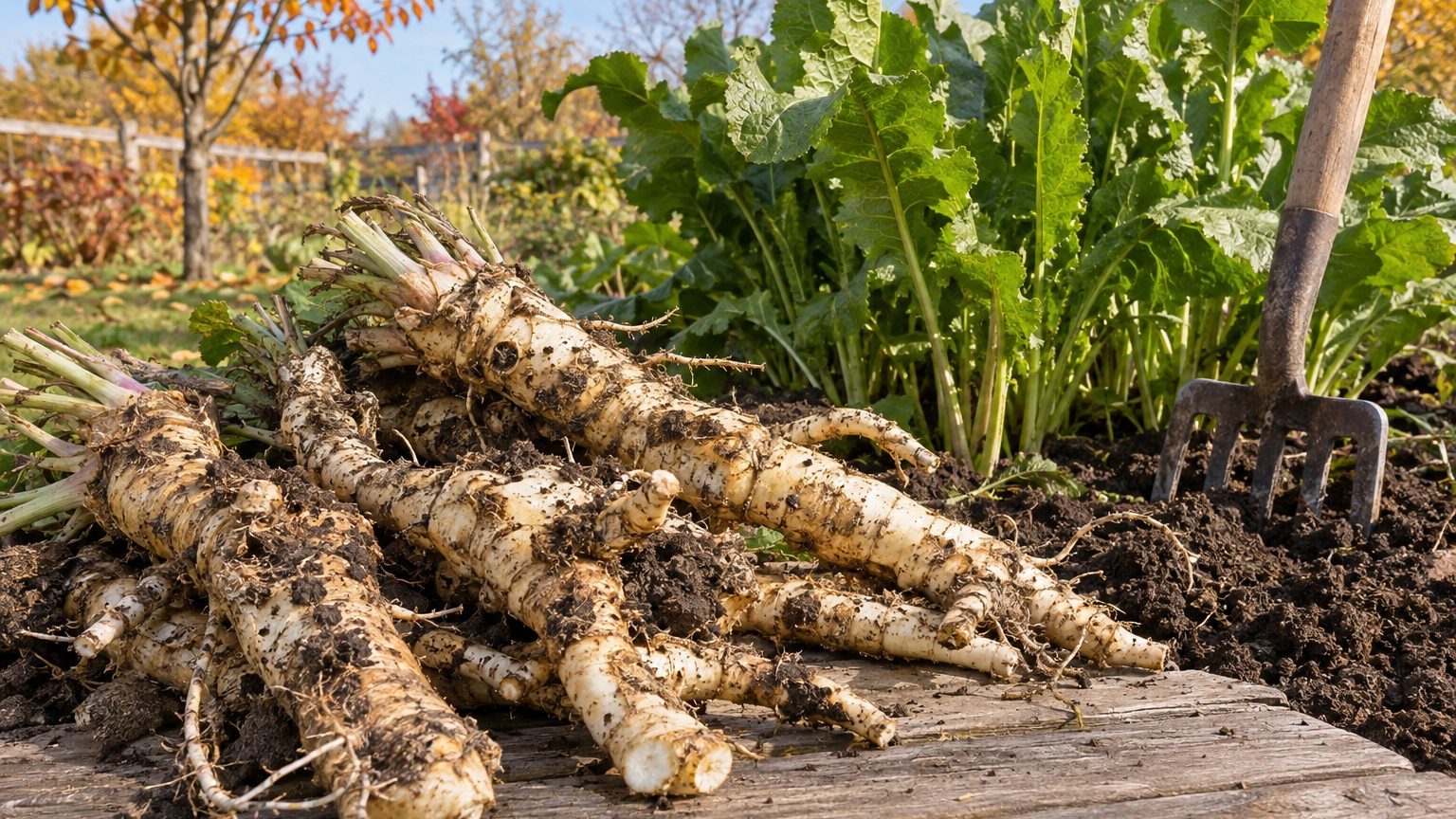

Horseradish (Armoracia rusticana) is about as forgiving as a garden vegetable gets. Push a piece of root into loose soil in early spring, ignore it through summer, and you’ll be digging thick, fiery roots by late fall. The trouble starts afterward. Every piece of root left in the ground can sprout a new plant, so a patch you meant to harvest once can keep coming back for years. Anyone planning to grow it should think about the exit before the planting.
This guide is one stop in the larger series on Celeriac, Kohlrabi, Horseradish and Jerusalem Artichokes. Here the focus is on horseradish alone: how to start it, how to harvest it, and how to keep it where you put it.
Why horseradish grows so easily, and why that cuts both ways
Horseradish is a hardy perennial in the cabbage family, the same family as mustard, broccoli and radish. It tolerates cold winters across most of the country, typically through USDA zones 3 to 9, and the top growth dies back after hard frost while the roots wait underground. Come spring, the crown sends up big, coarse, wavy leaves that can reach two to three feet tall.
The plant is almost entirely propagated by root, not seed. Most garden horseradish rarely sets viable seed, so nurseries and mail-order suppliers sell short root cuttings, often called sets or thongs. That is also the source of the weediness. A pencil-thick fragment a few inches long, left behind after digging, has everything it needs to start over. Tilling a patch to “clear it out” can backfire, because the tiller chops roots into dozens of new planting pieces.
The main root can run down two feet or more in loose soil, with side roots spreading wide. You rarely get all of it out on the first pass. Gardeners who inherited a horseradish bed from a previous owner, or from a grandparent’s farm, know how long the plant can persist. Old homestead sites, roadside ditches and creek banks across the Midwest and Northeast often hold patches that outlived the people who planted them.
Its pungency is a defense. The root stores compounds called glucosinolates (sinigrin is the main one) in separate compartments from an enzyme. Cut or grate the root and the two meet, producing allyl isothiocyanate, the same family of compounds that gives mustard and wasabi their bite. Slugs and most mammals leave the roots alone. Insects are less impressed, which brings us to a few pest notes below.
Planting and growing horseradish
Plant as soon as the soil can be worked in spring. Fall planting works in many areas too, though spring is the standard. Pick a spot you can afford to give up to horseradish for the long term, in full sun to light shade. Roots grow longest and straightest in deep, loose, fertile soil with a pH around 6 to 7. Rocks and heavy clay cause forked, stubby roots, which are harder to peel and grate.
Set each root cutting at a slant, with the thicker top end (the one cut flat) a couple of inches below the surface and the thinner end angled down. Space plants roughly 12 to 18 inches apart. A single plant can overrun that gap within a season or two, and most households need only a few plants. Four or five healthy crowns will outproduce what a family eats.
Water during dry spells, especially the first summer. Consistent moisture gives you juicier, more even roots, while drought makes them woody and sharply bitter. Mulch holds moisture and keeps weeds down. Heavy feeding is unnecessary, and too much nitrogen mainly buys you leaves instead of roots.
The side-root trick for straighter roots
Commercial growers often scrape or rub off the small side roots on the upper part of the planted set in early summer. Gently dig back the soil near the crown, wipe the side shoots from the main root with a cloth or gloved hand, and cover it again. This pushes the plant’s energy into one thick, straight root instead of a tangle of thin ones. It’s optional, but it makes harvest and grating noticeably easier.
Pests are mostly a leaf problem. Flea beetles pepper the foliage with tiny holes, and imported cabbageworms and diamondback moth larvae chew on it too. A plant with ragged leaves will usually still produce a good root, though heavy defoliation early in the season can reduce size. White rust and turnip mosaic virus can show up as chalky blisters or mottled leaves. If a plant looks sick, avoid replanting cuttings from it, and rotate to fresh, clean stock when you start a new bed.
Gardeners short on space or nervous about spread should read about Growing These Roots in Containers. A deep, sturdy pot is the easiest way to keep horseradish contained, as long as the pot is tall enough (at least 18 to 24 inches deep) and you don’t let roots escape through drainage holes into the ground below.
Harvesting, storing and preparing the root
Fall is the usual harvest window. Wait until frost has knocked the leaves back, often October or November depending on your region, because cold weather improves flavor. Loosen the soil with a garden fork well away from the crown, then work inward and lift the roots. Spring harvest, before new growth gets going, also works. Roots dug in the heat of summer tend to be milder and less rewarding.
Think of the harvest as two jobs. First, pull the roots you intend to eat. Second, set aside the replanting stock: pencil-thick side roots, eight to twelve inches long, make good cuttings for next year. Store them in damp sand or sawdust in a cool, dark spot, or wrap them in a moist towel in the refrigerator, and they’ll be ready for spring planting.
Roots for the kitchen keep best cold and humid. Unwashed roots wrapped in a damp cloth or in a perforated bag last weeks in the refrigerator, and some gardeners store them in a root cellar or a cool garage in sand. Scrub, peel and grate only what you need, because the flavor fades quickly once the root is cut.
Preparation is the part that surprises first-timers. Fresh-grated horseradish gives off fumes strong enough to sting your eyes and sinuses, more like onions with a vengeance. The full details are in Grating Horseradish: Ventilate the Room, but the short version is to work near an open window or fan and keep your face away from the food processor when you lift the lid.
Timing the vinegar controls the heat. Because the pungent compounds form only after the root is crushed, adding vinegar right away stops the reaction and gives a milder sauce. Waiting two or three minutes lets the heat develop first, which makes a hotter result. Prepared horseradish keeps its kick for roughly a month or so in the refrigerator before it darkens and mellows. After that, it’s still safe if stored properly, but flat.
The uses go beyond the prime rib sidecar. Grated horseradish goes into cocktail sauce, beet relishes, deviled eggs, potato salad and Bloody Marys. Mixed with sour cream or mayonnaise, it makes a sandwich spread. And the green paste served as “wasabi” at many American sushi counters is usually made largely from horseradish, mustard and coloring, since real wasabi is far harder to grow and costs much more.
How to keep it from taking over, and how to get rid of it
Prevention is a lot easier than removal. Plant horseradish in its own bed, away from the vegetable garden proper, and keep it well clear of ground you till. A raised bed with a solid bottom layer, a large buried container, or a patch edged with deep barriers (roots can dive past ordinary edging) all help. Mowing or trimming around it prevents stray shoots from becoming new colonies.
Digging out a patch you no longer want takes patience. Remove as much root as possible with a fork or spade in fall or early spring, going deeper than seems necessary, and sift the soil for fragments. Then watch the area all season. Every green shoot that emerges should be cut or pulled right away, because each time the plant is forced to regrow leaves from stored energy, the root reserves shrink. Persistent cutting every couple of weeks, for a full season or two, exhausts most patches.
Smothering can speed that up. Cover the area with thick black plastic or heavy tarps for a full growing season, weighting the edges so light stays out. Sheet mulch with cardboard and a deep layer of wood chips is another option, though horseradish crowns can push through thin layers. Skip tilling at all costs. It’s the fastest way to turn one plant into fifty.
Herbicides are a last resort, and the waxy, deeply rooted plant isn’t always easy to kill with a single application. If you go that route, follow label directions closely and check with your state’s cooperative extension office for current recommendations before spraying near edible plants, water or property lines.
One more nuance for anyone who wants horseradish but fears the commitment: treat the patch as a long-term crop and dig all of it every year. Harvest every root, replant only a few chosen cuttings in fresh ground, and the plant never builds up a sprawling, entrenched mass. Commercial growers in places like southwestern Illinois, long known for its horseradish production, handle the crop that way, lifting the roots and starting again from selected sets, rather than leaving the field to run wild.