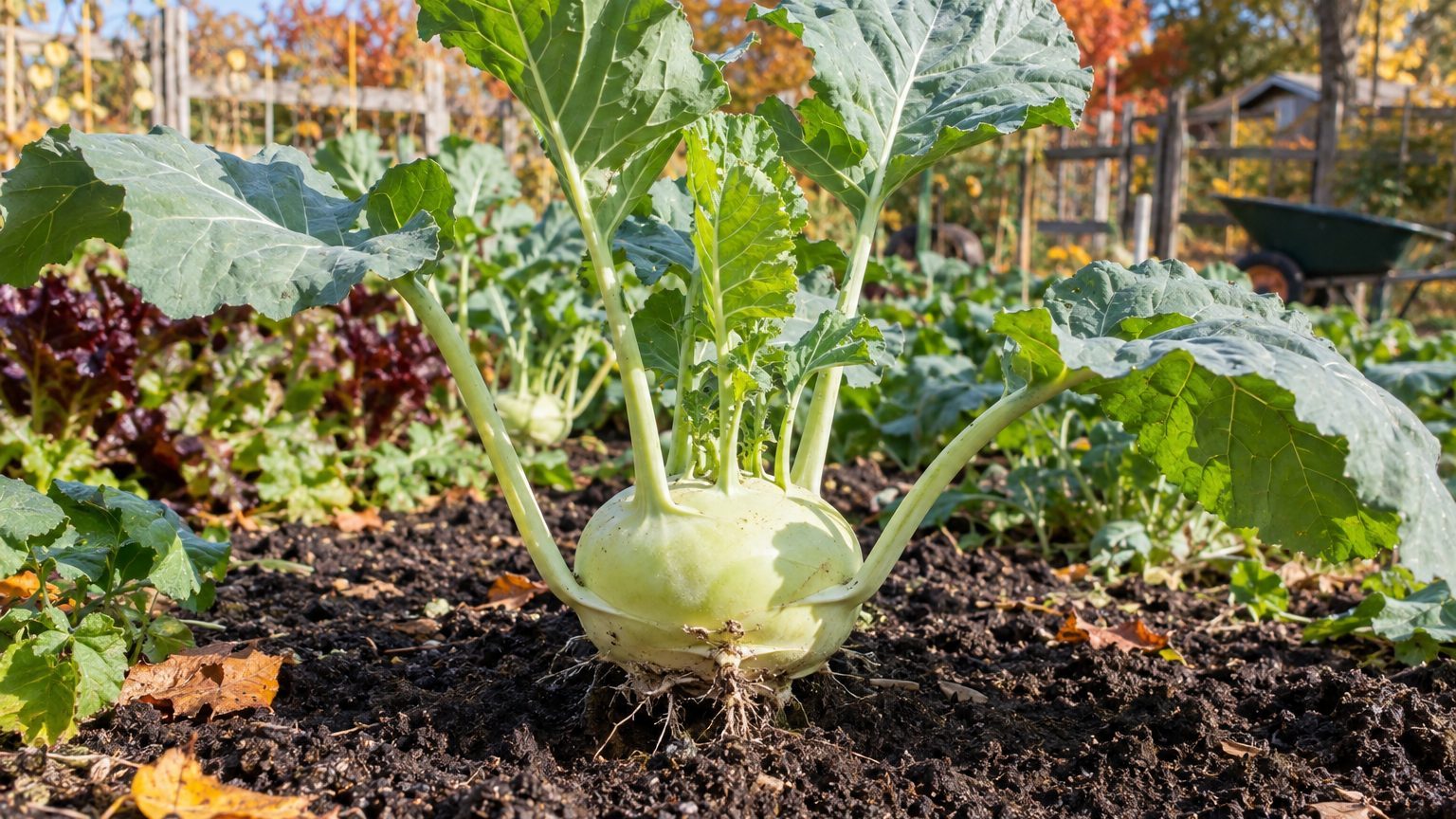

Kohlrabi is ready to eat roughly 45 to 60 days after sowing, which makes it the fastest crop in the unusual-roots family. It also isn’t a root. The round, bulbous part is a swollen stem that grows just above the soil line, with leaves sprouting from its sides like antennae. Plant seed on Memorial Day and you could be slicing a bulb by mid-July.
That speed comes with a catch. Kohlrabi is a cool-season brassica, and the weather decides whether you get a crisp, sweet bulb or a fibrous one. Sowing at the right time matters more than any fertilizer or trick.
A stem wearing a root’s costume
Kohlrabi (Brassica oleracea, Gongylodes group) is the same species as cabbage, broccoli, kale and Brussels sprouts. The name comes from German: Kohl for cabbage, Rübe for turnip. Early cooks saw a turnip-shaped thing and made a reasonable guess. Botanically, though, the globe is thickened stem tissue. The true root is a thin network of fibrous roots underground, much like a cabbage’s.
This matters for how you grow it. Real roots such as horseradish need deep, loose soil so they can push downward. Kohlrabi doesn’t. Its bulb swells upward, so the crop does fine in shallow raised beds and even in large containers about 10 to 12 inches deep. Compaction hurts it far less than it hurts parsnips or carrots.
Among the vegetables covered in our Celeriac, Kohlrabi, Horseradish and Jerusalem Artichokes guide, kohlrabi is the oddball. Celeriac forms its knob partly at the base of the stem and the top of the root. Horseradish is a true taproot. Jerusalem artichokes make tubers, which are underground stems. Kohlrabi alone does its swelling in plain sight, and that is useful: you can watch the bulb size up and pick it at the exact moment it’s ready, with no digging a test plant to check.
The flavor sits between a broccoli stem and a mild radish, with a sweet, slightly peppery crunch. Peeled and eaten raw, it has the texture of a firm apple. A cup of raw kohlrabi supplies most of an adult’s daily vitamin C, according to USDA nutrient data, which is more than many people expect from a pale green knob.
Timing, spacing and the weather window
Most kohlrabi problems trace back to temperature. The plant grows best when days run between about 60 and 75°F. Once highs push past the low 80s, growth speeds up, the flesh toughens, and the bulb turns woody and sometimes hollow. Cold snaps cause trouble from the other direction. Young plants that get a stretch of temperatures below 50°F for a week or two can mistake it for winter and bolt, sending up a flower stalk instead of a bulb.
So the calendar splits into two windows. For a spring crop, sow seed or set out transplants about four to six weeks before your last expected frost. Kohlrabi tolerates a light frost, which is why gardeners in Minnesota, Michigan and Maine can start in April. For a fall crop, sow about six to eight weeks before the first fall frost. Many growers consider fall the better of the two, because bulbs mature in cooling weather and taste sweeter. Gardeners along the Gulf Coast, in Texas and in Florida mostly skip spring and grow it from fall through winter, when it’s the right temperature. In the Pacific Northwest, you can keep sowing small batches from March into August.
Succession sowing is the best use of a fast crop. Instead of planting 20 seeds at once and facing a glut, sow a short row every two weeks. A 45-day crop lets you do that several times in a season, which is something garlic or parsnips could never offer.
Soil, water and spacing
Aim for a soil pH between 6.0 and 7.0, with plenty of finished compost worked in before planting. Direct-seed about a half inch deep, then thin to 4 to 6 inches apart in rows 18 to 24 inches apart. Crowding stunts bulbs. Giant varieties such as Kossak or Gigante need the wider end of that range, or more.
Water is the other half of the job. Kohlrabi wants steady moisture, around an inch a week, and a layer of mulch helps hold it. Swings between dry spells and heavy soaking make the bulbs split and pushes them toward fibrous tissue. Because the root system is shallow, a dry week hits harder than you’d expect. Go easy on nitrogen too. A side-dressing of compost partway through is plenty, and heavy feeding gives you lush leaves with a mediocre bulb.
The size you harvest at is a variety question as well as a timing one. Early types such as Early White Vienna and Purple Vienna are best at 2 to 3 inches across. Giant storage types can reach the size of a softball or bigger and stay tender, but they take longer, often 80 to 100 days, and so they don’t have the speed that makes kohlrabi appealing in the first place.
Pests, diseases and what goes wrong
The same insects that chew cabbage go after kohlrabi. Cabbage worms, the green larvae of the white cabbage butterfly, eat leaf holes. Flea beetles pepper young seedlings with tiny pits. Cabbage root maggots can attack the fibrous roots below the bulb, and aphids cluster on the leaf undersides. The simplest fix is floating row cover, laid over the bed at planting and anchored at the edges. It keeps the adult butterflies and flies from laying eggs, and it adds a few degrees of frost protection in early spring.
Clubroot is the disease that makes experienced gardeners rotate carefully. It’s a soil-borne pathogen that swells and deforms the roots of any brassica, and it can persist in soil for many years. If you’ve had trouble with cabbage family crops, rotate brassicas to a new bed every three to four years, and avoid planting them where another brassica grew last season. Raising soil pH toward 7.2 can suppress it, though your own soil test should guide that choice.
Tough, stringy bulbs are the complaint we hear most often. The cause is almost always heat, slow growth from poor watering, or leaving the bulb to grow too large. Our page on Kohlrabi That Is Tough and Woody goes through each cause in detail, including how to tell whether a bulb is salvageable by cutting it open. Cracking, by comparison, is usually a watering issue. A heavy rain after a dry stretch makes the bulb swell faster than its skin can stretch.
A few other quick diagnoses:
- A bulb that stays tiny while the leaves thrive usually means crowding or too much nitrogen.
- A flower stalk emerging means bolting from a cold snap or a heat spike.
- Purple varieties can show some leaf color change in cold weather that isn’t a problem.
Harvesting and cooking
Pull or cut kohlrabi at the base when the bulb reaches the target size for its variety. For most early types that means about the size of a tennis ball at most, and many cooks prefer them smaller, around golf ball to baseball. Use a knife to cut just under the bulb, or pull the whole plant if the soil is loose. Smaller is nearly always better. The bulb doesn’t get sweeter by sitting in the garden, and size beyond a certain point just means more fiber.
Don’t toss the leaves. They’re edible and cook like collards or kale, and a tender young leaf works sliced thin in a stir-fry. Take only a few from each plant, though, because the leaves feed the bulb. Stripping them off early reduces the yield.
In the kitchen, the skin on small bulbs can be thin enough to eat, but most cooks peel at least the base, where it’s tougher. A paring knife or vegetable peeler works. Beyond that, kohlrabi is flexible:
- Raw in slaw, matchsticks or thin rounds with salt, lime and chili.
- Roasted at 425°F in wedges until the edges brown.
- Steamed or boiled, then mashed with potatoes.
- Grated into fritters or stirred into soups.
Fresh bulbs keep better than most gardeners expect. Trim the leaves, bag the bulbs, and refrigerate; they typically hold for a few weeks. For long-term holding, giant storage types are the better bet, and the methods in Keeping These Roots Through the Winter apply to them. Early varieties stored too long turn spongy, so eat or preserve those first.
One last practical detail for fall growers: kohlrabi that has already formed a full bulb handles a light frost fine, and many gardeners say a few chilly nights improve the sweetness. A hard freeze in the low 20s°F is another matter, and that’s your cue to bring the last of the crop in.