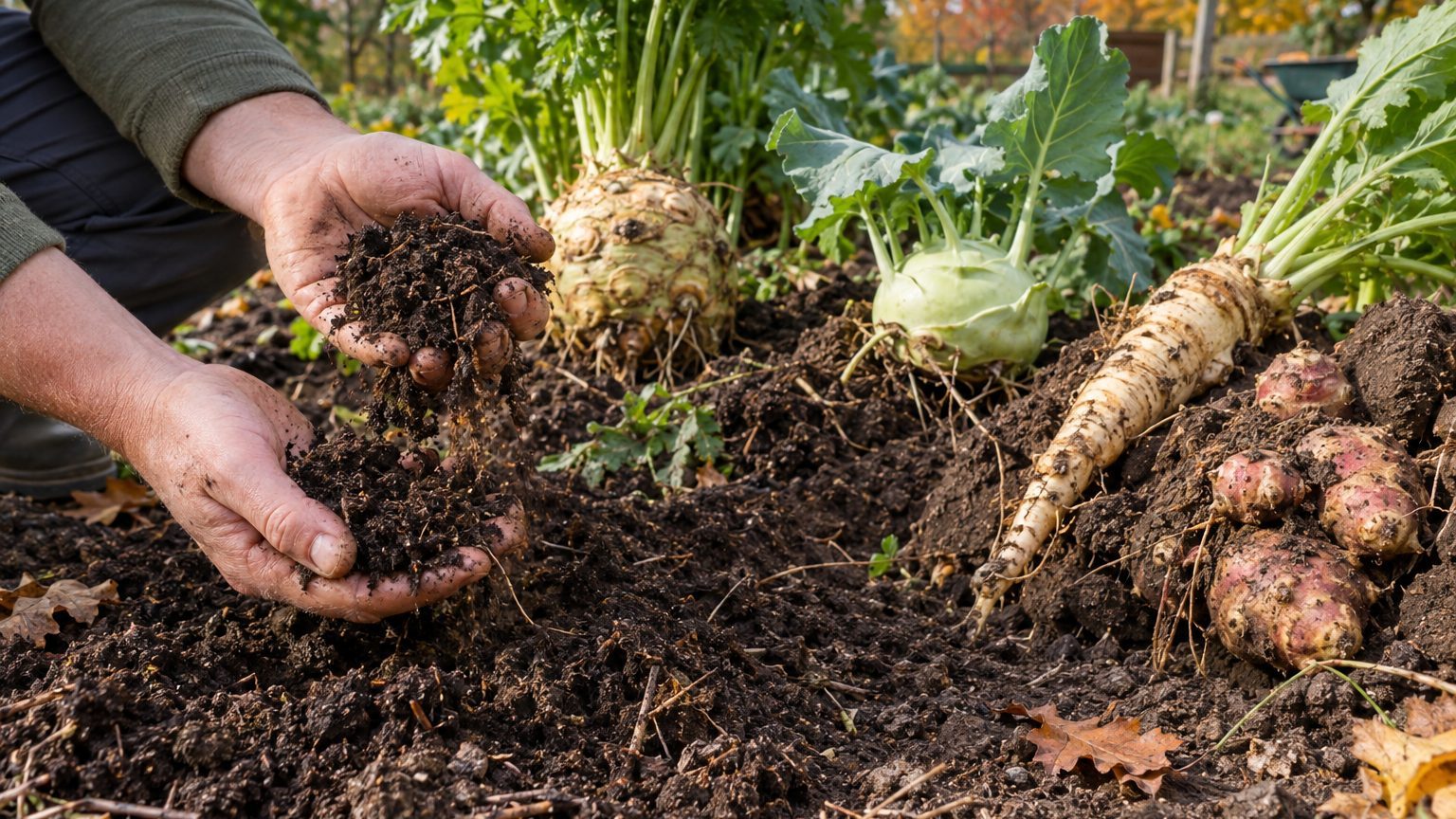

Four crops, three different soil personalities. Celeriac wants rich, moist ground and punishes neglect. Kohlrabi wants fertile soil that isn’t acidic. Horseradish wants depth above all, and Jerusalem artichokes will grow in almost anything that drains. A loose, well-drained loam with plenty of organic matter and a pH between 6.0 and 7.0 suits the whole group, but each crop leans on a different part of that description.
That matters because these plants rarely fail from lack of effort. They fail from a mismatch between what the crop does underground and what the soil allows. If you’re still choosing which to plant, the overview of Celeriac, Kohlrabi, Horseradish and Jerusalem Artichokes covers what each one is. This page is about the dirt.
The baseline: texture, depth, and pH
Start with texture, because it controls almost everything else. A sandy loam (the kind that crumbles when you squeeze it and then holds a loose shape) drains well, warms early in spring, and lets roots expand without a fight. Heavy clay holds water and nutrients but compacts, and compacted soil is where you get forked horseradish, knobby tubers and stunted bulbs. Pure sand drains too fast, which is a problem for celeriac in particular.
A quick field check takes two minutes. Grab a handful of moist (not wet) soil and squeeze it. If it falls apart the moment you open your hand, it’s sandy. If it forms a ribbon you can stretch an inch or more between thumb and finger, it’s clay-heavy. Something in between that holds together but breaks with a poke is the target.
Depth comes next. Loosen the planting area to at least 12 inches for celeriac and kohlrabi, and deeper for horseradish. Fork or broadfork the bed rather than tilling it repeatedly, since heavy rototilling can create a compacted pan just below the blades. If a shovel won’t go in past the blade, the soil is too hard for the long roots to take on.
Then pH, which sets how much of the fertilizer in the ground the plant can actually use. The working ranges for these crops overlap in a useful way:
- Celeriac: about 6.0 to 7.0
- Kohlrabi: about 6.0 to 7.5, with the higher end protective against disease
- Horseradish: about 6.0 to 7.0
- Jerusalem artichokes: roughly 5.0 to 8.0, very forgiving
A soil test is the only reliable way to know where you stand. Most state cooperative extension offices run low-cost tests, and the report usually comes with lime or sulfur recommendations scaled to your bed size. Guessing at pH is how people end up dumping lime on soil that was already fine.
Celeriac and kohlrabi: the fussy pair
Celeriac is a heavy feeder with a long runway. Expect roughly 100 to 120 days from transplanting, and a good deal longer if you count the seedling stage (the seeds are slow and tiny). Over that stretch the plant needs a soil that stays evenly damp and keeps feeding it. Work in 2 to 3 inches of finished compost before planting, and add more as a side-dressing midseason. Sandy beds benefit most from extra organic matter because it acts like a sponge.
Celeriac also sits shallow. Plant the crown at soil level, not buried, because the bulb swells at the surface and deep planting leads to a misshapen, hard-to-clean root. Soil that crusts over after rain will choke the base, so a thin mulch of straw or shredded leaves helps. And because celeriac belongs to the celery family, boron shortages can cause brown, cracked or hollow patches in the flesh. A soil test that includes micronutrients is worth the few extra dollars if you’ve had that problem before. The follow-up on Watering Root Crops for a Smooth Swelling explains how moisture swings make the same problems worse.
Kohlrabi is quicker, about 45 to 60 days for most varieties, and the swollen part is technically a stem rather than a root. It still cares about soil. Fertile, well-drained ground with steady moisture gives tender globes. Dry spells or sudden nitrogen shortages push the plant toward woody, fibrous flesh.
The bigger kohlrabi risk is clubroot. It’s a soilborne disease of the cabbage family, caused by a organism whose resting spores can persist in soil for a decade or longer. Clubroot thrives in acidic, wet ground. Keeping pH near 7.0 or slightly above, improving drainage, and rotating brassicas on a 3 to 4 year cycle all reduce the odds. If you’ve grown cabbage, broccoli or kale in a bed recently, put kohlrabi somewhere else.
Horseradish and Jerusalem artichokes: the tough pair
Horseradish is a perennial that forgives a lot, but the quality of the root depends on how easily it can push down. In loose, deep, moist loam you get a straight, thick taproot. In rocky or compacted ground you get forks, thin side roots and a lot of peeling work. Most gardeners plant “sets” (root cuttings) at a slant, with the top an inch or two below the surface, and the soil they’re planted into should be loosened well beyond that depth.
Heavy clay can still work if you build up. A raised bed 10 to 12 inches tall, filled with a mix of native soil and compost, lets the root go down into the loosened ground below as well. Fresh manure is a bad idea. It encourages forking and hairy side roots in root crops, so finished compost or manure aged at least six months is the better choice.
One warning belongs here because it’s really a soil issue: horseradish regrows from any piece of root left behind. Dig the bed and you’ll leave fragments, and every one of them becomes a plant. Many gardeners give it a dedicated corner, or grow it in a deep container or lined bed, so the roots don’t wander into the lawn or the rest of the vegetable garden. In loose soil, containment is harder than cultivation.
Jerusalem artichokes sit at the other end of the fussiness scale. They tolerate poor soil, partial drainage problems and a huge pH range, which is why they grow wild along roadsides across much of the eastern and central US. The one thing they truly dislike is standing water. Tubers sitting in saturated ground rot over winter, so a spot that puddles after storms is a poor choice, however tolerant the plant is otherwise.
Richer soil does give bigger, smoother tubers, and plants can reach 6 to 10 feet tall in good ground, so a moderate dose of compost pays back. Tubers go in about 4 to 6 inches deep and a foot or more apart. Loose soil also makes harvest easier. Jerusalem artichoke skins are thin and the tubers are knobby, so digging in clay means broken, muddy and hard-to-wash pieces. Like horseradish, they come back from any tuber left behind, so plan where they’ll live for good.
Fixing the soil you actually have
Few backyards start as perfect loam, and the fix is usually organic matter, applied in the right order. For heavy clay, compost is the main tool, plus a raised bed if drainage is the problem. Gypsum gets recommended often, but it only helps in certain sodic clays, so check your test results before buying it. For sandy soil, compost again, plus a mulch layer to cut evaporation.
Nitrogen deserves some restraint with these crops. Too much produces big leaf canopies and small roots, which is the opposite of what you’re after. Celeriac is the exception because it’s a long-season heavy feeder, but even there, spread the nitrogen across the season rather than loading it all in spring. A balanced approach based on your soil test beats a generic fertilizer bag. Phosphorus and potassium support root development, and tests will tell you if you’re short on either.
For drainage, a simple test tells you more than guesswork. Dig a hole about a foot deep and wide, fill it with water, let it drain, then fill it again and time it. If the second fill drains at roughly 1 to 2 inches per hour, you’re in good shape for most of these crops. If water is still sitting after several hours, go for raised beds or choose a different spot. Celeriac and kohlrabi hate wet feet as much as they hate drought.
Last, think about rotation and neighbors. Kohlrabi shouldn’t follow other brassicas. Celeriac shouldn’t follow celery, parsnips or carrots if you’ve had soil pest problems. Horseradish and Jerusalem artichokes are perennial-style crops that stay put. If space is tight, the guide on Which of These Are Actually Worth the Space helps decide which ones deserve your best bed and which can live in the rougher corner.
One more detail that surprises people: soil temperature matters at the start and the end. Celeriac and kohlrabi seedlings are fine to set out once the ground has warmed above about 50°F, while horseradish and Jerusalem artichokes sweeten up in cold ground. Fall frosts convert some of the starch in both into sugars, and mulched soil that stays workable lets you keep digging well into winter in many states.