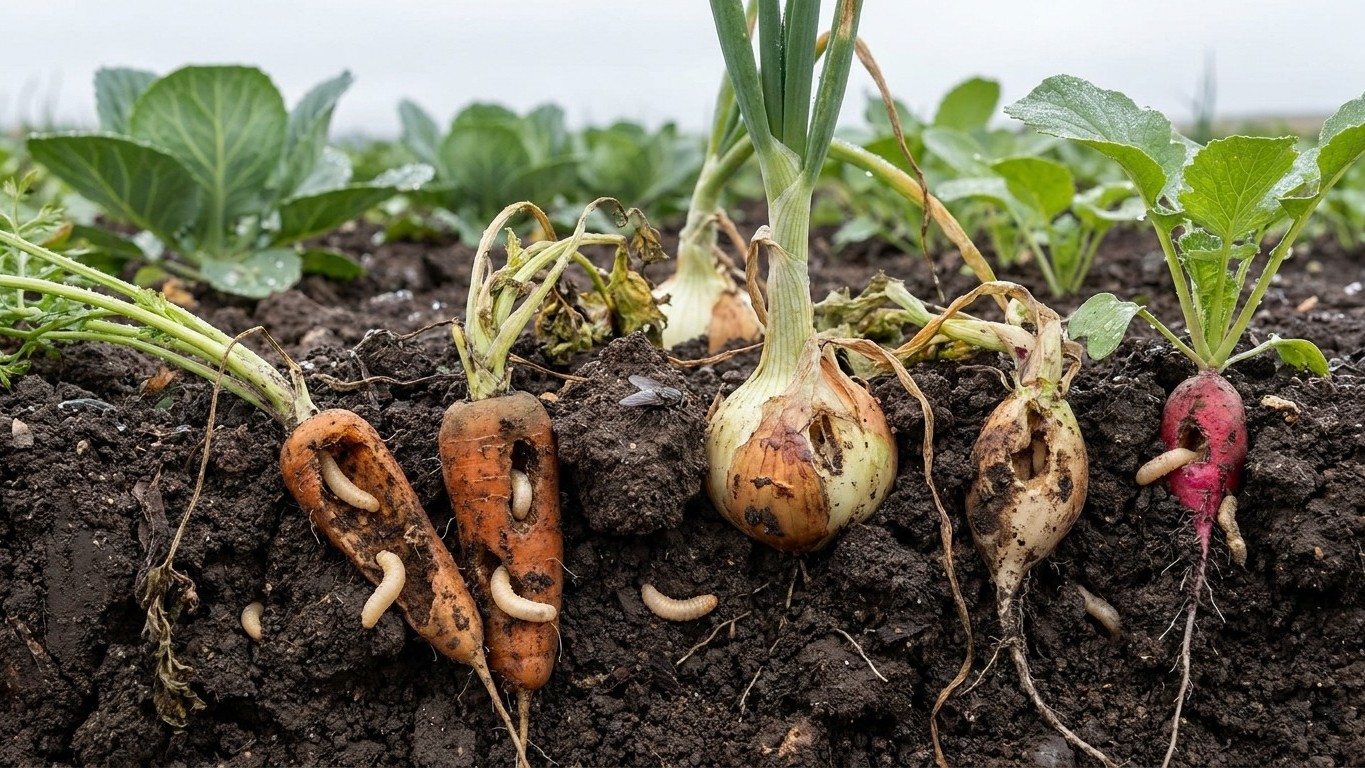

In the Denver area, the last spring freeze falls between May 1 and May 11, and the first fall freeze between September 30 and October 12. That leaves about five months for celeriac, kohlrabi, turnips, rutabagas, horseradish and Jerusalem artichokes. Elevation rewrites the whole calendar, though: mountain towns run far shorter, and the western slope differs again.
When the soil is warm enough in Colorado
For the Denver area, NOAA’s 1991-2020 Climate Normals (station USW00003017, 32F freeze probabilities in the 30-70% band) put the last spring freeze between May 1 and May 11. That is a probability band, not a promise. Some years the cold comes back after the window closes, and a gardener who has seedlings out should keep a sheet within reach.
Frost is a proxy, and an imperfect one. These root crops wait for warm soil, and soil warms after the frost risk ends, not alongside it. Air can climb into the 60s while the top few inches of ground stay cold and wet, and seed sown into that sits, rots or sprouts weakly. A cheap soil thermometer pushed in to planting depth in the morning tells you more than the calendar does. Cool-season roots such as turnips, rutabagas and kohlrabi accept cooler ground than celeriac, which is a slow, warmth-loving crop and nearly always started indoors as transplants.
Denver sits at 5,280 feet on the plains, and that is the reference here. Mountain towns can frost in July. The western slope runs on its own pattern. Slide the dates later, and the whole plan tighter, the higher you garden.
Site Jerusalem artichokes before you plant them
Jerusalem artichoke is effectively permanent once planted. Every fragment of tuber left in the ground regrows, and no fall dig-up gets them all. It is the planting gardeners most often regret. Choose a spot you can live with indefinitely: a far corner, a strip bounded by lawn you mow, or a place where spreading does no harm. Keep it away from your vegetable beds. Only then does timing matter, and it is simple. Plant tubers in spring once the soil is workable and no longer soggy.
A rough order of play for the rest of the group:
- Turnips, rutabagas, kohlrabi: direct sow or set out as soon as the soil can be worked, since they tolerate cool ground.
- Horseradish: plant crowns or root pieces in spring, in a spot you will not want back, because it also lingers.
- Celeriac: transplant after the frost window and once the soil has clearly warmed, after hardening off.
How long the season lasts here
Both dates come from the same NOAA normals, so the subtraction is honest. May 1 to September 30 is 152 days. May 11 to October 12 is 154. Pair the late spring date with the early fall one and the window shrinks to 142 days; pair the early spring with the late fall and it stretches to 164. Call it 20 to 23 weeks of frost-free growing around Denver, with the weight of probability somewhere in the middle.
The number matters less than what it allows. A window this long permits a second sowing of the quick crops. Turnips and kohlrabi sown in spring come out in early summer, and a late-summer sowing counted back from the fall freeze dates can ripen in cooler weather, when roots tend to taste sweeter. The succession sowing guide on this site explains how to count backward from your own fall date.
Celeriac is the opposite case. It gets one sowing, started indoors early, and one transplant date, and its slow growth has to finish before the first hard freeze. Compare the days to maturity on the seed packet with the days between your transplant date and the early end of the fall range, September 30. If the packet number is larger, you are betting on a mild fall. At a high-elevation address, with a shorter window, the first sowing is the only sowing for everything, and transplanting a root crop only pays if the roots survive being moved. Celeriac tolerates it reasonably, while turnips and other taproots usually do better sown where they will grow.
If your garden sits well above Denver, your window is shorter than anything computed above, and the right comparison is the extension office’s local frost data. Gardeners in much colder country will recognize the tradeoffs in Growing Unusual Root Crops in North Dakota, where the first sowing is often the only one.
Heat and water in Colorado
This page does not carry a verified count of days above 90 F at a reference station, nor a figure for summer rainfall, so it will not invent either one. What gardeners here can say safely is that high-plains summers run hot and dry enough that watering is part of the job, and that mountain summers are cooler with sharp nights. Heat and drought act on roots the same way: stalled growth, then a heavy rain or watering, then splitting, or tough and woody flesh. Steady moisture, a layer of mulch over the root zone and some afternoon shade for the leafy tops go a long way. Where summers run cool and damp instead, the trouble flips to mildew, slow ripening and rot.
Two facts govern this group more than any weather average. The first is season length, which decides whether celeriac, the long one, can finish at all. In the Denver window it can, if it goes out as a healthy transplant at the right time. Higher up, you should doubt it.
The second is the winter low. At the Denver reference station, the mean daily minimum of the coldest month is 18.4 F (NOAA Climate Normals 1991-2020). That is a statement about air temperature, not about how deep the soil freezes, but it tells you something. Horseradish and Jerusalem artichokes are hardy perennials and stay in the ground. The hardy annuals, turnips, rutabagas and kohlrabi, can often be left under a thick mulch late into the fall and harvested as needed. Celeriac is less forgiving and should be lifted before the soil freezes. The USDA Plant Hardiness Zone Map (2023) puts Colorado anywhere from zone 3b to 7b, a range built on one variable, the average annual extreme minimum temperature. So the general statement is only a starting point, and a mountain garden may need to lift crops that a Denver garden leaves.
Storage is a food safety matter. Lift roots on a dry day, brush off the soil and inspect each one. A soft patch, a weeping spot or a moldy crown ends the question, and the root goes to the compost, not into a jar or the cellar. A firm, clean look does not prove a root is safe, and no keeping time is guaranteed.
Which these root crops suit Colorado
Choose by type first. A short season favors the earliest-maturing types, and that means quick turnips and kohlrabi at higher elevations. Heat and dryness favor types you can give airflow and shade at the root, such as celeriac under a mulch and a light shade cloth. And wherever humidity rises, disease resistance becomes the first thing to read on the label.
| Type | What the Colorado season favors | Main care point |
|---|---|---|
| Turnip, rutabaga, kohlrabi | Early spring and late summer sowings | Brassicas, so rotation matters |
| Celeriac | Transplants started early on the plains; doubtful at elevation | Steady water, lift before the soil freezes |
| Horseradish | Spring crowns left in place | Plan for it to persist |
| Jerusalem artichoke | Almost any site | Permanent once planted |
Turnip, rutabaga and kohlrabi are brassicas. They share their pests and diseases with cabbage, kale and mustard, so a gardener who rotates them into a cabbage bed has rotated nothing. See the crop rotation page in this series before you plan the beds. Horseradish belongs to the mustard family too.
This page names no cultivar, and that is deliberate. The only variety recommendation that means anything is one trialled where you garden, and Colorado’s elevations are too varied for a single list to hold. Colorado State University Extension can point you to what has done well locally, and your county office knows your elevation. For a humid, disease-heavy comparison, Growing Unusual Root Crops in Pennsylvania shows how that changes the choice, and the general guide to Celeriac, Kohlrabi, Horseradish and Jerusalem Artichokes covers each crop in detail.
Common questions
Is May 11 a safe date to put everything out?
It is the late edge of the freeze band for the Denver area, not a guarantee. Cool-season roots can go in earlier. Celeriac should wait until the soil has clearly warmed and you have hardened off the transplants.
Can celeriac finish in Colorado?
On the plains, with a window of roughly 142 to 164 days, it can if started early and transplanted on time. At higher elevations, treat it as a gamble and ask your county extension office.
Are Jerusalem artichokes easy on the stomach?
Many people get digestive discomfort from them, because the tubers store inulin rather than starch. A small first portion is the sensible way to find out how you respond.
How do I handle fresh horseradish safely?
Grating a fresh root releases compounds that burn the eyes and airways, and this is not a joke. Work in a well-ventilated room, keep your face and eyes away from the bowl, and keep it away from children.