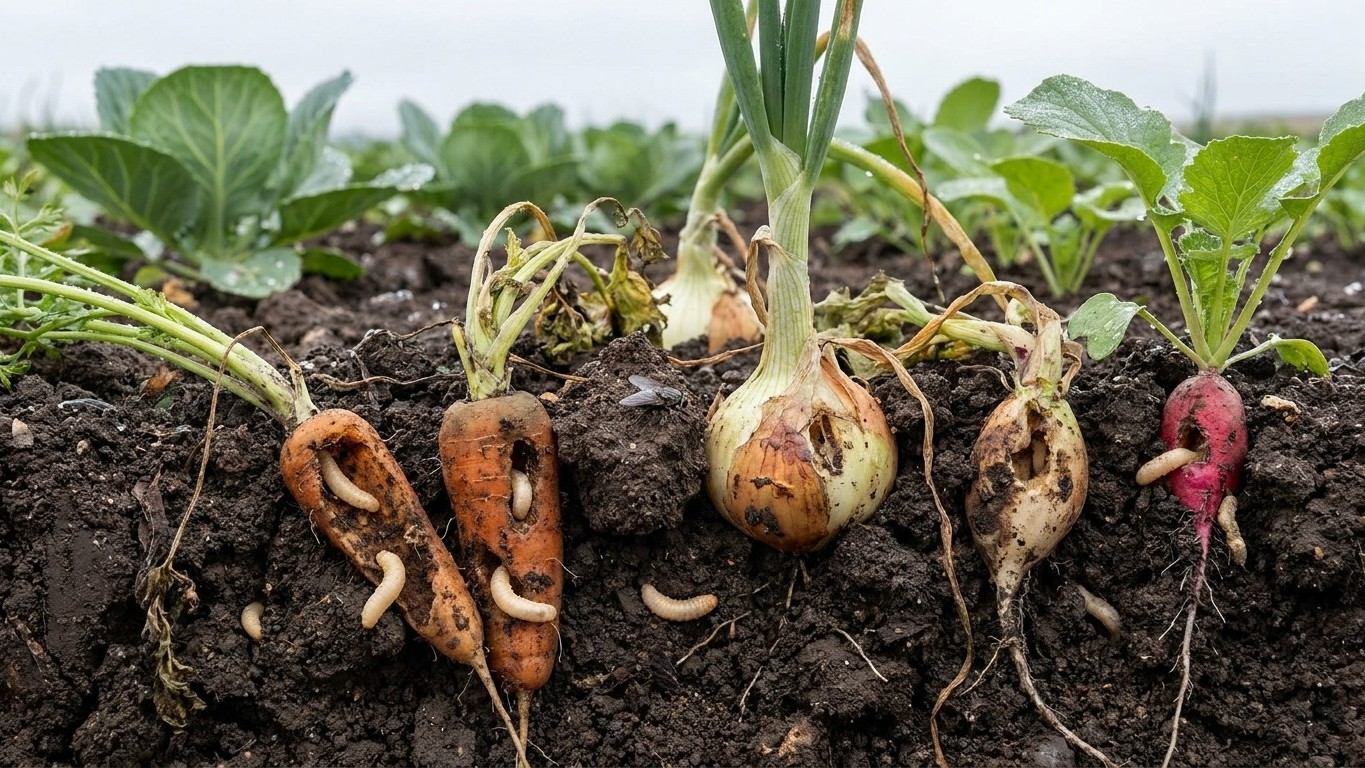

In Philadelphia, the last spring freeze lands between March 29 and April 6, but celeriac, kohlrabi, horseradish and Jerusalem artichokes care more about soil than air. Plant after the soil has warmed and drained, not on the frost date. The window runs roughly seven months, enough for celeriac in the mildest parts of the state. Elsewhere in Pennsylvania, both ends of the calendar shift.
When the soil is warm enough in Pennsylvania
Start with the date everyone asks about. At the Philadelphia reference station, NOAA’s 1991-2020 U.S. Climate Normals put the last spring 32°F freeze between March 29 and April 6, using the 30-70% probability band. That is a probability, not a promise, and a late freeze can still arrive after the band closes. Philadelphia is also the mildest corner of the state. The northern tier and the Alleghenies run two to four weeks later in spring.
Why the frost date is only a proxy
A frost date measures air. Roots live in soil, and soil lags behind the air by weeks. After the last freeze, the ground still has to shed winter’s cold and the excess water that comes with it. Seeds sown into cold, saturated soil sit and rot, and transplants stall. A cheap soil thermometer pushed a few inches down tells you more than the calendar. Penn State Extension can give you the soil temperature thresholds for each crop, and I would use theirs over any number I could print here.
The group splits by temperament. Kohlrabi is a cool-season brassica and tolerates cooler ground than the others, so it can go in earliest. Horseradish is planted as a root piece or crown and wants workable soil in early spring. Celeriac is the fussy one. It is usually started indoors and set out as a transplant once the frost risk has passed and the bed has warmed, and a cold snap or a stressed seedling can push it to bolt or stall.
Site the Jerusalem artichoke before you plant it
Decide where Jerusalem artichokes go before you read how to grow them, because this is the planting gardeners most often regret. Once established it is effectively permanent. Every fragment of tuber left in the ground regrows, and digging the bed only scatters more pieces. Give it a corner you are willing to surrender, bounded by a lawn edge, pavement or a deep barrier, and away from the vegetable beds you rotate. Plant tubers in spring once the soil is workable, and expect tall stalks by midsummer.
They also come with a fact of the vegetable: Jerusalem artichokes store inulin rather than starch, and in many people it causes digestive discomfort. A small first portion is the sensible way to find out how you react. Neither cooking nor frost can be counted on to change that.
How long the season lasts here
The same NOAA normals put the first fall 32°F freeze between November 5 and November 16 at the Philadelphia station. Count the days between the spring and fall bands and the gap is about 213 to 232 days, depending on which ends you pair. That is a little over seven months between freezes. It is not seven months of good growing, since the first weeks are cold soil and the last are shortening days. Still, it is generous for a crop group that includes a slow performer.
What does that length allow? A second sowing, for one. With this much room, a gardener at the Philadelphia end can sow kohlrabi in spring, clear it, and sow again for a fall crop, because a fall planting matures into cooling weather instead of racing a freeze. The succession sowing guide on this site lays out how to stagger those plantings. Celeriac also becomes realistic. It needs the longest stretch of any root in this group, and transplanting a started seedling in after the frost risk ends leaves it a long runway.
Move north or into the Alleghenies and the arithmetic changes. Spring arrives two to four weeks later there, and this page does not have a verified fall date for those areas, so I will not guess at one. The sensible reading is a shorter window. A shorter window makes the first sowing the only one for most crops, and it raises the question of whether transplanting celeriac is worth the root disturbance. A transplant that sulks for two weeks has used up a meaningful share of a short season. In that case choose the earliest-maturing types and consider whether you want celeriac at all.
Neighboring states show how much this varies. Gardeners in the high, dry West face a different calculation, covered in Growing Unusual Root Crops in Colorado, while the Midwestern version appears in Growing Unusual Root Crops in Illinois. The full crop-by-crop background sits in Celeriac, Kohlrabi, Horseradish and Jerusalem Artichokes.
Heat and water in Pennsylvania
This page is built on verified figures, and the verified set for Pennsylvania has no count of days above 90°F and no summer rainfall total. I won’t fill that gap with a number I half remember. What I can say is that the state’s summers are humid, not arid, and that matters differently from the western pattern. Where summers run cool and damp, the trouble is not heat stress. It is mildew on foliage, slow ripening, and rot in soil that never quite dries. Where a hot spell does arrive, celeriac and kohlrabi are the two that mind it, since heat stress can turn kohlrabi woody and leave celeriac stunted. Penn State Extension and your county office can supply local heat and rainfall figures to fill in the picture.
The coldest-month figure is better documented. At the Philadelphia reference station, the mean daily minimum of the coldest month is 26.0°F. That is an average of the nightly lows, not a record low, so a cold snap will go well below it. The USDA Plant Hardiness Zone Map 2023 covers Pennsylvania with zones 5a through 7b, and it is built on only one variable, the average annual extreme minimum temperature. That range is statewide, so Philadelphia, the northern tier and the ridges of the Alleghenies do not share a zone. Check yours before deciding what stays in the ground.
Leave it under mulch or lift it
Winter cold decides which crops can stay outdoors. Horseradish and Jerusalem artichokes are hardy perennials, and in this climate they overwinter in the ground under mulch. Many gardeners simply dig them as needed. Celeriac and kohlrabi are less forgiving and usually come out before the soil freezes hard. Celeriac tolerates cool nights, but a hard freeze that reaches the crown damages it.
Lifted roots demand inspection, not trust. Look each one over for a soft patch, a weeping spot or a moldy crown. Any of those ends the question, and the root should not be eaten just because the rest of it looks sound. Do not count on a certain number of weeks of storage, as it depends on the crop, the condition at lifting, and the conditions you keep them in.
Horseradish needs a warning of its own. Grating a fresh root releases compounds that burn the eyes and airways. Work with good ventilation, keep your face away from the bowl, and do not treat the sting as a joke.
Which these root crops suit Pennsylvania
The choice comes down to type, and I will not name a cultivar. This page has no verified local trial data, and a variety invented from memory is the one error a gardener spots at once. The varieties that have been trialled in Pennsylvania are listed by Penn State Extension, and that list is the only recommendation that carries weight.
The reasoning from the state’s facts is straightforward. A shorter season, as in the northern tier and the higher ground, favors the earliest-maturing types. A warm spell favors types with airflow and some shade at the root. A humid summer, which Pennsylvania generally has, makes disease resistance the first criterion, ahead of size or flavor. Space plants generously for air movement, water at the base, and avoid wetting foliage late in the day.
| Crop | What Pennsylvania’s facts say | Type to look for |
|---|---|---|
| Celeriac | Needs the longest window. Realistic around Philadelphia, riskier in the northern tier. | Earlier-maturing types in short-season areas; disease-tolerant types in humid ones |
| Kohlrabi | Tolerates cool soil, suits spring and fall sowings. | Quick-maturing types for the second sowing |
| Horseradish | Hardy perennial, overwinters under mulch. | Types sold as disease-free planting stock |
| Jerusalem artichoke | Hardy and permanent; thrives with little care. | Any, provided the site is chosen with care |
Turnip and rutabaga belong on the same planning sheet. Both are brassicas, as is kohlrabi, and they share pests and diseases with cabbage, kale and mustard. A gardener who rotates them into a cabbage bed has rotated nothing, because the trouble waiting in that soil is the same. Check the rotation page on this site before you place them.
Common questions
When should I plant these roots in Pennsylvania?
Plant once the soil has warmed and drained, not on the frost date. At the Philadelphia reference station, the last spring freeze falls between March 29 and April 6, but the northern tier and the Alleghenies run two to four weeks later. Hardy crops like kohlrabi and horseradish can go in earlier than celeriac, which wants warmer soil.
Can I leave these crops in the ground over winter?
Horseradish and Jerusalem artichokes are hardy perennials, and they overwinter under mulch. Celeriac and kohlrabi are usually lifted before the soil freezes. Pennsylvania spans USDA zones 5a to 7b, so check your own zone first, since the coldest areas are far harsher than Philadelphia.
How do I keep Jerusalem artichokes from taking over?
Prevention is the only dependable method. Plant them in a corner you can sacrifice, bounded by lawn, pavement or a deep barrier. Every tuber fragment left in the soil regrows, so digging cannot be treated as removal.
Which varieties should I buy?
Ask Penn State Extension for the varieties trialled in Pennsylvania. This page names none, because the local trial results are the only guidance worth trusting, and a name picked without them would be a guess.