
Lowland Hawaii has no frost date to wait for. NOAA’s 1991-2020 normals for Honolulu show zero days a year at or below 32°F, so the mainland calendar for celeriac, kohlrabi, horseradish and Jerusalem artichokes doesn’t apply. Elevation, rainfall and windward versus leeward exposure decide when these roots go in. Heat, not cold, is the main obstacle, and a few of these crops carry warnings that matter more here than elsewhere.
When the soil is warm enough in Hawaii
On the mainland, the date question starts with the last spring frost. Here that date doesn’t exist. The NOAA NCEI 1991-2020 Climate Normals for station USW00022521 (Honolulu) flag every freeze percentile at 32°F and 36°F as not computable, and the station records zero days per year at or below 32°F. Frost reaches only the high volcanic summits of Mauna Kea, Mauna Loa and Haleakala, where nobody keeps a vegetable bed. Anywhere you can actually garden, no frost-based calendar is worth writing.
Frost was always a stand-in for soil temperature
A frost date is a probability, not a promise, and it was only ever a proxy. Root crops that like warmth wait for warm soil, and soil warms after the frost risk ends, not at the same moment. In lowland Hawaii the proxy drops out because the soil is warm all year. The coldest month still has a mean daily minimum of 66.8°F at Honolulu (NOAA NCEI Climate Normals 1991-2020). So the question flips from “is it warm enough yet?” to “is it too warm, too wet, or too dry for this crop?”
For cool-season roots, that usually points to the cooler months in the lowlands and to higher, cooler ground for anything that resents sustained heat. The exact windows differ by island and by slope, and I won’t invent them. The University of Hawaii College of Tropical Agriculture and Human Resources, the state’s extension service, is where the local sowing calendar lives.
Site Jerusalem artichokes before you plant them
Jerusalem artichoke is effectively permanent once planted. Every fragment of tuber left in the ground regrows, and a spade only chops one tuber into several. It is the most regretted planting in a vegetable garden, so choose the spot first. That means a bed you’re willing to give up for good, or one edged with a deep barrier, well away from beds you rotate.
After that, it asks very little. Plant tuber pieces in loose soil, keep them watered through dry spells, and harvest what you want. Expect the rest to come back.
The vegetable also has a plain fact worth knowing: it stores inulin instead of starch, and many people get digestive discomfort from it. Eat a small first portion to find out how you react. Don’t count on cooking or a cold snap to change that, and in Hawaii you won’t get the cold snap anyway.
How long the season lasts here
On the mainland, you subtract the last spring frost from the first fall frost and get a window. Both dates here are the same fact: no freeze occurs in inhabited areas (NOAA NCEI 1991-2020 Climate Normals, station USW00022521). With neither date available, there is nothing to subtract, and I won’t estimate one. The window isn’t closed by cold. It is bounded by heat, rain and altitude.
What does that allow? A long window allows a second sowing, and lowland Hawaii allows many more than two. Quick roots such as turnips and kohlrabi can go in as small repeat batches rather than one big planting that matures all at once and then bolts or rots. The succession sowing guide on this site covers how to stagger them. Here the limiting factor for each batch is heat during the weeks it grows, not a looming frost.
The same logic changes the transplanting question. In a short season, transplanting buys weeks, and that can justify the risk to the root. With no frost cutting the season short, that trade matters less. Taprooted crops such as turnips and rutabagas resent disturbance, so sow them where they will grow. Celeriac is the exception. It is slow to start, it is normally raised as a transplant, and it tolerates the move if the root ball stays intact.
Gardeners in places with a real frost season play a different game. They count weeks and race the first freeze, as described for Growing Unusual Root Crops in Texas and Growing Unusual Root Crops in Oklahoma. A Hawaii gardener skips that race and manages comfort instead, which comes down to shade, water and the altitude of the bed.
Heat and water in Hawaii
Two facts govern this group of crops. One is how long and how hot the growing period runs. The other is the winter low. I don’t have a verified count of days above 90°F or a figure for summer rainfall to quote for this territory. A count from a single reference station would not describe a territory where a windward slope and a leeward coast live in different climates anyway. So I’d rather describe how the pressures work than print a number I can’t source.
Start with the winter low. At Honolulu, the coldest month’s mean daily minimum is 66.8°F. That is the figure that decides winter hardiness, and it means a root left in the ground faces no freeze. The USDA Plant Hardiness Zone Map (2023, built on 1991-2020 normals) places the territory across zones 9a to 13a. That is a wide range because it spans summits and shorelines, so treat it as a territory-wide span, not your zone, and check where your own garden falls. For the hardy roots and the perennials, this removes the usual autumn chore of lifting before the ground freezes. They can stay put, under mulch if you like, for shade rather than insulation.
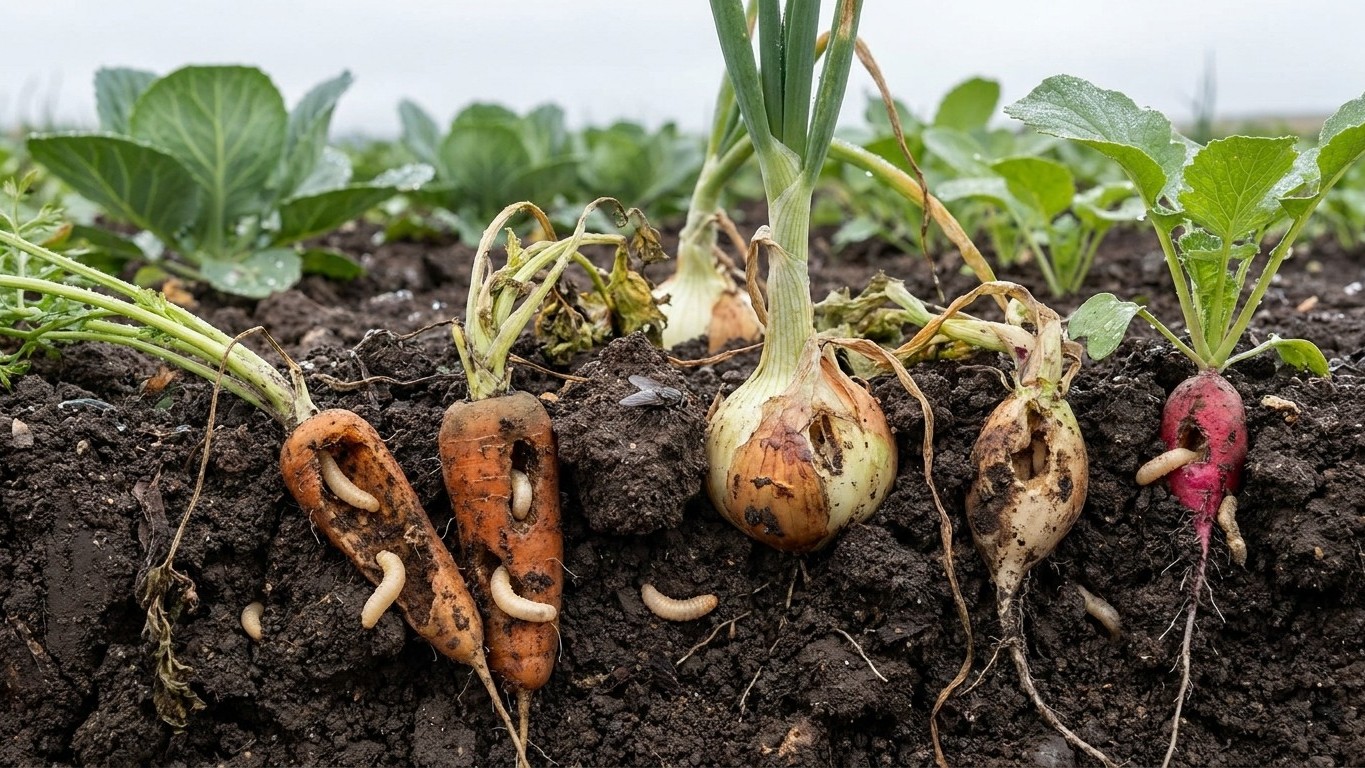
What replaces the freeze is wet soil. Roots left in saturated ground, especially on windward slopes with frequent rain, invite rot and fungal disease. Leeward gardens run the other way. They are drier, they need steady irrigation, and mulch earns its place by keeping the root zone cool and evenly moist. Warm soil also favors root-knot nematodes, microscopic worms that gall and deform root crops, so rotation and clean, well-drained beds count for more here than a catalog description would suggest.
Celeriac is the one to question. It is the long, cool-season crop of the group, and in lowland heat it is the least likely to finish well. Without a frost to end the season, the limit is whether the plant gets enough cool weeks to swell its root. Higher elevations give it more of those weeks. At sea level, a gardener is gambling on the coolest part of the year, and consistent water and shaded roots are what keep the gamble reasonable.
Storage needs extra caution in a warm, humid place. Lifting a root and holding it is harder than it is in a cold cellar climate, and the easiest approach is often to harvest as you need it. If you do keep roots, inspect them every time. A soft patch, a weeping spot or a moldy crown ends the question, and a root that looks sound from the outside is not proof it is safe to eat.
Which these root crops suit Hawaii
Choose by type, not by name. There is no short season to favor the earliest types here, but the other two rules apply with force. A hot climate favors types that get airflow and shade at the root, and a humid one makes disease resistance the first criterion. For a general overview of the whole group, see Celeriac, Kohlrabi, Horseradish and Jerusalem Artichokes.
| Type | What Hawaii’s conditions ask | Practical lean |
|---|---|---|
| Celeriac (long, cool-season) | Cool weeks, even water | Higher elevation or the coolest months, mulched roots |
| Kohlrabi, turnip (quick brassicas) | Short cool spell, disease pressure | Small repeat sowings, disease-resistant types |
| Rutabaga (slower brassica) | Cool weeks, drained soil | Elevation or cooler months, airflow around the plants |
| Horseradish (perennial) | Contained spread, wet-soil rot | Raised or well-drained bed, a spot you won’t mind keeping |
| Jerusalem artichoke (permanent) | Containment above all | A bed you will never rotate |
The turnip, rutabaga and kohlrabi in that table are brassicas, and so is horseradish. They share their troubles with cabbage, kale and mustard, so a gardener who rotates them into a cabbage bed has rotated nothing. The rotation page on this site explains how to space them away from the whole family.
Preparation needs a second warning. Grating fresh horseradish releases compounds that burn the eyes and airways. Do it with the windows open or a fan running, and keep your face away from the bowl. This is a real irritant, not a quirk of the vegetable.
This page names no varieties, and that is deliberate. The only variety recommendation worth following is the one trialled where you garden, and Hawaii’s range of microclimates makes borrowed advice from another state close to worthless. The state’s extension service, the University of Hawaii College of Tropical Agriculture and Human Resources, is the source for what has actually been tested on each island. A variety name I could not source would be a guess, and a gardener would catch it immediately.
Common questions
Is there a last frost date in Hawaii?
Not where people garden. NOAA’s 1991-2020 normals for station USW00022521 show zero days a year at or below 32°F, and the freeze percentiles can’t be computed. Frost occurs only on Mauna Kea, Mauna Loa and Haleakala. Planting is governed by rainfall, elevation and exposure instead. You can read the NOAA station data yourself.
Do I have to lift root crops before winter?
Not to escape a freeze, because the coldest month’s mean daily minimum at Honolulu is 66.8°F. The risk is wet soil. Roots left through heavy rain can rot, so drainage and mulch matter. If you lift and store, inspect them and discard anything soft, weeping or moldy.
Which varieties should I plant?
Ask the University of Hawaii College of Tropical Agriculture and Human Resources, which publishes what has been trialled locally. This page deliberately names none, because a recommendation that hasn’t been tested near you doesn’t mean much in a state with so many microclimates.
Is it safe to plant Jerusalem artichokes in my garden?
Safe, yes, but permanent. Every tuber fragment left in the ground regrows, so site it where it can stay indefinitely. Many people also get digestive discomfort from the inulin it stores, so a small first portion is the sensible way to find out how you react.