
For Florida, pick roots by season rather than by name. Heat lovers like ginger, turmeric, cassava, malanga and sweet potato carry the long warm months. Cool-season roots like daikon, beets and carrots belong to winter in the center and south of the state. The cool-season group is the one that earns its keep in a mild winter. Everything below hangs on that split. For the full catalog, start with Growing Unusual Root Crops in Florida.
The short answer for Florida
The best unusual roots for Florida are the ones that treat heat as fuel: ginger, turmeric, cassava, malanga (also sold as yautía), taro and sweet potato. In winter, daikon radish, beets and carrots fill the beds. That is the decision by type. Which half of the year you plant each group in depends on where you garden, because Florida has two different calendars.
Here is the mechanism. The only frost dates on file for this page come from Jacksonville, in north Florida. At that inland airport station, the last spring freeze (32F) falls between February 16 and March 7. The first fall freeze falls between November 26 and December 13. Both ranges come from the 30-70% probability band in the NOAA NCEI 1991-2020 Climate Normals. They are not guarantees. Each date marks a point where the odds of a 32F freeze fall into that band, so a freeze outside the window is still possible. Three of the thirty falls in the record saw no freeze at all, and the other twenty-seven did.
Central and south Florida are effectively frost-free, and there the calendar inverts. The main season runs through winter. Summer becomes the hard part. Do not apply the Jacksonville window to Orlando or Miami.
| Type | Examples | Where the season sits | Best fit |
|---|---|---|---|
| Warm-season tubers and rhizomes | Ginger, turmeric, cassava, sweet potato | Planted after the last spring freeze in the north; nearly year-round but slowed by cold snaps in the center and south | Whole state, with frost protection in the north |
| Wet-heat corms | Malanga, taro | Summer rains and warmth, in wet or well-mulched ground | Central and south first, north with winter mulch |
| Cool-season roots | Daikon, beets, carrots | Fall through early spring | North in the cool months, center and south as the main winter crop |
Winter cold is mild by national standards. The mean daily minimum of the coldest month at the Jacksonville reference station is 42.9F. That figure is an average of lows, not a record, so individual nights run colder. It does explain why tropical roots are even on the table in a state where the northern edge still sees freezes.
What will not work here
Slow cool-season roots such as parsnips, celeriac and salsify struggle most. They want a long stretch of cool weather to size up. A Miami or Orlando winter is cool enough to start them but short on the sustained chill they like, and the heat that returns in spring pushes them toward bolting or rot before they bulk up. A gardener in Jacksonville has a better shot because the freeze window leaves a real cold season. Even there, a warm stretch can stall them.
Summer is the second failure point in the center and south. Warm-season roots love the heat, but summer rain and humidity punish close spacing. Crowded rows of sweet potato vines or tightly packed ginger hold moisture against the stems and crowns, and fungal rot follows. Space plants wider than a northern seed packet suggests and plant on raised ground so water runs off.
Watering by the calendar, a deep soak once a week, fails on Florida’s sandy soils. Sand drains fast, so the root zone can dry out between a weekly soak during the dry spells of spring and fall. In the wet season the same schedule piles water onto soil that is already saturated. Mulch holds moisture in sand, and a quick finger test of the top few inches beats any fixed day of the week.
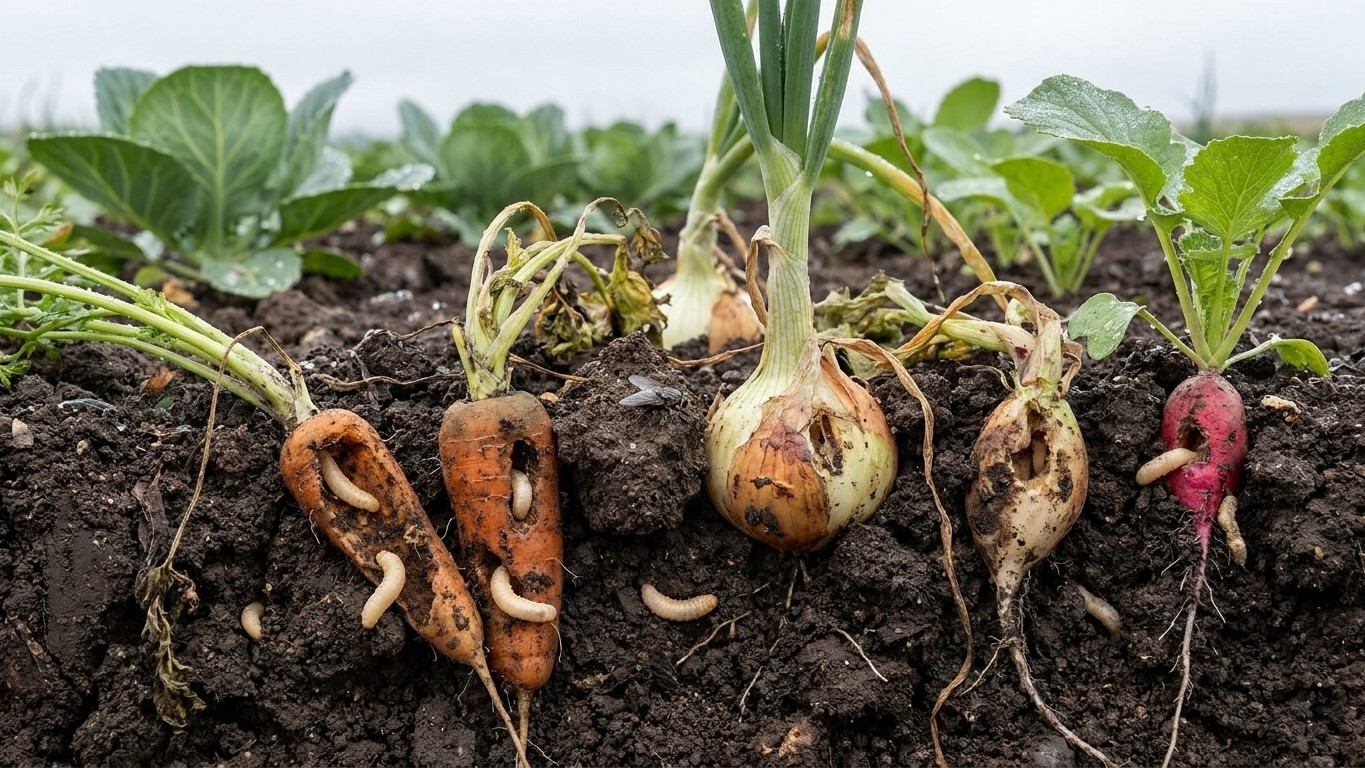
Warm, sandy soil also favors root-knot nematodes, microscopic worms that distort carrots, beets and many other roots. This one is a well-known Florida problem. Rotating crops, adding organic matter and picking resistant varieties help. Your county extension office is the right place to ask which crops in your area have been hit hardest.
The last failure is applying one date everywhere. A planting plan built from the Jacksonville window would be wrong for Orlando or Miami, because the frost it describes does not reliably occur there. The reverse is just as costly. A north Florida gardener who plants cassava in February because it works in Miami may lose the tops to a late freeze. Cassava and ginger foliage are tender, and the underground parts survive only with mulch and luck.
What changes across Florida
The USDA Plant Hardiness Zone Map (2023 edition, built on 1991-2020 normals) places Florida in zones 8b through 11b. That is a spread of several zones inside one state, so there is no single answer for Florida. The zone system rests on one variable only, the average annual extreme minimum temperature. It says nothing about summer heat, rainfall or soil, which matter just as much for roots.
If you garden in the north
The northern end of the range is where the Jacksonville numbers apply: a real last-freeze window in late winter, a first freeze in late fall, and a cool season long enough for carrots and beets to do well. Treat ginger, turmeric and cassava as summer crops. Plant after the spring window closes, then mulch deeply or lift the roots before the fall window opens. A cold-season bed of daikon and beets fits between those two windows.
If you garden in the center or south
In the frost-free areas the logic flips. Winter is the easy season for cool-season roots, and summer is the stress test, with heat, rain and disease pressure. Tropical roots like malanga and taro take to the wet months, while carrots and beets move to the cooler stretch of the year. Spring and fall are the shoulder seasons where timing matters most. For the month-by-month detail, see When to Plant Unusual Roots in Florida.
I cannot tell you which zone your yard sits in. Look up your location on the USDA map, then compare it to the zones above. A ZIP code lookup takes about a minute.
Where to check this for your own county
A county recommendation beats a state one, and this page is the state one. Florida stretches so far north to south that advice written for the whole state is a rough average at best. The place to get local detail is UF/IFAS Extension, the state’s land-grant extension service. It runs offices in the counties, staffed by agents who know the local soils, pests and weather.
Once you find your county office, look for two things. The first is the local planting calendar for vegetables, which will list sowing windows for your area rather than a statewide average. The second is any list of varieties trialled in your county. A variety that performs well in one county’s sand may fail in another’s clay, and the trial results tell you which is which. County agents also know where nematodes are bad and which roots tolerate your soil.
This page does not have county-level calendars or variety trial results, so I will not guess at them. If your county office does not publish a root-crop calendar, call or email and ask. Agents field questions like that all season, and a good answer is worth more than any chart.
Checking this against your own garden
Your own observations outrank every date on this page. A yard in a low spot, a yard against a south-facing wall and a yard under oaks can differ by weeks, even on the same street. Three signs are worth watching.
- Soil warmth by feel. Push your bare hand into the bed in the morning. If the soil feels cool and damp, warm-season rhizomes like ginger and turmeric will sit and risk rotting. If it feels comfortably warm, they will sprout.
- The first true leaves. On a carrot, beet or daikon seedling, the first true leaves appear after the rounded seed leaves. Fast, sturdy leaves mean the soil and temperature suit the crop. Slow or yellow ones point to heat stress, poor drainage or nematodes.
- Cold-damage patterns. After a cold night, note which tender plants, such as basil or cassava tops, show leaf damage and which do not. The damaged spots are your cold pockets. Plant tender roots away from them.
Keep notes for a season or two, jotting down when each sign appears. Over time those dates will tell you more about your microclimate than a map can.
Common questions
Is sweet potato an unusual root for Florida?
Not really, since it is one of the most reliable root crops in the state, but it makes a good starting point. It handles heat and humidity well, and its vines cover a lot of ground, so give them room.
Can I grow ginger and turmeric in north Florida?
Yes, as summer crops. Plant after the last spring freeze window (February 16 to March 7 at the Jacksonville reference station) and mulch heavily or dig the rhizomes before the first fall freeze window (November 26 to December 13).
Do parsnips grow in south Florida?
They are a poor fit. They want a long cool season, and south Florida is effectively frost-free with a short, mild winter. Daikon, beets and carrots are better bets there.
Which unusual root is easiest to start with?
Malanga and taro are forgiving in wet, warm conditions in the center and south, while daikon is a quick winter crop in cooler beds. Your county extension office can say which has done best locally.