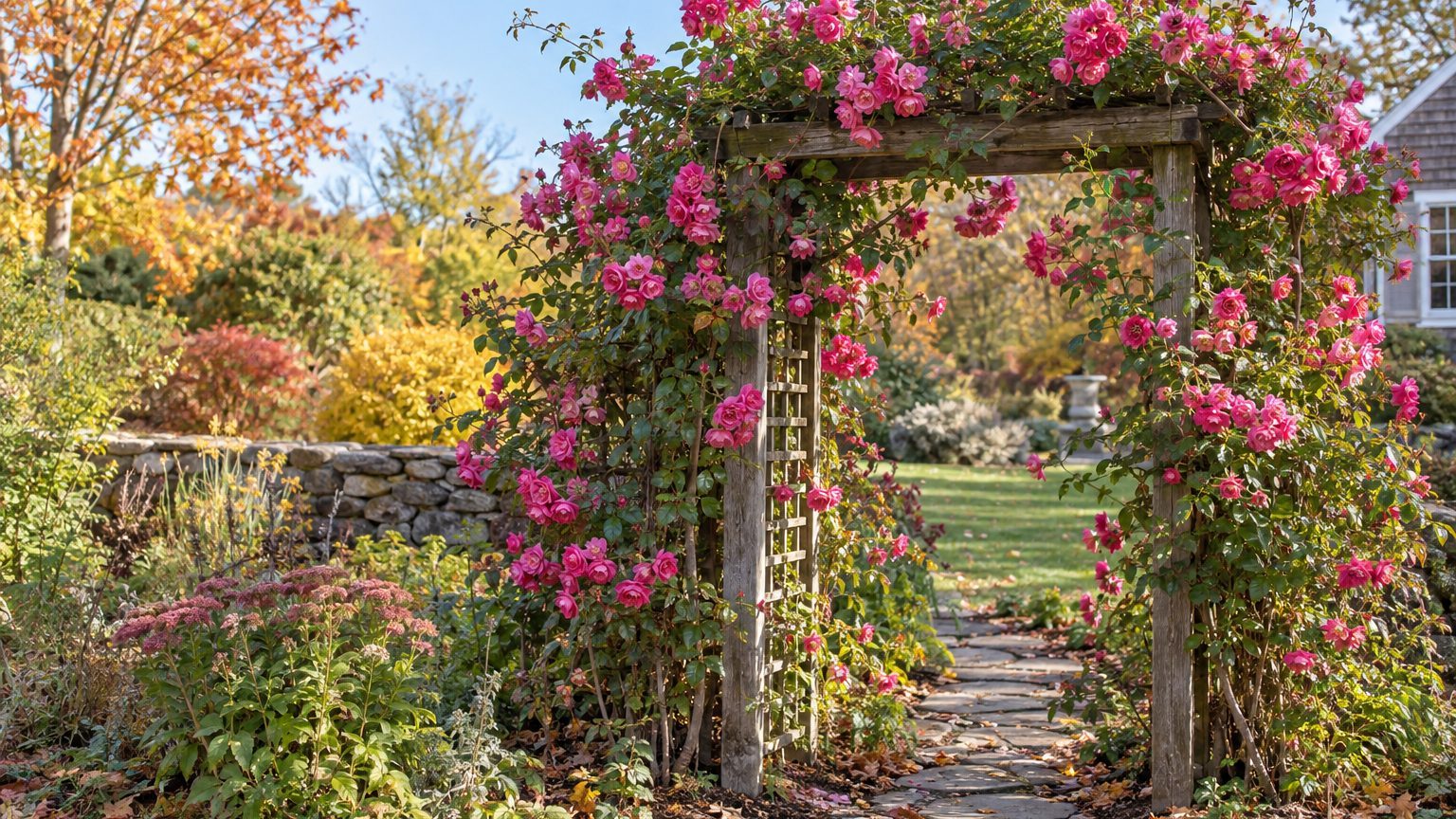

Zephirine Drouhin is a climbing rose with cerise, semi-double flowers in clusters, and the catalogue description calls it almost free of prickles. It blooms on new wood grown from laterals off a permanent framework. So the question is whether your season gives that new wood time to grow and ripen, not how many days to count. No tomato arithmetic applies to a rose, and nothing here ripens all at once.
What Zephirine Drouhin actually is
Start with the habit, because it decides everything else. This is a climbing rose, and climbers flower on new wood. Each year the plant sends up fresh laterals from a framework of older canes that stays in place, and the flowers open on those laterals. A rambler works the opposite way and flowers on old wood. The source (the NC State Extension Gardener Plant Toolbox entry for Rosa, at plants.ces.ncsu.edu/plants/rosa) states that distinction plainly, and it is the reason this page exists. The type decides the pruning date because it decides which wood carries the bloom.
The catalogue figure people look for does not exist for a rose. There is no days-to-maturity number counted from transplant, because a rose is a perennial shrub, not a crop with a harvest date. The nearest equivalent is the hip, the plant’s fruit. It is an accessory fruit holding achenes, edible, and it turns from green to red in fall.
Size is the other fact that decides whether a garden suits it. The only dimensions documented are for the genus: 1 to 8 feet tall and 1 to 6 feet wide, depending on cultivar. They do not describe this climber specifically, so check the nursery tag for a per-plant figure before choosing a wall or trellis. The source also lists growth rate as medium and maintenance as HIGH for the genus. Expect a plant that rewards attention.
What Zephirine Drouhin is good for

This rose is grown for its flowers, and the source description is short: cerise, semi-double, borne in bouquets, almost without prickles. That last trait explains much of its use. A climber with few prickles can be tied to a porch post, an arbor or a doorway without anyone getting snagged, and the trade calls such cultivars “thornless.” The sharp structures on rose stems are technically prickles, not true thorns. They grow from the outer skin of the stem, which is why they can be rubbed off. Reaching in to tie a lateral is easier when there are few of them.
Semi-double matters too. Petal counts in the genus run from 5 (single) to more than 20 (double), and a semi-double flower sits between those poles. The flower parts come in multiples of five. A flower with fewer petals shows more of its center, and the clusters give you many blooms per lateral in one season of growth.
Fragrance is where the record goes quiet. The source sorts rose scent into five groups (old rose, fruity, tea, myrrh and musk), but it does not say which one applies to this cultivar. Any scent claim here would be invention, so the honest answer is that it is not documented. Smell a plant in person before you plant it by a window.
For the vase, cut once the sepals have folded back and the first one or two petals are unfurling. A bud cut tighter than that often never opens. For the kitchen, the hips are edible and are the only part of the plant the source marks that way. The source gives no flavor note for this cultivar’s hips, so how they taste is not recorded. Leave some on the plant: the color change from green to red is the plant’s fall show, and every deadheading cut pushes a new shoot, so the plant tells you nothing by “signaling” with its hips. Stopping the cuts is what keeps late growth from coming.
Where it ripens in time, and where it is a gamble
The brief for this page called for a crossing of days to maturity with the frost-free window at named weather stations. For a rose that table does not exist in the record. No days-to-maturity figure is published for this cultivar, and no station-by-station frost dates are published here, so naming a city and its figures would be inventing data. What the source does give is a hardiness range for the genus: USDA zones 5a through 11b. That is a wide band, covering most of the lower 48 and then some. Whether this specific climber matches the full band is not documented, so treat 5a through 11b as the outer limit for roses in general.
For a rose, “ripening” means wood. A climber that flowers on new wood needs a growing season long enough to push laterals and then let them firm up before winter. The arithmetic is simpler than a tomato’s and has no figure to plug in. Take your last spring frost and your first fall frost. Subtract the weeks the plant needs to leaf out and push laterals. What remains is the stretch in which new wood can mature, and a short stretch is the gamble. The risk is shoots that are too soft to ripen in time. The wood ripens and the plant hardens on its own, but only if growth stops early enough for it to do so.
Warm gardens face a different calendar. Where winters are mild, the plant has more time to build a framework and the question shifts from surviving the cold to managing a long season. That is why this national page gives no pruning month, zone-specific mounding depth or planting date. All of those depend on your zone, and your state’s page in this silo carries them.
One planning note applies everywhere. Check whether the plant was sold budded or own-root. Hybrid teas, grandifloras and many climbers are budded onto a rootstock, while most landscape shrub roses sold today (Knock Out and Drift among them) are own-root with no union at all. Winter protection guards the union on a budded rose and the crown on an own-root one, so the tag tells you what to protect.
The two ways a season goes wrong
The tomato version of this problem has two familiar limits, cold nights that stop fruit set and extreme heat that sterilizes pollen. The record here carries no temperature thresholds for roses, and borrowing the vegetable numbers would be wrong. Two failures are documented in the facts, and a frost table cannot show either of them.
The first is soft late growth. Every deadheading cut pushes a new shoot, and every late feeding does the same. In a zone with an early fall freeze, those shoots are too soft to ripen before frost and they die back. Dormancy follows day length and cold, not the hips and not your calendar, so the gardener’s lever is to stop cutting and stop feeding in time. How early depends on your zone, so it belongs on the state page.
The second is pruning the wrong wood at the wrong time. This is the mistake the bloom habit invites. Because this rose flowers on new wood off a permanent framework, the rule is to keep the framework and shorten the laterals. Treat it like a rambler and you cut the wrong canes. Skip pruning and the laterals grow long and weak while the framework crowds. Most roses need yearly pruning in late winter, according to the source, but that is a genus-level statement and your zone sets the actual date.
Of the two, the pruning error costs more for this variety. A soft-growth setback is a bad year at the cold edge of its range, while a pruning mistake can repeat every year and thin the bloom each time. The plant flowers on new wood, so it forgives a cold-damaged tip more readily than it forgives a framework cut to the ground.
What it resists, and what it does not
The catalogue entry lists no disease resistance for this cultivar. Not high, not intermediate, none. Plan as though the plant is unprotected, and do not assume a low-prickle rose is a low-maintenance one. The source rates maintenance HIGH for the genus. Resistance is also a per-cultivar matter, not a group trait: several classic ramblers are mildew-prone, and Knock Out was bred precisely for resistance. Climbing as a group tells you nothing about this plant.
The source names these diseases for roses:
- botrytis
- blights
- powdery mildew
- leaf spots
- anthracnose
For those, the practical point is where they spend winter. Powdery mildew overwinters in dormant buds and on stems, not in leaf litter. Raking the ground alone does not end it, so inspect the canes when you prune.
The pests the source names are Fuller rose beetle, Japanese beetle, rose chafer, rose thrips, southern red mite and two-spotted mite. Two of those are mites, and mites are arachnids, not insects, so call the group “pests” or “insects and mites.” Nothing else is documented on this site for roses, so do not go looking for other culprits based on this page alone.
Growing it without the usual mistakes
This is a climber on a framework, so it needs a structure before it needs anything else. Install the trellis, wires or arbor when you plant, not after the laterals have started to sprawl. Tie laterals loosely as they grow, and keep the permanent canes in place from year to year. Spacing depends on the final size, which the source gives only for the genus, so use the per-plant figure from the nursery tag or from a cultivar page. Other cultivars in the silo include Don Juan Rose: When to Plant the Tomatoes That Ripen All at Once and Graham Thomas Rose: When to Plant the Tomatoes That Ripen All at Once, and each page carries its own dimensions.
Give it full sun, which means 6 or more hours of direct sunlight a day. The documented soil is clay or loam, with pH from acid (below 6.0) to neutral (6.0-8.0). Do not narrow that to a single tidy number. Iron chlorosis shows up on strongly alkaline soil, above about 7.5, and that is a different problem from the wide range the source allows.
The habit-specific mistake is feeding and cutting late. A plant that flowers on new wood keeps rewarding fertilizer and deadheading with fresh shoots, which is exactly what you do not want near the first frost. Stop feeding and stop deadheading ahead of fall, and let the hips redden. When you do prune, remove what is diseased or unsafe, and leave dead stems cut back to 12-24 inches standing for stem-nesting native bees. Do not clear everything dead.
Propagation is a nursery matter for most gardeners. Grafting is the best strategy, and seed and stem cuttings also work. Compare the habit with other climbers, or with a very different plant such as Joseph’s Coat Rose: When to Plant the Tomatoes That Ripen All at Once, and browse the full set under Rose Varieties.
Common questions
Are rose thorns a problem on Zephirine Drouhin?
Rarely. The catalogue description says it is almost without prickles, and the trade sells it as thornless. Strictly, the sharp structures on rose stems are prickles, not true thorns. They grow from the skin of the stem, which is why they snap off sideways. “Almost” is the word to keep: expect few, not none.
When do I prune it?
It flowers on new wood from laterals off a permanent framework, so keep the framework and shorten the laterals. The month depends on your zone, and this national page gives none. Use your state’s page in this silo for the date.
Will it grow where I live?
The source gives USDA zones 5a through 11b for the genus Rosa. It does not publish a separate range for this cultivar, so treat that band as the outer edge and check the nursery tag. Also check whether the plant is budded or own-root, which decides what winter protection covers.
Can I eat the hips?
Yes, the source marks rose hips as edible, and they turn from green to red in fall. No flavor note exists for this cultivar’s hips. Leaving some on the plant also costs you nothing, since dormancy follows day length and cold, not the hips themselves.