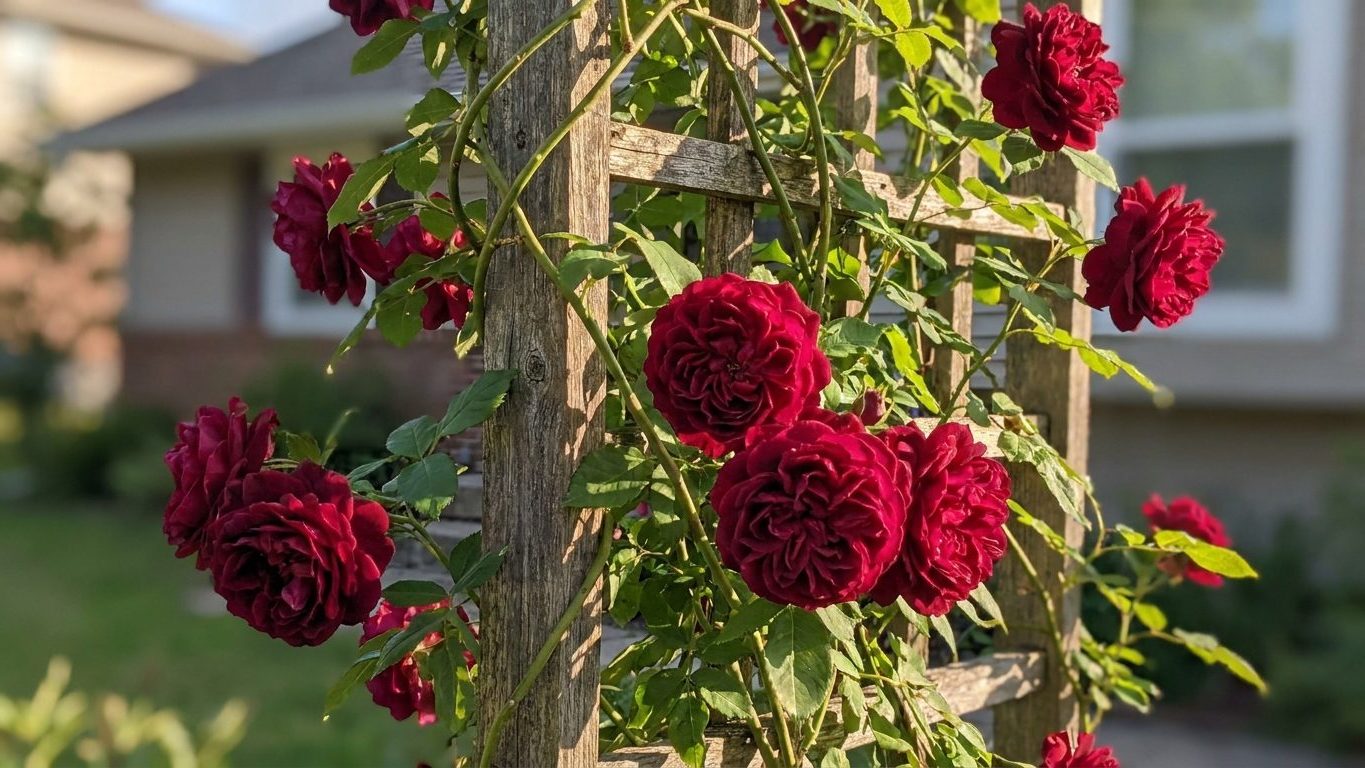

Don Juan is a climbing rose grown for large, velvety dark red double blooms with a tea and fruity scent, hardy from USDA zone 5a through 11b, and it flowers on new wood produced each season on laterals off a permanent framework. That single fact, flowering wood, is what decides how and when you prune it, and it is the fact the rest of this page works from.
What Don Juan actually is
Three details set the terms for growing this rose. First, the hardiness range: USDA zones 5a through 11b, according to the North Carolina Extension Gardener Plant Toolbox, a wide bracket that explains why Don Juan shows up in catalogs from Minnesota to South Florida. Second, the light and soil it needs: full sun, at least six hours of direct light a day, in clay or loam soil with a pH anywhere from acid (below 6.0) to neutral (6.0 to 8.0). Third, and this is the one that governs the calendar, it flowers on new wood, growing on laterals off a framework the plant keeps from year to year.
That last point separates Don Juan from a rambler, which blooms on wood grown the previous season and gets ruined by a badly timed cut. Because Don Juan flowers on new growth, the permanent canes stay in place year after year while the side shoots off them get renewed. Size is documented at the genus level only, 1 to 8 feet tall and 1 to 6 feet wide depending on cultivar, so the actual reach of a Don Juan plant on your fence is a question for the cultivar page, not this one. Growth rate is medium, and maintenance is rated high.
What Don Juan is good for

The flower is the whole point. Large, fully double blooms, somewhere well past 20 petals given the genus range of 5 (single) to more than 20 (double), in a dark, velvety red. That density of petal is why the flower reads as heavy and formal rather than airy, and why it holds up as a cut flower once you cut it right: wait until the sepals have folded back and the first one or two petals are unfurling, since a bud cut tighter than that often never opens in the vase.
Scent is the other half of the appeal. The source description places Don Juan in the tea and fruity fragrance families, two of the five recognized groups (the others being old rose, myrrh, and musk), reading brighter and less heavy than old rose or musk.
Because it is a climber, its practical job in a landscape differs from a shrub rose’s: it is a plant you put to work covering a fence, a pergola post, or an arbor, using the permanent framework as scaffolding while the new laterals do the flowering. That distinction is why a climber earns its keep in a smaller yard, producing a season of bloom on a footprint measured in width of trellis rather than width of border. The hips that follow are edible, turning from green to red in fall, though most gardeners deadhead through the season instead, since every deadheading cut pushes a new shoot and more bloom.
Where it ripens in time, and where it is a gamble
Zones 5a through 11b is not a narrow window, and the practical question for most readers is less “can I grow this” and more “what does my zone cost me in care.” The zone number is a proxy for the average annual minimum winter temperature. Zone 5a sits around -20 to -15°F at its coldest average, covering parts of the Upper Midwest, upstate New York, and mountain valleys in the Rockies. Zone 11b sits around 45 to 50°F, covering south Florida, Hawaii, and pockets of coastal Southern California.
| Zone | Typical winter minimum | What it means for Don Juan |
|---|---|---|
| 5a (cold end of range) | -20 to -15°F | Cane dieback likely most winters; framework may need rebuilding from lower buds |
| 7 to 9 (middle of range) | 0 to 20°F | Framework generally persists; light dieback at the tips is routine |
| 11b (warm end of range) | 45 to 50°F | Little to no dieback; the limit is disease pressure, not cold |
Here is the detail that changes the arithmetic for this rose: because Don Juan flowers on new wood produced fresh each season, winter dieback to the framework does not necessarily mean a lost bloom season the way it would on a rambler that flowers on old wood. New laterals still grow, and Don Juan can still flower off them, just later and lower on the plant than in a milder zone. What dieback threatens is the framework itself, the permanent structure giving a climber its height and shape. Losing it repeatedly means starting over each year rather than building on a taller plant.
At the warm edge of the range, cold is not the limiting factor at all. The gamble runs the other way: mild winters mean the plant barely rests, growth continues nearly year round, and the humid, warm conditions common to zones 10 and 11 favor the fungal diseases documented for roses generally. The zone bracket tells you whether Don Juan survives; it does not tell you whether it thrives.
The two ways a season goes wrong
A wide hardiness range hides two separate failure modes that a single zone number cannot show. Near the cold edge of zone 5a, winterkill is not just about the framework dying back. If cold reaches the graft union on a budded plant, and the rose is lost below that point, the entire cultivar is gone; whatever regrows comes from the rootstock, not from Don Juan. That risk is specific to budded roses, and climbers like Don Juan are commonly budded onto a rootstock, though own-root plants exist too and the only way to know which you have is to check the tag.
In the south, the failure runs through disease rather than cold. Warm, humid conditions that never really let up favor powdery mildew, blights, leaf spots, anthracnose, and botrytis. Powdery mildew overwinters in dormant buds and on stems, not in fallen leaf litter, so raking up debris alone will not stop it. A continuous growing season gives these diseases more cycles per year to build up, which is why gardeners in the warmest zones often see more spraying and more pruning for airflow, even though their plants never lose a cane to cold.
For a rose that flowers on new wood, the northern risk matters more in terms of losing the plant outright, while the southern risk matters more in terms of losing bloom quality through the season. Which one bites depends entirely on which end of the 5a to 11b range you garden in.
What it resists, and what it does not
The source description for Don Juan does not grade its resistance to any specific disease, and that absence matters: no resistance claim should be made for this cultivar beyond what is documented for the genus generally. The pests recorded for roses as a category are Fuller rose beetle, Japanese beetle, rose chafer, rose thrips, southern red mite, and two-spotted mite. Note that the last two are mites, not insects; treating them as insects means reaching for the wrong control.
The diseases recorded for roses as a category are botrytis, blights, powdery mildew, leaf spots, and anthracnose. Because disease resistance is documented per cultivar and Don Juan’s own description carries no resistance rating, the honest answer is that this plant’s specific resistance level to any of these five is not documented on this source. Assuming protection that has not been demonstrated is the mistake that costs a crop of blooms to mildew or black spot in a wet spring. Watch the plant, not the group name, and treat preventively in the pest and disease conditions your own zone favors.
Growing it without the usual mistakes
The mistake most specific to Don Juan is pruning it like a rambler. Because it flowers on new wood growing off a permanent framework, the job every year is to keep that framework and shorten the laterals coming off it, not to cut the whole plant back hard or remove the old canes thinking they are spent. Pruning time depends on your zone and the wood-ripening cycle there, so the actual month belongs on the page for your state, not here.
Structurally, this is a plant that needs support decided at planting, not added later: a trellis, pergola, or wall strong enough to carry a mature framework, since retrofitting support around an established climber damages the very canes you are trying to keep. High maintenance, per the source rating, means regular tying-in of new growth through the season, plus watching for soft, late growth that will not ripen before frost. Stop feeding by late summer in your zone so the plant is not pushing tender shoots when cold arrives; wood that has not ripened is the wood that dies back hardest.
At the end of the season, resist the instinct to cut back Everything that looks dead. Remove what is diseased or clearly unsafe, but leave dead stems cut back to 12 to 24 inches standing, since they serve as nesting sites for stem-nesting native bees.
Common questions
Are Don Juan’s thorns dangerous?
They are prickles, not true thorns. Prickles grow from the outer skin of the stem, which is why they can be rubbed off, unlike a true thorn, which is a modified stem and woody all the way through.
Does Don Juan need winter protection?
It depends on your zone and on whether the plant is budded or own-root, since protection guards the graft union on a budded rose and the crown on an own-root one. Check the tag to know which applies, and see the page for your state for the specific depth and timing.
Is the Don Juan rose hip edible?
Yes. The hip is an accessory fruit holding the plant’s achenes, and it turns from green to red in fall. Most gardeners deadhead through the season instead, since each cut encourages another round of bloom rather than hip formation.
Why is Don Juan rated high maintenance when other climbers are not?
Rating is set at the plant level by the source, tied to its growth habit: a permanent framework with new-wood laterals needs regular tying-in and lateral pruning to keep producing large blooms, work that a self-supporting shrub rose does not require to the same degree.