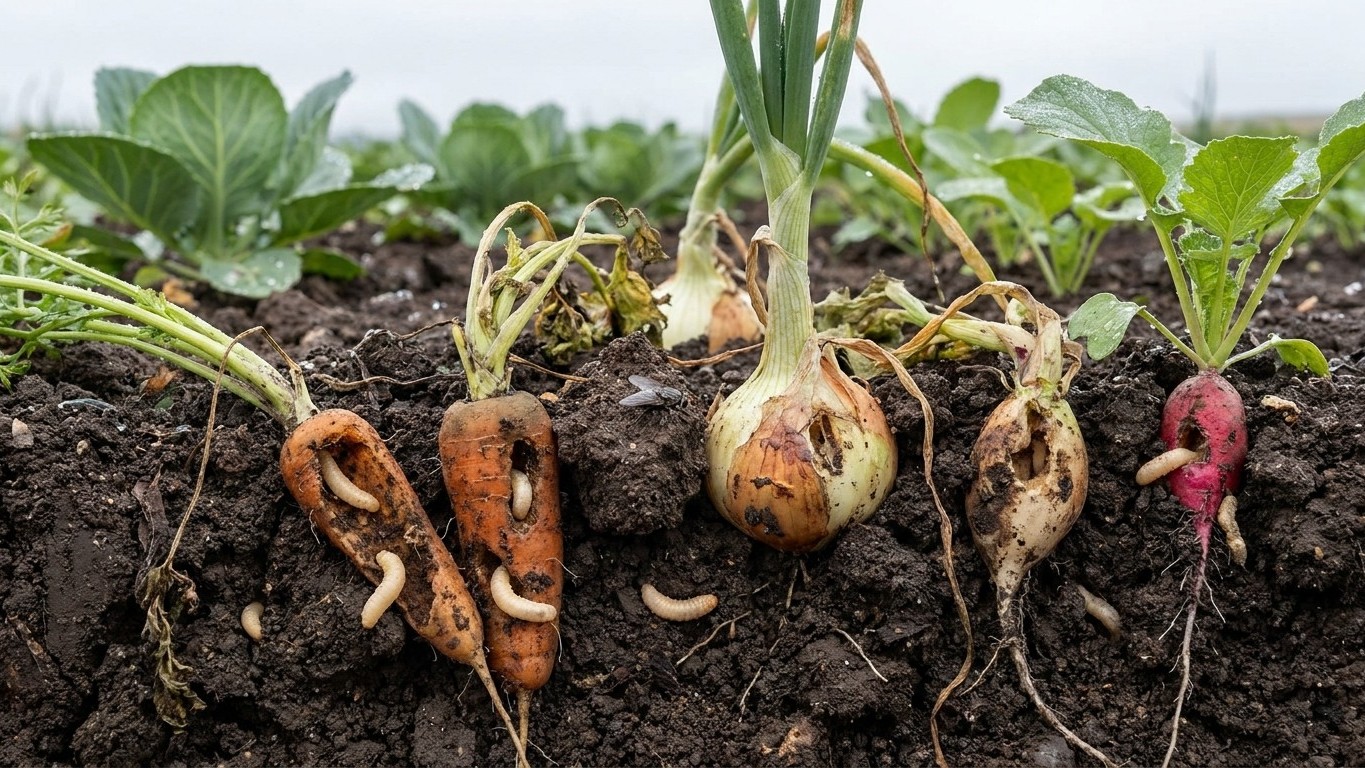

For Nunavut, the best unusual roots are the quick ones: small round radishes, baby turnips and short-season beets, grown in a bed or greenhouse where you control the soil. Slow roots such as parsnip, salsify and celeriac ask for more summer than the Rankin Inlet record offers. The dates below come from a single weather station, so use them as a starting point, not a schedule.
The short answer for Nunavut
Choose by type, and let season length make the cut. At the Rankin Inlet A station, the last spring frost comes on average on June 19 and the first fall frost on average on September 13, which leaves about 86 days between them.
Those two dates are means from Environment and Climate Change Canada’s 1981-2010 normals, not safe dates. A mean last-frost date is a 50/50 line: in one year out of two, frost arrives later than June 19 in spring, and in one year out of two it arrives before September 13 in fall. So 86 days is the middle of a window, and in a bad year it shrinks from both ends. (One more wrinkle: Canadian normals cover 1981-2010, while the US figures elsewhere on this site cover 1991-2020, so don’t line the two up too neatly.)
This page also has no summer heat figure for Nunavut, so it can’t say how warm the soil gets in July. What it does have is a short frost-free stretch and a brutal winter, and that is enough to sort the crops.
| Type | Examples | Fit with an 86-day average window |
|---|---|---|
| Quick roots | Small round radishes, baby turnips | Best match. They finish well inside the window, even in a short year. |
| Mid-season roots | Beets, standard turnips | Workable, ideally started under cover or in a warmed bed, with a short-maturity variety. |
| Slow roots | Parsnip, salsify, scorzonera, celeriac | Poor odds in open ground. They need more days than a typical year hands out. |
| Perennial roots | Horseradish, Jerusalem artichoke | A gamble outdoors. Safer in a container or bed you can protect. |
When you shop for seed, read the days-to-maturity line on the packet and subtract a margin. A root that needs nearly the whole 86 days leaves no room for a late thaw or an early September frost. Also check whether the count runs from sowing or from transplanting, because the difference can be a few weeks of your short season.
For sowing dates tied to those frost figures, see When to Plant Unusual Roots in Nunavut. For the wider picture of what counts as an unusual root up here, start with Growing Unusual Root Crops in Nunavut.
What will not work here
Anything that needs a full season of growth fails first. Parsnips are the classic case. Gardeners farther south sow them in spring and dig them after fall frosts for the sweeter flavor, a rhythm that assumes months of growing weather. Here the frost-free window averages 86 days, and spring frost can run past June 19 in half of all years. A slow parsnip seedling that stalls in cold soil never catches up.
Salsify, scorzonera and celeriac fall into the same trap. They are slow to germinate and slow to size up, and celeriac in particular is normally started indoors weeks ahead and then transplanted. You can copy that approach with a windowsill and patience, but the crop still needs warm days after transplanting, and the first fall frost on average on September 13 ends the argument.
Heat-loving roots are out entirely. Sweet potatoes, ginger and turmeric want long, warm seasons, and nothing in this territory’s numbers supports them in open ground. A greenhouse changes the math, but this page has no trial data to say whether any of them succeeds in Nunavut, so it won’t promise one.
The winter is the second wall. The mean daily minimum of the coldest month at Rankin Inlet is -34.3 °C (-29.8 °F), and that is the average low, not the record. Leaving roots in the ground to overwinter, a common trick for parsnips and Jerusalem artichokes in milder places, is a bet against that cold. Deep snow can insulate soil, and permafrost shapes what happens underground, but air temperature is the only figure this page can vouch for, and it argues against counting on survival.
Last, sowing by the calendar instead of the soil. June 19 is an average, so a bed sown that day in a cold year may sit with seed that never sprouts. Seed that rots in cold, wet ground is a more common loss than frost itself. Wait until the soil has actually warmed, and read the final section for how to tell.
What changes across Nunavut
Nunavut is not one garden. Its communities stretch across an enormous span of Arctic and sub-Arctic coastline and island, and the frost dates above belong to one station, Rankin Inlet A. Northern and upland districts run weeks behind it, so a reader farther north should assume a shorter window than 86 days, and a reader in a sheltered spot may do a little better.
The hardiness figure carries the same warning. Natural Resources Canada lists Canadian zone 0a for the reference city, Rankin Inlet, using 1991-2020 normals. This page doesn’t have zone figures for other communities, so it can’t give the spread across the territory, and there is no single answer for Nunavut as a whole. What it can say is that 0a sits at the cold end of the Canadian scale, and that other communities can differ from it.
A caution about the label: the Canadian system is built on seven climate variables, while the USDA system uses one, and NRCan itself says there are no simple conversions between them. Canadian zone 4a, for example, overlaps nine USDA zones, from 3a to 7a. So 0a is not a USDA zone, and nothing here should be read against a US map.
To find the figure for your own community, use Natural Resources Canada’s plant hardiness site and look up your municipality. Don’t guess it from a neighbor’s number.
The shift for a reader in the north or at altitude is simple. Narrow your list to the quick roots in the table, favor containers and raised beds that warm sooner than native ground, and treat mid-season roots like beets as an experiment with a small test row rather than the whole bed. If the frost window is shorter than 86 days where you live, a radish still has a chance and a celeriac does not.
Where to check this for your own county
Nunavut has no counties and no state extension service in the US sense, so the closest official source is the federal department. Start with Agriculture and Agri-Food Canada. The territorial department’s own site refused automated checks when this page was verified, which is why the federal one is linked instead. This page does not have a Nunavut-specific root-crop calendar from either source, and it won’t borrow one from another jurisdiction.
When you get there, look for two things. First, a planting calendar for your community or the nearest one, which will replace the average Rankin Inlet dates on this page with figures from closer to home. Second, a list of varieties trialled in your area, ideally with notes on which ones reached harvest size. A short list of varieties that actually matured near you beats any long list of what should work in theory.
A local recommendation always outranks a territorial one, and this page is the territorial one. It reasons from one station’s frost dates, one coldest-month figure and one hardiness zone. A community garden group, a local greenhouse project or a neighbor with several seasons of notes can tell you things no normal can, such as which corner of town gets the snow cleared first.
Checking this against your own garden
Your own observations outrank every date on this page. Three are worth tracking, and none needs equipment you don’t already own.
- Soil warmth by feel. Push your hand into the bed up to the wrist. If it feels cold enough to ache, seed will sit idle. A raised bed that feels noticeably warmer than flat ground tells you it will give you a head start.
- The first true leaves. Seedlings first show rounded seed leaves, then the true leaves that look like the adult plant. Note the date your radishes or turnips reach that stage. A bed that gets there weeks sooner than a neighbor’s has a milder microclimate than the average implies.
- The first blackened leaf. Watch tender leaves for frost damage in late summer. If yours blacken before September 13, your window is shorter than the Rankin Inlet mean, and your root list should shrink accordingly.
Write the dates down each year. After two or three seasons you have a calendar that beats the averages here, because it measures your bed, your wind and your snowmelt. Then compare it with the sowing guidance in When to Plant Unusual Roots in Nunavut, and adjust by weeks, not days.
Common questions
Is June 19 a safe planting date in Nunavut?
No. It is the mean last spring frost at Rankin Inlet A, so in one year out of two the last frost comes later. Treat it as the midpoint of a window, and wait for soil that feels warm to your hand. Other communities, especially farther north, run weeks behind.
Which unusual root should a first-timer try?
Start with a quick type, such as small round radishes or baby turnips. They fit inside an 86-day average window with room to spare, so a cold spring or early fall frost is less likely to wipe them out.
Is Canadian hardiness zone 0a the same as a USDA zone?
No. The Canadian system uses seven climate variables and the USDA system uses one, and NRCan says there are no simple conversions. Zone 0a here is the figure for the reference city, Rankin Inlet, not for all of Nunavut.
Can I grow sweet potatoes in Nunavut?
Not in open ground, on the evidence of the season length and winter cold on this page. A heated greenhouse is a different question, and this page has no trial data to answer it. Check with Agriculture and Agri-Food Canada or a local grower before spending money on slips.