
Shallots can be grown across California, but one calendar will not fit the state. At the Los Angeles reference station, NOAA records no freeze in an average year, so frost gives a coastal gardener no planting date at all. In the Central Valley, the north and the Sierra, winter cold decides the schedule. Heat and water decide it everywhere else.
When the soil is warm enough in California
Start with the number most people search for: the last spring frost. For the Los Angeles reference station there isn’t one. NOAA’s 1991-2020 Climate Normals return no computable freeze date (code -666), and NOAA’s RCC ACIS daily records show zero days at or below 32°F in 30 years. The frost-free season is listed as 365 days. Coastal and southern California simply doesn’t run on a frost calendar.
Why frost is only a stand-in
Gardeners lean on the last frost because it is easy to look up, but shallots never read it. They respond to soil: cold, waterlogged ground stalls them, and workable, moderately warm ground gets them rooting. Soil warms after the frost risk ends, not at the same moment. Where frost exists, a date from the almanac tells you roughly when to start checking the ground, nothing more. And a frost date is a probability, not a promise. A late cold snap can still arrive after the “average” date.
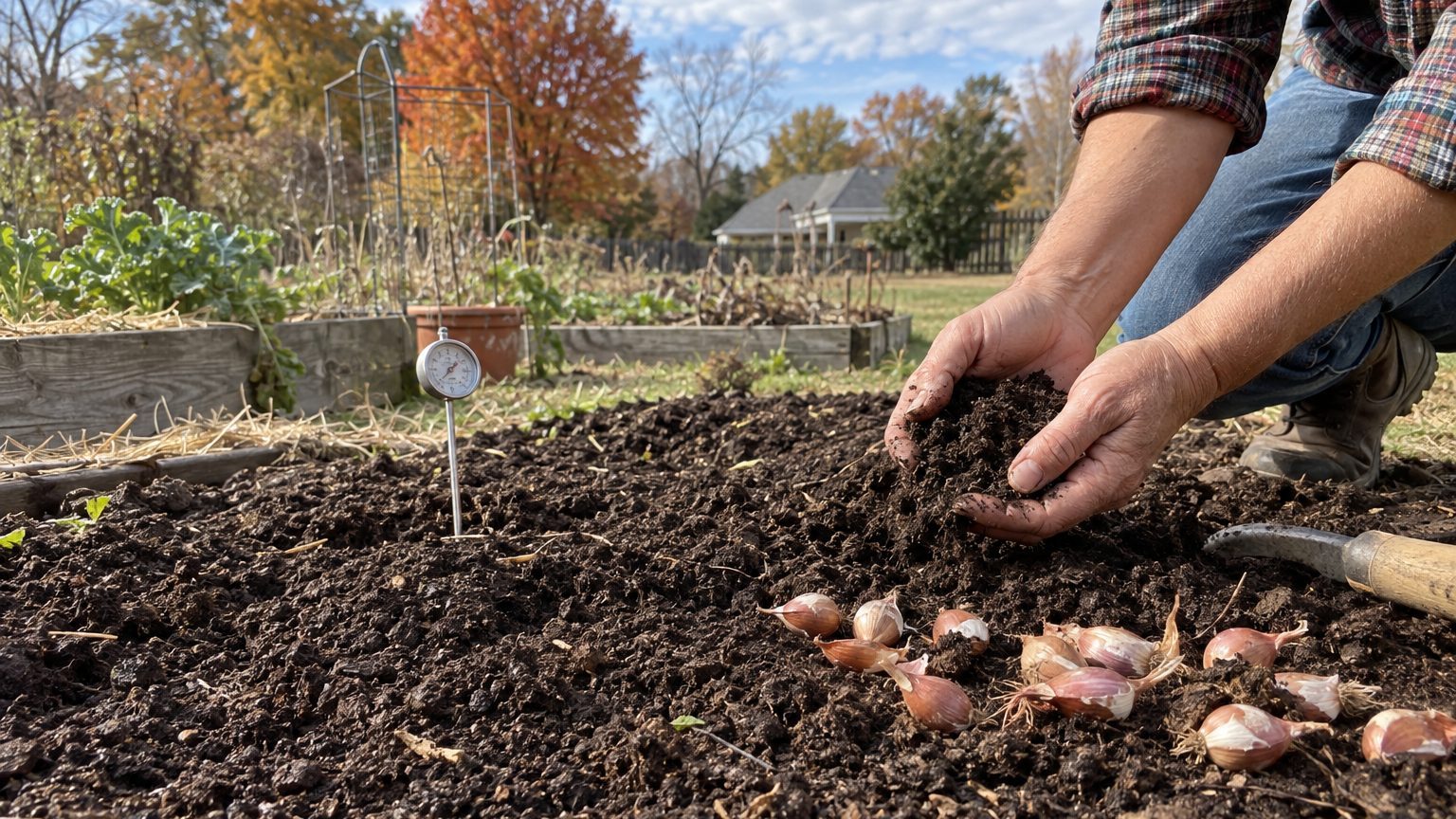
In a place with no freeze, the stand-in falls apart and you have to measure the real thing. Push a soil thermometer about 4 inches down in the morning, when the reading is at its lowest, and watch the trend over several days instead of acting on one warm afternoon. Mild nights help here. At Los Angeles the mean daily minimum of the coldest month is 49.1°F (NOAA Climate Normals 1991-2020), so winter soil on the coast rarely approaches the conditions that heave or kill a planted set.
Don’t carry the coastal answer inland
The Los Angeles figure describes one station. Northern California, the Central Valley and the Sierra do freeze, and this page has no verified frost dates for them. USDA’s 2023 Plant Hardiness Zone Map, built on the average annual extreme minimum temperature, spans zones 5a through 11a across the state. That is a spread of many degrees between the coldest mountain gardens and the warmest coastal ones. If you garden outside the Los Angeles basin, treat the “no freeze” finding as a different climate than yours and look up a local date through University of California Agriculture and Natural Resources.
Shallots share an autumn-planting habit with garlic, and this site has a full garlic section covering timing, curing, storing and allium rotation, so those details aren’t repeated here. What differs for shallots is the set itself. A shallot set is smaller than a garlic clove, it goes in shallow with the tip at or just below the surface, and each one multiplies into a cluster. That cluster is the whole point, which is why Growing Shallots: One Bulb In, a Handful Out is the place to start for the basic method.
How long the season lasts here
The brief for any season-length calculation is simple: take the last spring frost, take the first fall frost, subtract. For the Los Angeles reference station both dates are absent because no freeze occurs, so the subtraction gives the whole calendar. NOAA lists the frost-free season at 365 days. That is the entire year, and it tells you the window is not closed by cold.
For the rest of California this page cannot do the arithmetic. Frost dates for the Central Valley, the northern counties and the mountains aren’t among the verified facts here, and estimating them would be guesswork presented as data. Those are exactly the places where the window can be short, so look them up locally before you plan anything.
What a long window allows
A year-round frost-free window allows things a short one doesn’t. You can plant a first round of sets in the cool months and follow it with a second sowing a few weeks later, so the harvest comes in stages instead of one pile of bulbs that all need curing at once. The practical case for that is storage: a staggered harvest means you cure and inspect a manageable batch at a time. The main shallot guide covers the basic cycle, and the succession sowing guide on this site walks through how to space the rounds.
A long window doesn’t mean a window with no limits. On the coast the limit isn’t cold, it’s the stretch of the year when shallots are comfortable. Heat and dryness close the window from the other end, so the useful question is how much cool, workable weather you have before the ground turns hot and dry, not how many days are frost-free.
What a short window changes
Where a hard freeze does arrive, the first sowing may be the only one. That changes the transplanting question. Starting seed-grown shallots indoors buys weeks, but every transplant carries a root check: the seedling stalls while it re-establishes. In a long window that stall costs nothing. In a short one it can eat the margin you were trying to create. Sets planted directly skip the problem, which is one reason they dominate in colder gardens. Treat the choice as a trade between a head start and the risk of a setback, and make it with your own local dates in hand.
Heat and water in California
This is where California separates from the rest of the country, and it’s also where this page has to be honest about a gap. The verified facts here don’t include a count of days above 90°F or a summer rainfall total, so I won’t give you either. What the facts do support is the winter side of the question, and that is the side that settles autumn against spring.
The winter low decides autumn or spring
Autumn-planted shallots are grown for larger, earlier bulbs, because the plant spends the cool months building roots and foliage. That works where winter is mild. At Los Angeles the coldest-month mean minimum is 49.1°F, so autumn planting is the natural calendar for much of the coast and the south. Where the ground freezes hard and stays wet, autumn-planted sets are the ones that rot or heave out of the soil, and spring planting is the safer call. High elevations and the colder parts of the north and the Sierra fall into that second group. Between those two extremes, the Central Valley and the foothills need a local answer, not a guess.
Heat, drought and drying down
In frost-free California the constraints are heat, drought and water restrictions, and shallots suit them better than many crops because they are a cool-season planting that finishes before the worst heat. The work is in the timing and the plumbing. Mulch keeps the root zone cooler and cuts evaporation, and drip lines put limited water where roots are instead of wetting the whole bed. Then you stop watering as the tops begin to fall over, which suits a restricted water budget anyway.
A cool, damp summer would bring different trouble: mildew, slow ripening and disease. That describes humid regions more than most of California, and if that’s your world, Growing Shallots in Georgia and Growing Shallots in North Carolina deal with it directly. Coastal fog belts can lean that way, so watch for it if you garden near the water.
Curing deserves care, since it touches food safety. Once the tops have fallen, lift the bulbs and let them dry in a shaded, airy spot. Garlic’s curing and storage pages here cover the shared method. For shallots, the inspection matters more than the schedule. Check every bulb at the neck and the base. A soft neck or a moldy base ends the question: that bulb is out. A firm-looking bulb is not proof of a sound one, and no keeping duration can be promised.
Which shallots suit California
The honest answer starts with a refusal. This page doesn’t name a variety, because the only recommendation worth following is one that has been trialled where you garden, and the verified facts here don’t include any trial results. California spans zones 5a to 11a, so a cultivar that shines on a foggy coastal bench may sulk in a Central Valley summer. A variety name offered without evidence is the mistake a gardener spots immediately.
What can be reasoned from the facts is the type of shallot that fits each situation, and the logic is straightforward:
| Your situation | What to favor |
|---|---|
| Short season (cold north, mountains) | The earliest-maturing types, planted in spring, with sets rather than slow seed-grown plants |
| Hot inland ground | Types that tolerate warmth, set with space for airflow and mulched for shade at the root |
| Mild, frost-free coast | Autumn-planted types suited to a long cool window and a succession of sowings |
| Damp or foggy spots | Disease resistance first, plus wide spacing for air movement |
Treat the table as a way to sort the questions, not an answer. A short season favors the earliest types because they finish before the window closes. A hot one favors bulbs given airflow and shade at the root, since that keeps the soil near the bulb cooler. A humid one makes disease resistance the first criterion, ahead of size or flavor.
For actual names, go to University of California Agriculture and Natural Resources and ask for the shallot and allium varieties tested in your county or a similar climate. Garlic gardeners will recognize the approach, and the garlic section on this site treats allium rotation too: keep shallots out of beds where onions, garlic or leeks grew recently, and rotate on the same schedule. Start with the main shallot guide and bring your local variety list to it.
Common questions
Can I grow shallots where it never freezes?
Yes. At the Los Angeles reference station NOAA records no freeze in an average year, so frost is not the limit. Heat, water and timing are. Confirm variety performance locally before buying in bulk.
Should I plant in autumn or spring?
It depends on your winter. Mild winters, like the coast’s, suit autumn planting. Where the ground freezes hard and stays wet, sets can rot or heave, so spring is safer.
Does the Los Angeles climate apply to all of California?
No. It describes one station. Northern California, the Central Valley and the Sierra do freeze, and USDA zones across the state run from 5a to 11a.
How do I know cured shallots are safe to store?
Inspect each bulb. A soft neck or a moldy base ends the question, and that bulb should go. Looking firm doesn’t prove a bulb is sound, and no storage time can be promised.