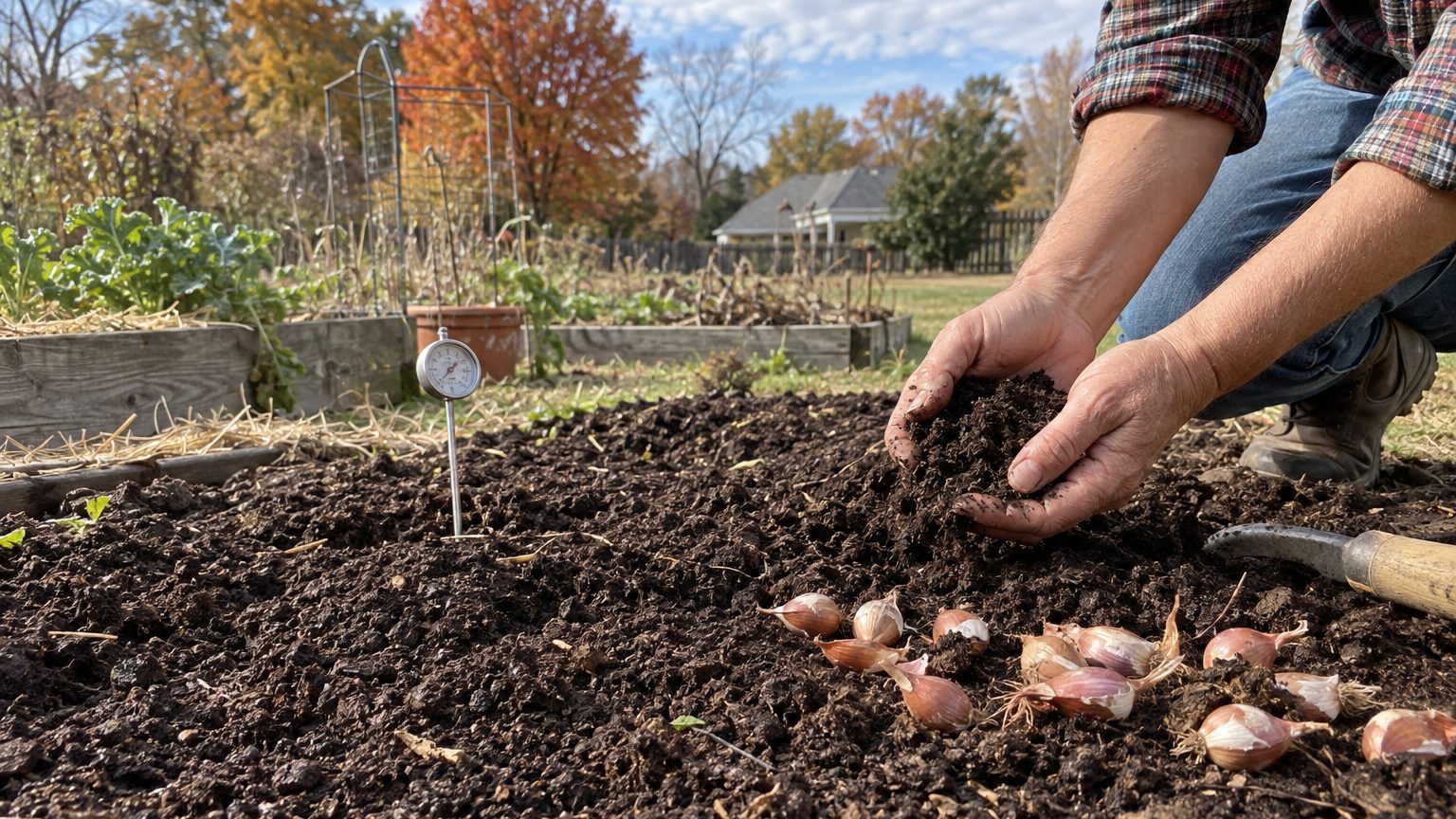

Most Illinois gardeners should plant shallots in early spring, as soon as the soil has thawed, drained and crumbles in the hand. For the Chicago reference station, that points to mid-to-late April, with suburban and rural beds often a week or two later. Southern Illinois gives autumn planting a better chance. Everything below explains how to place yourself between those two answers.
When the soil is warm enough in Illinois
Start with the number gardeners ask for. In NOAA’s 1991-2020 Climate Normals, the last spring freeze at the Chicago airport station falls between April 11 and April 22, a band that covers the 30% to 70% freeze probabilities at 32°F. That is a probability, not a promise, so a hard freeze after April 22 is possible in any given year.
Those dates are a proxy, though, and it helps to treat them that way. Shallots respond to the soil, not the air. Ground that has been frozen and saturated all winter lags well behind the thermometer, and it keeps warming after the frost risk ends, not at the same moment. A bed can be frost-free on paper and still be a cold, sodden mess two inches down. Tuck a bulb into that and it sits, stalls, or rots.
The practical test costs nothing. Dig a handful from planting depth and squeeze. If it holds as a slick, glossy ball, wait. If it crumbles when you poke it, the bed is ready. A soil thermometer gives you a number to track, but the crumble test catches the problem that matters most, which is waterlogging.
The airport figures describe the reference city, not every Illinois garden. Suburban and rural plots typically see the last spring frost later than the airport does, often by one to two weeks, and the same plots see the first fall frost earlier. Plan from the reference dates and then check your own county. University of Illinois Extension has county-level offices that know local conditions better than any statewide table.
Autumn planting and what differs for shallots
Shallots can go in during autumn, and that is where they share ground with garlic. This site’s garlic section covers fall planting, mulching, curing and allium rotation in detail, so there is no point repeating it here. The differences are specific to shallots. Each set multiplies into a cluster rather than a single bulb, and the sets are small, so a set pushed up out of the ground by winter heaving has little reserve to recover. The general method is laid out in Growing Shallots: One Bulb In, a Handful Out. Whether autumn is wise in Illinois depends on winter, which comes up again further down.
How long the season lasts here
Frost dates at both ends give you the window. NOAA’s normals put the first fall freeze at the same Chicago airport station between October 24 and November 3, using the same 30% to 70% probability band. Matching earliest to earliest, April 11 to October 24 is 196 days. Matching latest to latest, April 22 to November 3 is 195 days. Mixing the ends gives a shortest window of 185 days (April 22 to October 24) and a longest of 206 days (April 11 to November 3).
| Pairing of dates | Last spring freeze | First fall freeze | Frost-free days |
|---|---|---|---|
| Earliest dates | April 11 | October 24 | 196 |
| Latest dates | April 22 | November 3 | 195 |
| Shortest window | April 22 | October 24 | 185 |
| Longest window | April 11 | November 3 | 206 |
Now subtract again for your own yard. If your last spring frost runs one to two weeks later and your first fall frost one to two weeks earlier than the airport’s, the window can shrink by anywhere from two to four weeks. Even then it stays generous for a crop that wants a cool start.
The useful question is what that length allows. A window of roughly 185 to 206 days, trimmed a little for a suburban or rural bed, leaves room for two things that a shorter northern season would not. First, you can start shallots from seed indoors and transplant them in spring. That means accepting some root disturbance, but with this much calendar the check to growth is affordable. Where the season is short, the first sowing is the only one, and lifting seedlings often costs more than it returns.
Second, the window supports a second, staggered planting. Sets go in as soon as the soil allows, then a later round follows a few weeks on, which spreads out harvests of green shallots and keeps a few late bulbs growing for storage. The mechanics of spacing those plantings are in the succession sowing guide in this site’s garden section.
Gardeners farther north, around the Great Lakes, work with a tighter calendar. Growing Shallots in Michigan shows how the same crop gets squeezed there. In Illinois the squeeze is milder, and the real limit is not the length of the season but how the end of it is handled.
Heat and water in Illinois
This page does not carry a count of days above 90°F or a summer rainfall total for Illinois, and a guessed figure would mislead more than it helps. What it does carry is the winter side, and that is the side that decides between autumn and spring anyway.
At the Chicago reference station, the mean daily minimum of the coldest month is 18.8°F (NOAA 1991-2020 normals). That is an average of the nightly lows, not a record cold snap. The USDA Plant Hardiness Zone Map (2023 edition, built on the 1991-2020 normals) places Illinois across zones 5a to 7b. That is a wide spread, and USDA zones rest on one variable only, the average annual extreme minimum. A bed in the north and a bed in the far south are not in the same conversation.
Shallot bulbs are hardy enough to survive cold in the ground. Cold alone is rarely what takes them out. Water is. Where the ground freezes hard, thaws, and sits wet, sets planted in autumn tend to rot in the cold mud or heave out of it as the soil freezes and thaws. In that situation spring planting is the safer call, and it is the one I would steer most northern and central Illinois gardeners toward. Where winters are milder, autumn planting earns its reputation: roots establish before the freeze, growth starts early, and the bulbs come out larger and sooner than spring-planted ones.
Illinois sits on the line between those two winters, so the choice shifts with latitude and drainage. Heavy clay that holds water favors spring, even in a mild year. A raised bed or a sandy loam that drains in an hour raises the odds for autumn planting, especially with a mulch layer to buffer the freeze-thaw swings.
Summer brings a different risk from the one a dry-climate grower faces. Illinois summers are humid, and in a wet year the pressure shows up as foliar disease, downy mildew among the usual suspects, along with slow ripening and tops that refuse to fall over. Bulbs that ripen slowly in damp conditions cure badly. Pull them in dry weather, give them airflow while they cure, and rotate alliums so the same bed does not host them year after year. The garlic section of this site covers curing and rotation in detail, and the shallot version differs mainly in scale: clusters take longer to dry through than single bulbs.
The opposite problem is winter-wet rot in a mild, rainy climate. Growing Shallots in Oregon deals with a very different version of it.
Which shallots suit Illinois
Choose by type first. This page names no cultivars, and that is deliberate. Variety recommendations only mean something when they come from trials run in your own conditions, and a name pulled from memory or from another state can easily be wrong for Illinois. A gardener who plants the wrong one loses a season. University of Illinois Extension is the place to ask which varieties have been trialled locally, and your county office can tell you what has done well near you.
Reasoning from the facts above, three criteria matter most. The first is disease resistance, because Illinois summers are humid and a wet year turns foliar disease into the main threat to the crop. Ask your extension office which types hold up in those conditions.
The second is maturity. A suburban or rural garden may have two to four weeks less window than the airport figures suggest. Earlier-maturing types suit those shorter windows and finish before the late-season weather turns. Shallots grown from seed are an option here given the length of the season, but sets give a head start and are the safer bet for a first crop.
The third is how well the type copes with summer heat and humidity. Types that tolerate being spaced for airflow, and that benefit from a mulch to shade the roots and hold even moisture, fit Illinois summers better than ones that crowd and hold damp foliage. Give each cluster room, and keep mulch off the bulb shoulders as they swell.
The choice of planting season interacts with all three. Autumn planting suits milder, well-drained sites and rewards you with larger, earlier bulbs. Spring planting suits heavy, wet or northern ground and is the lower-risk path for a first year.
At harvest, inspect rather than assume. Cured shallots should have dry, tight necks and clean, firm bases. A soft neck or a moldy base ends the question: that bulb does not go into storage, and it should not be eaten on the hope that it looks fine. Looking sound is not proof of being sound, and no keeping time can be promised, so check stored bulbs regularly and cull anything that softens.
Common questions
Can I plant shallots in the fall in Illinois?
Yes, with conditions. Autumn planting works best in well-drained soil and milder parts of the state. Where the ground freezes hard and stays wet, sets can rot or heave, and spring is safer.
Should I wait until after the last frost to plant?
Not necessarily after the exact date. The deciding factor is workable, crumbly, thawed soil. The Chicago airport figures run from April 11 to April 22, but your own garden may be a week or two later, so check with your county office.
Is it worth starting shallots from seed and transplanting?
The Illinois window of roughly 185 to 206 days at the reference station can support it, though suburban and rural beds have less. Sets are easier for a first crop, and transplanting costs some root disturbance.
How do I know my cured shallots are safe to store?
Inspect them. Dry, tight necks and clean, firm bases are what you want. A soft neck or a moldy base means the bulb should not go in storage. No duration can be promised, so keep checking them while they are stored.
One more local detail: the 1991-2020 figures here come from a single airport station, and a county extension office can tell you how far your own frost dates drift from them.