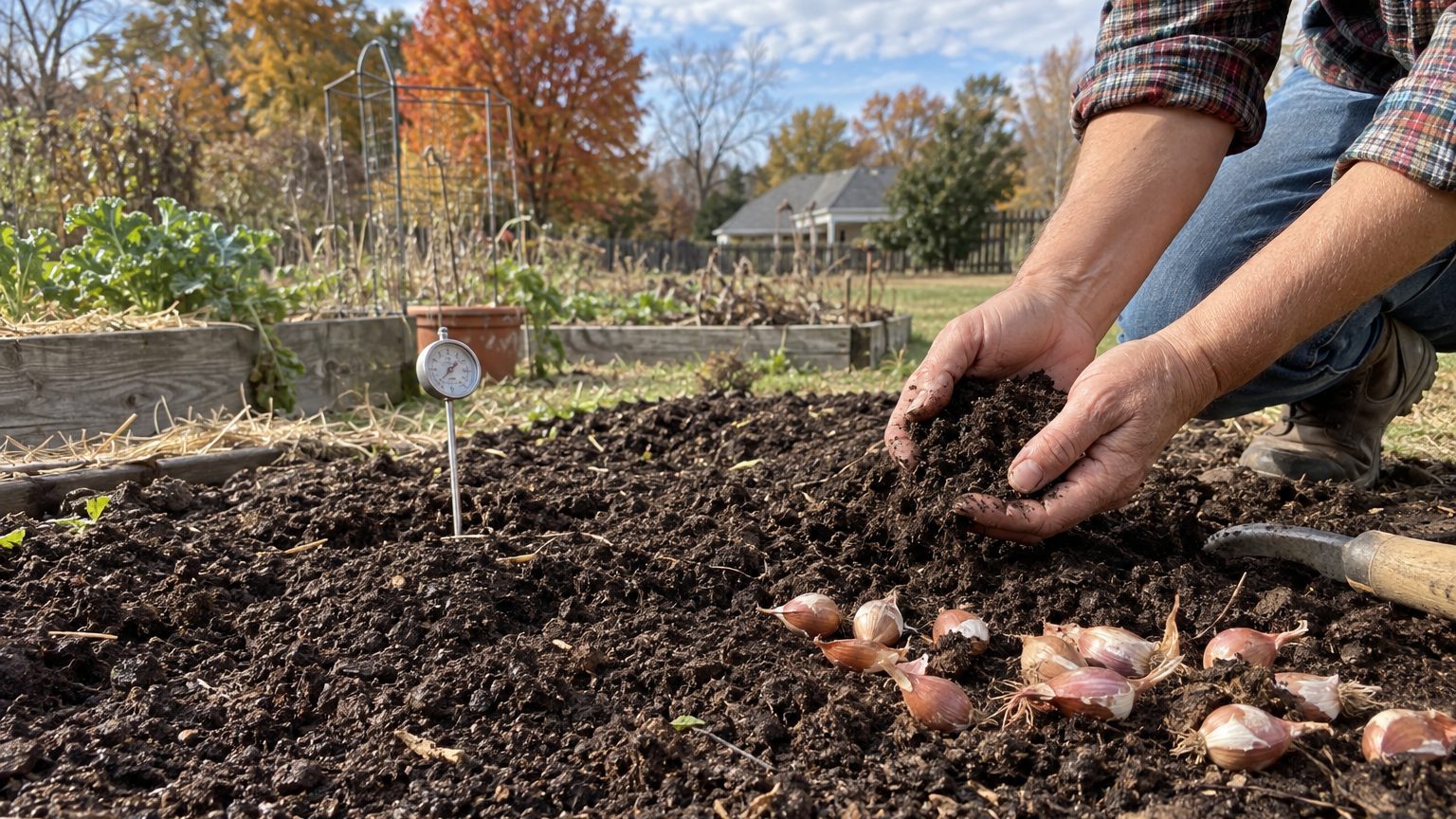

In Louisiana, shallots belong to the cool months, and frost is not what sets the calendar. In the south of the state, the last 32°F freeze typically falls between January 18 and February 8. The real deadline is summer heat, which stops bulb growth long before you’d like. Autumn planting is the natural fit, and a late-winter planting is the fallback. The LSU AgCenter holds the variety answers this page can’t.
When the soil is warm enough in Louisiana
What the frost dates say, and what they don’t
Start with the numbers. NOAA’s 1991-2020 Climate Normals, using the 30 to 70 percent band of 32°F freeze probabilities, put the last spring freeze in south Louisiana between January 18 and February 8. That is a probability band, not a promise. At the station behind these normals, a 32°F freeze happens in only 86.8 percent of years, which means roughly one year in seven has no freeze at all.
North Louisiana plays by different rules. It freezes far more reliably, so its dates sit later and its winters bite harder. The figures here describe the southern end of the state, and the farther north you garden, the more you should lean on local guidance.
Frost is a proxy. Shallots respond to soil, and soil warms after the frost risk ends, not at the same moment. In a northern garden that lag is the whole story: you wait for thawed, workable ground and plant sets in spring. In south Louisiana the lag matters less, because winter never locks the ground up. What you’re watching instead is soil that has cooled from summer in autumn, or soil that has drained after a wet winter spell in late winter.
Soil first, calendar second
The first fall freeze here arrives between December 17 and January 8, per the same NOAA normals. That window straddles the New Year, which tells you something odd about this state: the cool, usable planting season can run right through the point where a northern gardener would be putting tools away. Plant in autumn once the summer heat has broken and the soil has cooled, and let your parish’s extension office name the month.
Shallots share this rhythm with garlic. The garlic section of this site covers autumn planting, curing and allium rotation in depth, so I won’t repeat it. What differs for shallots is scale and depth. A shallot set is a small bulb, planted shallow with its tip at or just under the surface. Pushed deep into heavy, wet Louisiana clay, it sits cold and soggy and rots.
If you miss the autumn window, a late-winter planting after the freeze band still works. Just expect smaller bulbs, because the plant has less time before the heat arrives. For a broader look at the crop before you commit, the parent guide, Growing Shallots: One Bulb In, a Handful Out, covers how a single bulb multiplies into a cluster.
How long the season lasts here
Put the two NOAA dates side by side and the growing window is enormous.
| Marker | Date band (NOAA 1991-2020 Normals, 30-70% freeze probability) |
|---|---|
| Last spring freeze | January 18 to February 8 |
| First fall freeze | December 17 to January 8 |
Subtract one from the other, pairing the ends of each band, and the frost-free stretch runs from about 312 days to about 355 days. Pair the early dates together and you get 333 days. Pair the late ones and you get 334. That is somewhere between ten and nearly twelve months without a freeze, and in the one year in seven with no freeze, the window never closes.
A long window allows a second sowing. That is the textbook answer, and it holds here only in part. Frost isn’t the limit in Louisiana, so a second planting won’t be killed by cold. But every week you push planting later is a week taken from the cool season the crop actually wants. A late sowing doesn’t fail from freezing. It fails because the bulbs are still small when the heat arrives and growth slows down.
So the useful trick is staggering, not repeating. Plant a first round in autumn for full bulbs. Follow with a smaller second round in late winter that you pull early as green shallots, tops and all, rather than waiting on a cured bulb. The site’s succession sowing guide lays out spacing between rounds, and the logic transfers: you are trading bulb size for a longer harvest.
The long window also changes the transplant question. Where a short season forces you to start seed-grown shallots indoors and set them out as soon as possible, Louisiana leaves room to be choosy. If you do transplant, check the roots first. Seedlings that have wound into a tight mass in the cell set back after planting, and a set back in a state with a short cool season costs you the bulb. Compare that with a place where the clock really is tight, like the one described in Growing Shallots in Saskatchewan, where the first sowing is the only one.
Heat and water in Louisiana
Autumn versus spring, decided by the winter low
The coldest month at the New Orleans reference station has a mean daily minimum of 46.1°F (NOAA NCEI Climate Normals 1991-2020). That is the number that settles the autumn-versus-spring argument. Where the ground freezes hard and stays wet, autumn-planted sets rot or heave out of the soil, and spring is the safer call. At 46.1°F, south Louisiana doesn’t have that problem. Heaving from deep freeze-thaw cycles is a northern worry, and the larger, earlier bulbs that autumn planting is grown for are within reach.
The USDA Plant Hardiness Zone Map (2023, built on 1991-2020 normals) lists Louisiana as zone 8a to 10a. Two cautions go with that. The system rests on one variable, the average annual extreme minimum temperature, so it tells you whether a plant survives, not whether it will thrive in July. And a range that wide means the north of the state and the coast live in different climates. Use your own parish, not the range, when you plan dates.
The verified figures behind this page include no count of days above 90°F and no summer rainfall total, so I’m not going to put numbers on them. What any Louisiana gardener knows without a chart is that summer is hot, humid and wet. That combination is the real limit on shallots here. Heat ends bulb growth, and humidity invites foliar disease and rot at the base.
The practical response is drainage and airflow. Raised or well-mounded beds shed winter rain that would otherwise sit around the bulbs. Drip irrigation keeps foliage dry. Spacing that lets air move between clumps matters more in this state than in a dry one, and a thin mulch shades the root zone without smothering the neck.
Humidity at harvest and curing
Harvest is where Louisiana humidity does the most damage. Lift the bulbs once the tops fall over and yellow, and cure them somewhere dry, shaded and airy, because moist air slows drying and gives mold time. The garlic section of this site covers the mechanics of curing, which are nearly identical. For shallots, the clusters are smaller and dry faster, so watch them rather than trusting a schedule.
Curing and storage touch food safety, so be strict about inspection. Check that the neck is dry and tight, the skins are papery, and the base is clean and firm. A soft neck or a moldy base ends the question: that bulb does not go in storage. A bulb that looks fine from the outside is not proven sound, and no keeping time can be promised from a page like this one. Check stored bulbs every so often and pull any that soften.
Which shallots suit Louisiana
Choose by type, and let the state’s conditions do the sorting. Three facts on this page point in the same direction. The cool season is long but the heat after it is hard, the climate is humid, and winters are mild enough that autumn planting is realistic.
| Type | What Louisiana conditions favor | What to watch |
|---|---|---|
| Earlier-maturing types | They finish bulbing before peak heat, which is the main limit here | Smaller bulbs if planted late |
| Bulb-propagated multipliers (grown from sets) | Fit the autumn planting that suits the mild winter | Wet soil rots sets, so drainage comes first |
| Seed-grown types | Flexible timing in a long frost-free window | Seedlings need a root check at transplant |
| Disease-resistant types | Humidity makes this the first criterion | Resistance is not immunity, so airflow still counts |
In a hot, humid state, disease resistance goes at the top of the list, ahead of flavor or skin color. Next comes earliness, then a type that tolerates airflow and shade at the root rather than demanding open sun and bare soil.
Day length also matters. Onion-family bulbing responds to it, so a type bred for a northern summer can behave differently at Louisiana’s latitude. That is one more reason a catalog description written for a general audience isn’t enough.
This page names no cultivar, and that is deliberate. The varieties that perform in Louisiana are the ones trialled in Louisiana, and I don’t have those trial results. A variety name pulled from a national catalog or another state’s list is a guess, and gardeners spot a bad guess quickly. The LSU AgCenter is the source to ask. Its parish offices and publications reflect what actually grows in your soil, with your disease pressure and your heat. Ask which shallot types it has trialled, and whether it advises sets or seed for your part of the state.
For comparison, Growing Shallots in Texas works through a neighboring state’s heat and its own planting choices. A Texas recommendation won’t map cleanly onto Louisiana, though, because the humidity here shifts the disease picture.
Common questions
Can I plant shallots in spring in Louisiana?
Yes, after the last freeze band of January 18 to February 8 in the south of the state, once the soil has drained and is workable. The trade-off is time. A spring planting reaches the heat with less growth behind it, so expect smaller bulbs than an autumn planting would give. North Louisiana’s later and harder freezes push those dates back.
What if my area has no freeze one winter?
It happens in roughly one year in seven at the NOAA station behind these figures. Shallots don’t need a frost to be planted, so an unfrozen winter is no reason to hold back. The frost dates are just a calendar anchor, and the cool season, not the freeze, is what the crop works with.
Should I trust a Texas or national planting calendar?
Use them for the general logic, not the dates. The frost data and the humidity differ, and the NOAA figures in this article are specific to south Louisiana. Your parish extension office can translate the timing for where you actually garden.
How do I know shallots are safe to store?
Inspect each bulb. The neck should be dry and tight, the skins papery, and the base clean. A soft neck or a moldy base ends the question, and that bulb should not be stored or eaten. Looking sound isn’t proof of being sound, so keep checking stored bulbs and remove any that soften.