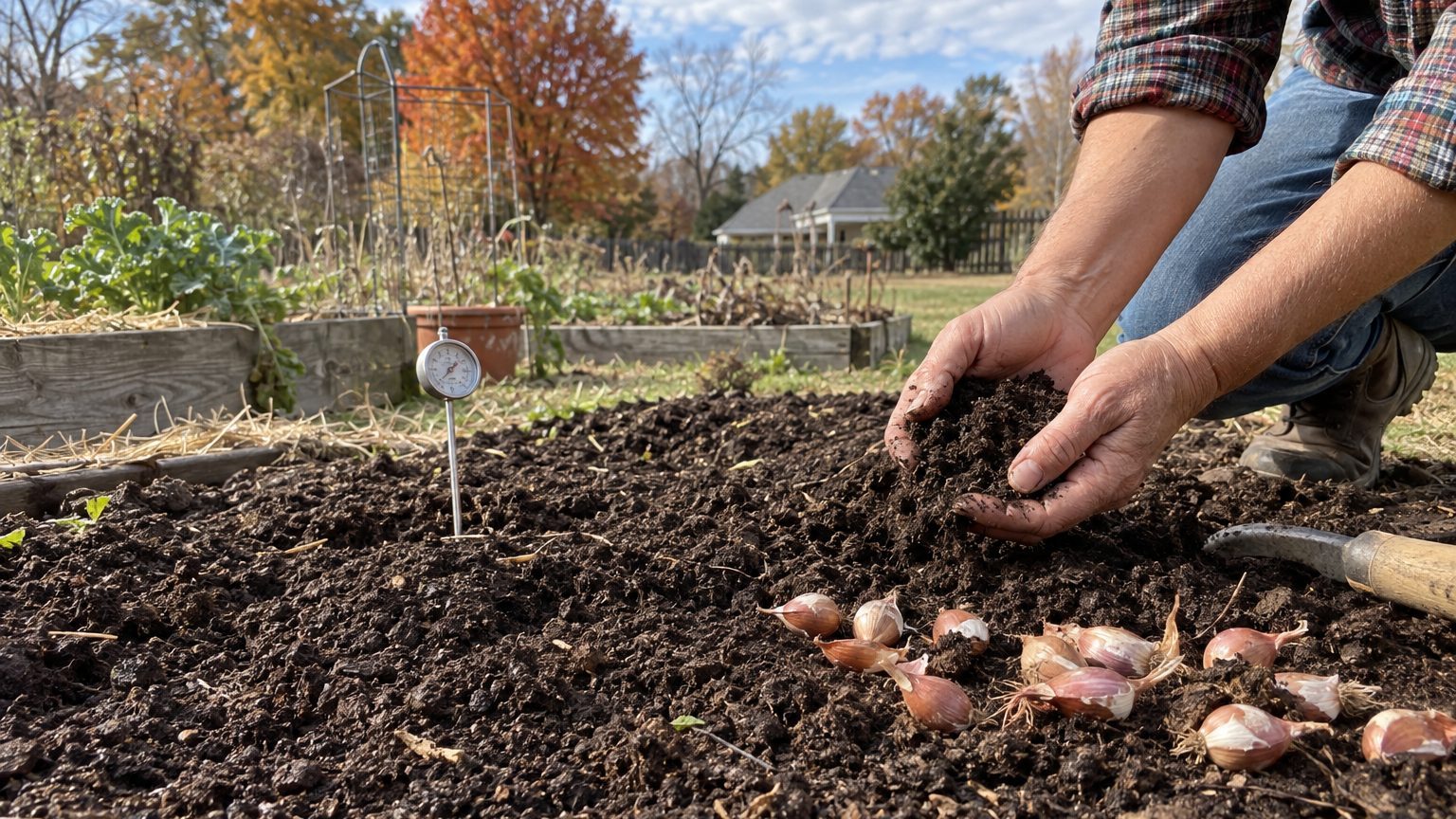

Growing shallots in Maine works best as a spring crop for most gardeners. Plant sets once the soil drains and crumbles, which in Portland follows a last freeze somewhere between April 22 and May 1. Autumn planting is a gamble the winter can lose. The window is long enough for one good crop, and the real risks are a cold, wet winter and a damp summer. For the basics, see Growing Shallots: One Bulb In, a Handful Out.
When the soil is warm enough in Maine
Start with the number most gardeners ask about. At Portland, NOAA’s 1991-2020 Climate Normals put the last spring 32F freeze between April 22 and May 1 (that is the 30-70% probability band from the NOAA NCEI station data). It is a probability, not a promise, so some springs will break it in either direction.
Portland is also the mild end of Maine. Inland and northern parts of the state run substantially later in spring and earlier in fall, so a garden in the western foothills or Aroostook County should push every date in this article later. Your own last-frost experience beats any table.
The frost date is a proxy, and an imperfect one. Shallots care about the soil, not the air. Soil warms after the frost risk ends, not along with it, because a spring soil in Maine holds snowmelt and cold well into the weeks after the last freeze. A bed can be frost-free and still be a cold, saturated sponge.
So the practical test is physical. Dig a handful from planting depth and squeeze it. If it crumbles, the bed is ready. If it smears into a slick ball or water beads out, wait. Sets pushed into cold, soggy ground sit idle and invite rot, and they gain nothing over sets planted a week later into friable soil. A few extra days of patience usually cost nothing, because shallots catch up quickly once roots get going.
Raised beds help here. They drain and warm sooner than flat ground, which matters in Maine’s heavier, wetter soils. Drainage, more than the calendar, decides whether early planting pays off.
Planting depth and spacing follow the general rules on the main shallot guide. If you plan to plant in autumn instead, the choice is a winter question, covered in the heat-and-water section below. Shallots share autumn planting, curing, storage and allium rotation with garlic, and the garlic guides on this site cover those practices in depth. What differs for shallots is that each set multiplies into a cluster of bulbs, so you are managing a handful of bulbs per planting spot rather than one. That makes airflow and spacing matter a little more.
If you want to see how the same crop shifts in another cold-winter state, Growing Shallots in South Dakota makes a useful comparison.
How long the season lasts here
Both frost dates are on record for Portland, so the subtraction is honest. The first fall freeze there falls between October 9 and October 21 (same NOAA 1991-2020 normals, same 30-70% band). Set that against the spring band of April 22 to May 1 and the frost-free stretch runs from as few as 161 days (May 1 to October 9) to as many as 182 days (April 22 to October 21). That is roughly 23 to 26 weeks.
Treat that as the generous end of the state. Inland and northern Maine lose weeks at both ends, so a gardener there is working with a noticeably shorter window than Portland’s.
What does 161 to 182 days allow? A single, well-timed planting of shallots, comfortably. Shallots are a one-crop-per-bed plant in a northern garden, because the tops need time to grow, yellow, fall over and dry down before cool, wet autumn weather sets in. The frost-free window is not really the limit. Harvest and curing need dry weather, and September rain in Maine can arrive early.
A second sowing is a different matter. A later planting two or three weeks after the first can stagger harvests and spread the workload, and in a Portland-type season it may be worth trying with a small block. In a shorter inland season, the first sowing is the only one that has the time to size up, and a late sowing mostly yields small bulbs that cure poorly. The site’s succession sowing guide lays out the spacing between sowings and how to read the calendar.
The same arithmetic shapes the transplant decision. Starting shallots from seed indoors and transplanting out, or starting sets in cells, buys a head start, but it costs a root check. Transplants that are potbound or tangled set back at planting, and in a long window the lost days do not matter much. In a short window, they do. If your season is short, direct-set bulbs are the lower-risk path, and transplanting is worth the root check only when you can keep seedlings from becoming rootbound before they go out.
Heat and water in Maine
This page does not carry a verified count of days above 90 F or a summer rainfall total for Maine, so it will not guess at them. What it does have is the geography: a northern state on cool Atlantic air, where intense summer heat is not the usual worry. The weather problem is the opposite one. Cool, damp summers keep foliage wet, slow ripening, and favor mildew and the neck rot that follows. Anyone growing alliums in Maine should plan around fungal disease before planning around drought.
The practical response is simple. Space bulbs so air moves between the clusters. Water at the soil, not over the leaves, and only when the top inch or two has dried. Pull weeds before they trap humidity at the base. Stop watering as the tops begin to yellow so the bulbs can finish and dry. A dry stretch in late summer is what you want at harvest, and you can sometimes lift bulbs and finish them under cover if rain is forecast.
Autumn against spring
The deeper question is when to plant, and winter decides it. At the Portland reference station, the mean daily minimum of the coldest month is 15.6 F (NOAA NCEI Climate Normals, 1991-2020). That is the mild coast. The USDA Plant Hardiness Zone Map (2023, built on 1991-2020 normals) spans zones 3b to 6a across the state, so inland winters are far colder than Portland’s.
Where the ground freezes hard and stays wet, autumn-planted sets can rot in cold, saturated soil, or heave out of the ground in repeated freeze-thaw cycles. Spring planting avoids both. In a milder winter, autumn planting gives larger, earlier bulbs, which is why people grow them that way. That is the Portland-coast end of the state, and even there a thick mulch layer is part of the bargain. Further inland, and certainly in the north, spring is the safer call.
For a contrast with a state where heat is the real concern, Growing Shallots in South Carolina shows how the same crop is managed when summers, not winters, set the rules.
Which shallots suit Maine
The right choice in Maine comes down to types, and the reasoning follows the numbers above. A season that tops out near 161 to 182 days at the mild coast, and shorter inland, favors earlier-maturing types over slow, late ones. A cool, damp summer makes disease resistance the first thing to ask about, ahead of size or color. Heat tolerance, which matters in the South, barely enters the conversation here.
Within those priorities, a few choices matter. Sets (small bulbs) get a fast start in a short season, and shallots grown from seed are a different, slower route that can pay off in storage quality but need more time. Round and torpedo-shaped types behave a bit differently, and a firm, tightly wrapped neck matters more than shape. Whatever the type, buy planting stock from a supplier of seed-grade alliums. Grocery-store shallots may carry disease or sprout inhibitors and are a poor bet in a damp climate.
This page names no varieties, and that is deliberate. A variety name is only worth passing on if someone trialled it in conditions like yours, and this page does not have those trial results. Maine alone runs from a mild coast to zone 3b interior, so a variety that does well in Portland may sulk in the north. The University of Maine Extension is the place to ask which varieties have been trialled in your county, and whether your soil needs testing first. That answer will beat any list a website can print.
At harvest and in storage, inspect rather than assume. Handle each bulb: the neck should be dry and tight, the skin papery, the base clean. A soft neck or a moldy base ends the question, and that bulb should not go into storage or onto your plate. A bulb that looks fine can still be compromised, so do not store on appearances alone, and do not rely on any fixed keeping time. Curing shallots follows the same principles as garlic, which the garlic guides here cover, and allium rotation applies too: keep onions, garlic and shallots out of the same bed in consecutive years.
Common questions
When should I plant shallots in Maine?
In spring, once the soil crumbles in your hand and is no longer waterlogged. At Portland, the last 32F freeze falls between April 22 and May 1 (NOAA 1991-2020 normals), but inland and northern Maine are later, and the soil test matters more than the date.
Can I plant shallots in fall in Maine?
It is possible on the milder coast with heavy mulch, and it can give larger, earlier bulbs. It is riskier inland, where hard, wet freezes can rot or heave autumn-planted sets. If you try it, start with a small test block.
How long is the growing season?
At Portland, the span between the spring and fall freeze bands runs from 161 to 182 days. That is the mild end of the state, and the window shortens inland and to the north.
Which shallot variety should I grow in Maine?
Ask the University of Maine Extension which varieties have been trialled near you. As a rule, favor earlier-maturing and disease-resistant types, because a short, damp season punishes late-maturing, mildew-prone ones.