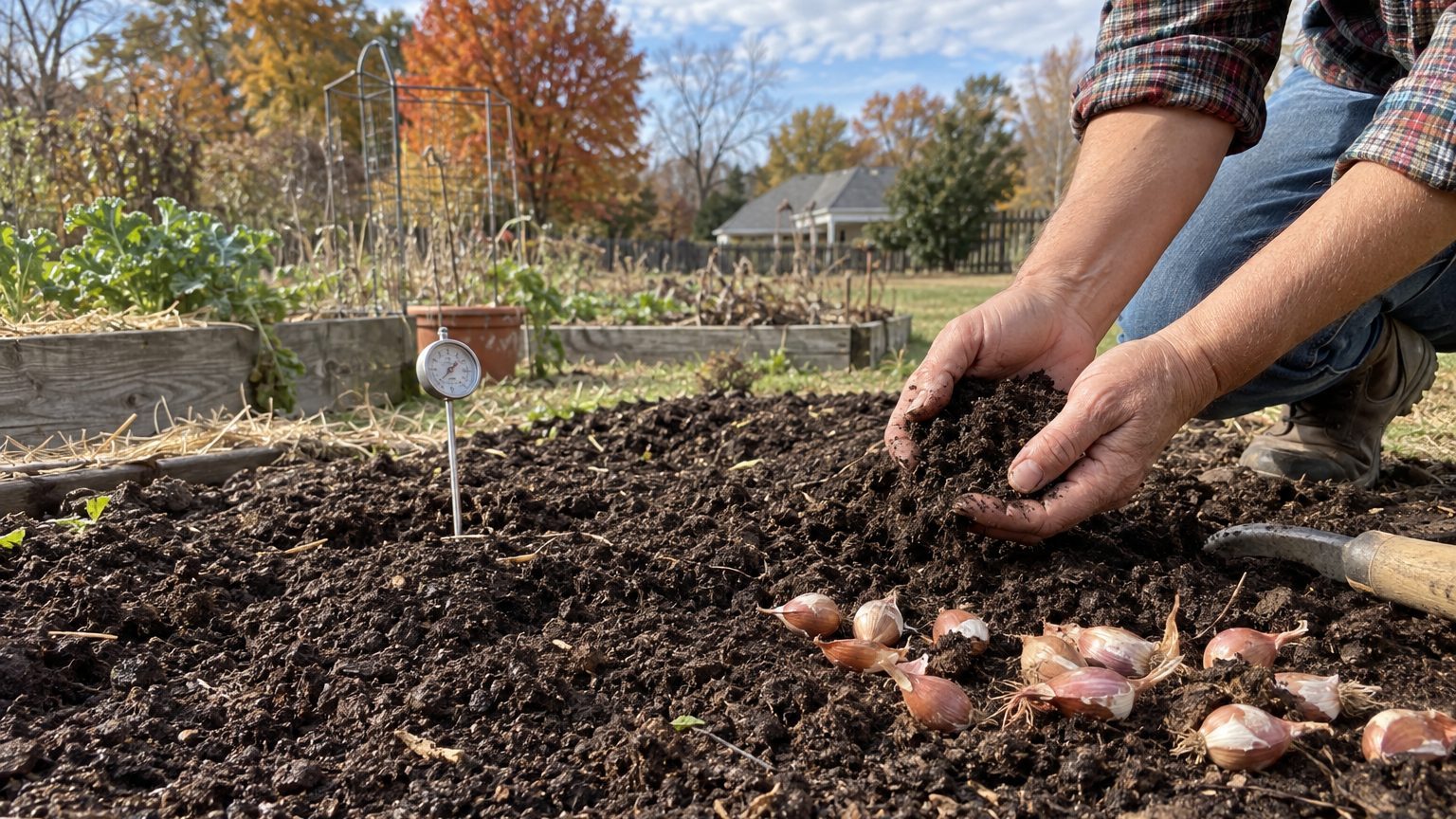

In Massachusetts, shallots go into the ground in early spring as soon as the soil can be worked, or in autumn where winters are mild enough to carry them. Boston Logan’s last spring frost falls between April 1 and April 8, but that date only starts the conversation. Most of the state sits inland, higher, and colder than that waterfront station, and that changes the plan.
When the soil is warm enough in Massachusetts
The reference point is April 1 to April 8, the last spring 32°F freeze in the NOAA NCEI 1991-2020 Climate Normals for Boston Logan, taken from the 30-70% probability band. A frost date is a probability, not a promise, so a hard freeze after that window is possible in any given year. Logan is also a waterfront urban station and the mildest spot in the state. Inland suburbs and the Berkshires see their last freeze noticeably later in spring.
Frost is a proxy, and an imperfect one. Shallots wait for warm soil, and soil warms after the frost risk ends, not with it. Cold, saturated ground in early April can hold a bulb in place for weeks without growth, and a set pushed into mud may simply sit there and rot. What you want is soil that has drained, crumbles in your hand instead of smearing, and no longer feels like a refrigerator shelf when you push your fingers in. A cheap soil thermometer takes the guesswork out of that judgment, though the crumble test costs nothing.
Reading the spring in your own yard
South-facing beds and raised beds drain and warm sooner than low, shaded ground. Two yards a few miles apart can be ten days or more apart on workable soil. Watch where snow melts first, where puddles linger after a rain, and where last year’s weeds greened up earliest. Those patches are your early bed.
Early planting in the mild stretch around Boston and the coast is often worth it, because shallots tolerate cool weather and use it to build roots and foliage before summer. Inland, lean later and let the ground tell you. A week of patience costs less than replanting rotted sets.
Autumn planting and the garlic overlap
Autumn planting works much like garlic: the bulb roots in cool soil, sits through winter, and takes off early in spring. This site covers that routine in its garlic section, including mulching, timing, and allium rotation, so there is no point repeating it here. What differs for shallots is that the planted bulbs are smaller and shallower-set, which leaves them less cushion against frost heave. Rotation is the same rule applied to a wider family: keep shallots out of any bed that held onions, garlic, or leeks recently. For the full crop overview, start with Growing Shallots: One Bulb In, a Handful Out.
How long the season lasts here
The same Logan normals give a first fall freeze between November 3 and November 14. Count from the latest spring date to the earliest fall one and you get 209 days. Count from the earliest spring date to the latest fall one and you get 227. So the frost-free window at Boston Logan runs from roughly 209 to 227 days. That is a generous stretch for a northern state, and it reflects the harbor’s influence more than the state as a whole.
Inland, the number shrinks. Logan’s own caution applies: inland suburbs and the Berkshires frost earlier in fall and later in spring, so a gardener in the hills may be working with a window noticeably shorter than that. This page has no verified frost dates for those places, and a guessed subtraction would be worse than none. Your local extension office or a nearby weather station can fill that gap.
What does the window allow? A long one allows a second sowing. Near the coast, a staggered planting two or three weeks after the first gives you a rolling harvest of tender green shallots through the season, rather than one pile of bulbs in July. The succession sowing guide on this site walks through the spacing and how to judge each interval. A second planting meant for full bulbs is a different bet. It needs enough season left to size up and cure, and the shorter your window, the less likely that works.
A shorter window also changes the transplanting question. Starting seed-grown shallots indoors and moving them out buys a head start, but every transplant takes a root check: the plant sulks for a bit while new roots catch up to the disturbance. In a 227-day window you can absorb that setback. In an inland garden with weeks fewer, the check can eat the advantage you started early to get. Direct-sowing or planting sets, with no root disturbance, is the simpler call there, and the first planting becomes your only planting.
Gardeners comparing northern states may find it useful to read Growing Shallots in Michigan, where the cold and the calendar push in a similar direction.
Heat and water in Massachusetts
This page does not carry a verified count of days above 90°F or a summer rainfall total for the state, so it will not quote one. What can be said honestly is the character of the climate: Massachusetts is a northern, humid state, and its summers are not the dry furnace that defines shallot-growing in the Southwest. A few hot spells will come, and shallots can bolt or stall in them, but heat is rarely the main limit here. For comparison, Growing Shallots in Texas is written around heat in a way this page is not.
Where summers run cool and damp, the trouble is different. Wet foliage invites mildew and other fungal disease. Ripening slows, and bulbs that never fully dry down in the field can store poorly. A wet June followed by a muggy July is harder on shallots in this state than a hot August. The practical answers are plain: wide spacing, a bed with good drainage, weeding that keeps air moving, and watering at the soil rather than overhead.
The winter low decides autumn versus spring
The number that matters most is the cold. The mean daily minimum of the coldest month at Boston is 23.1°F (NOAA NCEI Climate Normals 1991-2020), and the USDA Plant Hardiness Zone Map 2023 places the state anywhere from 5a to 7b. That is a range, and Boston is one of its milder points. Zone 5a hills and the Berkshires sit well below it.
Where the ground freezes hard and stays wet, autumn-planted sets rot or heave. Repeated freezing and thawing pushes small bulbs up toward the surface, where the roots tear and the tops die. A milder winter gives the larger, earlier bulbs that autumn planting is grown for. So the choice splits roughly along those lines:
| Setting | Safer call | Main risk if you choose the other |
|---|---|---|
| Coastal and Boston-area beds with good drainage | Autumn planting is reasonable, with mulch | Spring planting works but forgoes the early, larger bulbs |
| Inland suburbs, hills, the Berkshires | Spring planting | Autumn sets may rot or heave in wet, hard-freezing ground |
| Heavy, slow-draining soil anywhere | Spring planting, or raised beds | Standing water around dormant bulbs |
When in doubt, split the difference: put a small test row in this fall and the main planting in spring. One winter will tell you more about your yard than any table.
Which shallots suit Massachusetts
No variety names appear on this page, and that is deliberate. A shallot that thrives in one county of this state can sulk in the next, and the only recommendation worth following is one backed by local trials. This page has no trial data, so naming a cultivar would be guessing dressed up as advice. For what has actually been grown and tested here, ask UMass Amherst Extension. Its recommendations come from Massachusetts soil and Massachusetts weather.
What this territory’s facts do support is a choice by type. A shorter inland season favors the earliest-maturing types, since they have the best chance of sizing up and drying down before fall rain returns. A humid, disease-prone summer makes disease resistance the first criterion, ahead of flavor or bulb shape. Types with upright foliage and a open habit dry faster after a rain, which matters more here than tolerance for heat. Seed-grown types, started from seed instead of last year’s bulbs, avoid carrying disease over from a previous crop. Set-grown types are quicker and more forgiving for beginners. Neither is universally better; it depends on your window and your damp.
Whichever you choose, the end of the season needs care. Cure the harvested bulbs somewhere dry and airy, out of direct rain, until the necks are fully dry and the outer skins rustle. Before storing, inspect each bulb. A soft neck or a moldy base ends the question: that bulb comes out of the batch, and a bulb that looks sound is not proof that it is. Check stored shallots regularly and pull anything that softens or sprouts. This site’s garlic pages cover curing and storage in more detail, and the same inspection habits apply here.
Common questions
Can I plant shallots in Massachusetts in fall?
Yes, in milder, well-drained spots near the coast and the Boston area, usually with a protective mulch. Inland and in the Berkshires, hard freezes and wet ground make spring planting the safer choice, because autumn sets may rot or heave.
Is April 1 a safe planting date?
April 1 to April 8 is the last spring freeze range at Boston Logan, the mildest station in the state. Inland gardens run later, and soil temperature and drainage matter more than the calendar. Plant when the soil crumbles and has drained.
How long is the growing season in Massachusetts?
At Boston Logan, counting the NOAA freeze dates gives roughly 209 to 227 days between the last spring and first fall freeze. Inland and hill-country gardens have noticeably less, and no verified figure is given here for them.
Which shallot variety should I buy?
Choose by type, not name: early maturing for short inland seasons, disease resistant for humid summers. For specific varieties trialled in the state, check with UMass Amherst Extension.