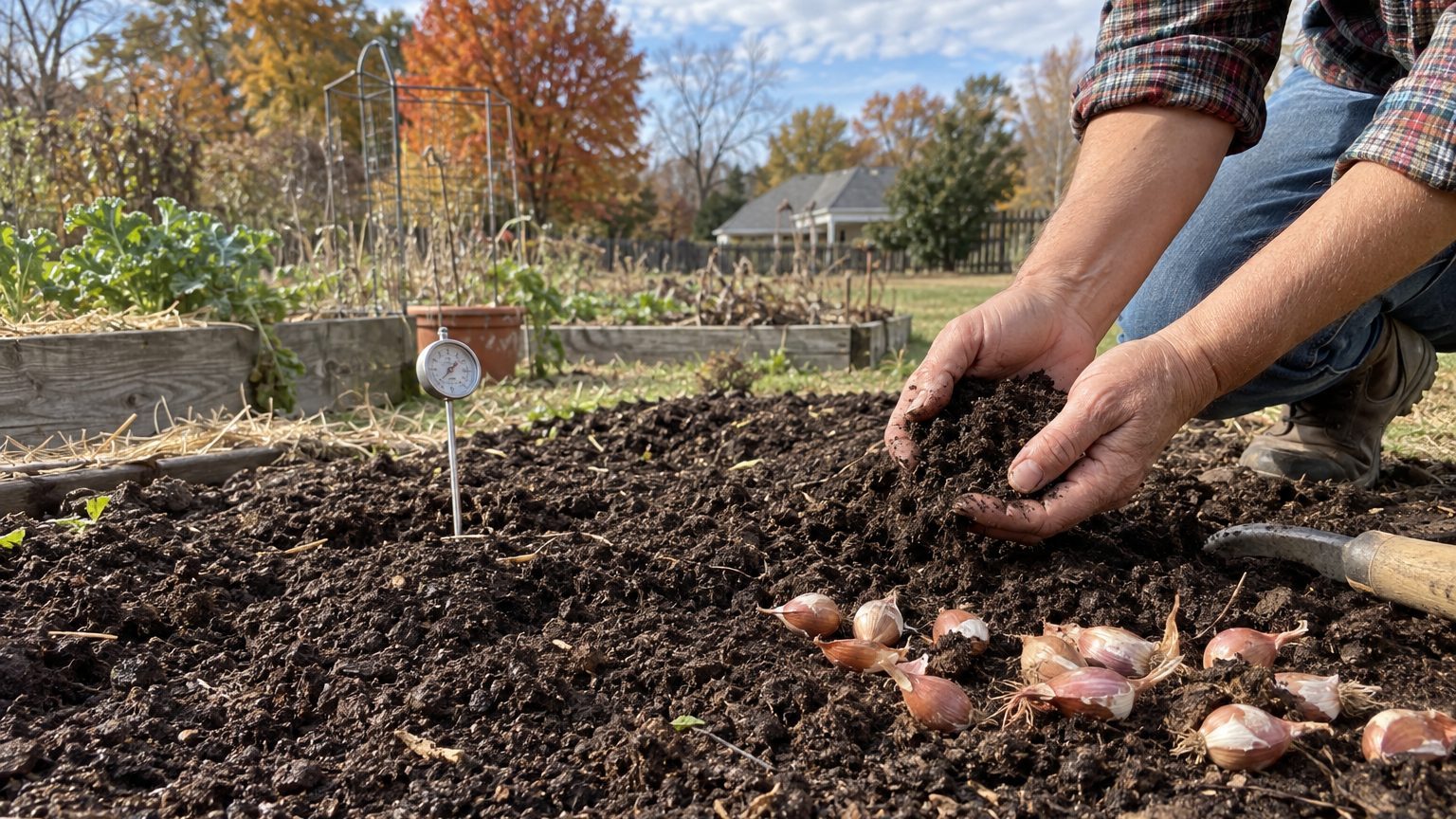

In Wyoming, plant shallots in spring, once the soil can be worked and has shaken off its winter chill. That usually means mid-May or later. Autumn planting is a gamble where winter lows run hard. The growing window is short, so choose early types and plan to cure the bulbs before a killing freeze.
When the soil is warm enough in Wyoming
The date most gardeners want is the last spring frost. For the station identified as USW00024018 in the NOAA NCEI 1991-2020 Climate Normals, the 32°F freeze probabilities (30-70% band) put it at May 7 to May 18. That is a probability band, not a promise. Some years the last freeze comes earlier, some years later, and nothing on the calendar will stop it.
A frost date is also only a proxy. Shallots don’t care about frost so much as they care about the soil. Sets pushed into cold, saturated ground sit there, stall, and sometimes rot, while sets planted into soil that has warmed begin rooting within days. Soil lags the air. It warms after the frost risk ends, not with it, and a bed that has lost its snow cover can still be cold a hand’s width down. A cheap soil thermometer pushed in to planting depth, read in the morning, tells you more than the date does. For the exact soil temperature threshold, ask your extension office rather than trusting a number from a gardening forum.
Elevation scrambles all of this. The frost-free season at roughly 6,000 feet comes to about 130 days, and at higher elevations frost can arrive in any month. A garden in a lower, warmer valley may be planting weeks ahead of one in the mountains, even inside the same county. So treat the May 7 to May 18 band as one reference point, not a statewide rule, and shift it according to your own elevation and your own spring.
What to do with the waiting weeks
Use them. Work the bed once the soil crumbles instead of smearing, mix in compost, and pull weeds while they are small. Shallots are shallow-rooted and lose badly to competition. If late freezes are common where you garden, cover young shoots with floating row cover. In Wyoming, season extension is a standing habit, not an emergency measure.
Shallots share a lot with garlic: the autumn-versus-spring decision, curing, storage, and allium rotation. Shallots multiply from a single set into a cluster, they are shallower rooted, and they mature on a different clock. Whatever you plant, keep alliums out of the same bed for a few years running to hold down soil disease.
For the general method, start with Growing Shallots: One Bulb In, a Handful Out. For a neighboring state with a different climate, Growing Shallots in Nebraska shows how the same crop plays out with a different frost calendar.
How long the season lasts here
Both frost dates come from the same NOAA station and the same 30-70% band. The first fall frost falls between September 24 and October 5. Subtract, and the window depends on how you pair the dates.
| Pairing | Frost-free days |
|---|---|
| Last spring frost May 18 to first fall frost September 24 | 129 |
| May 7 to September 24, or May 18 to October 5 | 140 |
| May 7 to October 5 | 151 |
So the window runs from about 129 to 151 days in a normal year, which squares with the roughly 130 frost-free days recorded at 6,000 feet. Plenty of years will fall outside that range on either side.
What does that length allow? Not much slack. A bulb crop needs the bulk of the season to size up and then a dry stretch to finish and cure. Nothing in a window this short leaves room for a second sowing of bulb shallots, so the first planting is the only one. If you do want a second round of anything, grow shallots from seed for green tops, and plan that sowing with the succession sowing guide on this site, which handles the spacing of repeat plantings.
Transplanting is where the short window changes the math. Starting sets or seedlings indoors and moving them out buys a head start, but every transplant means disturbed roots and a pause while the plant recovers. In a long season that pause is invisible. Here, with only 129 to 151 days to work with, it can cost you the size you were after. Check the roots at planting: white, firm, and actively growing means go, and brown or mushy roots mean toss it. Setting out sets directly, rather than potted transplants, avoids much of that stall.
The back end matters as much as the front. Bulbs need to reach maturity, tops falling over and yellowing, before a hard freeze in late September or early October. Then they need curing in a dry, airy, shaded spot. Inspect every bulb before it goes into storage. A soft neck or a moldy base ends the question for that bulb, no matter how good the rest of it looks. Do not put it up with the sound ones, and do not trust a bulb simply because the outside papery skin looks fine.
Heat and water in Wyoming
What is verified points in another direction: a high, cold state. The mean daily minimum of the coldest month at the Cheyenne reference station is 18.1°F, and the USDA Plant Hardiness Zone Map (2023, built on 1991-2020 normals) spans zones 3a to 6a across the territory. That is a very wide range, and it means the answer changes from valley to valley.
The coldest-month figure is a mean of the nightly lows, not the record low, and the hardiness zone rests on the average annual extreme minimum. Either way, the message is the same. Winter, not summer heat, is the deciding factor in Wyoming, and it decides the question of autumn against spring.
Where the ground freezes hard and stays wet, autumn-planted sets are at risk. Repeated freezing and thawing heaves shallow bulbs up out of the soil, and a wet, cold bed invites rot before roots take hold. Spring is the safer call in most of the state, especially in the colder zones. A milder, better-drained site, such as a lower valley bed with a south exposure, may give the larger, earlier bulbs that autumn planting is grown for. If you try it, plant in a trial row, mulch after the ground freezes, and keep your spring planting as insurance. The details of autumn planting are shared with garlic, so the garlic section here covers the timing and mulching.
In a cool, damp summer, the usual troubles are mildew, slow ripening, and rot in the necks. In a warm, dry one, the bulbs simply want steady water until the tops begin to fall, and then they want it withheld. Match that to your own site: give plants even moisture while bulbs are sizing, water at the soil rather than over the leaves, and stop irrigating as maturity approaches so the necks dry down. For a state with far more humidity to deal with, Growing Shallots in Connecticut shows the contrast.
Which shallots suit Wyoming
Choose by type, not by name. A short season of roughly 129 to 151 frost-free days favors the earliest-maturing shallots, the types that finish bulbing quickly and dry down before the late-September freeze. Later, slower types may keep growing right into the first frost and never cure properly.
Beyond earliness, two traits matter. Cold tolerance is the first, because the winter low of 18.1°F at Cheyenne and the zone 3a to 6a range mean that a type bred for mild coasts can fail here. The second is sturdy, well-ventilated growth: a plant with upright foliage and an open habit dries faster after rain and sheds disease better in a damp spell. If you get a cool, wet summer, disease resistance becomes the first thing to look for, ahead of size or flavor.
Whether to plant sets or seed also counts. Sets, the small bulbs, are the faster route and usually the right call for a short season. Seed-grown shallots can work, but they spend the first weeks just getting established, which uses up some of that precious window.
A cultivar that thrives at one elevation can fail 1,500 feet higher. The varieties tested in your own conditions are the only ones worth buying, and those results live with University of Wyoming Extension. Ask your county office what has been grown nearby, at your elevation, and who sells it locally.
Common questions
Can I plant shallots in the fall in Wyoming?
You can try, but spring is the safer choice. Hard winter freezes and wet ground can heave or rot autumn-planted sets. If you experiment, use a small test row, a well-drained spot, and mulch after the ground freezes.
Is May 7 safe for planting?
May 7 is the early end of the last spring frost band, not a guarantee. The soil also needs to be workable and not waterlogged. Be ready to cover young shoots if a freeze returns.
How do I know a cured shallot is safe to store?
Check the neck and the base. A soft neck or a moldy base disqualifies the bulb. Keep only bulbs that are firm, dry, and clean, and look them over again as the weeks go by.
Do I need season extension?
Yes, in most of the state. With roughly 130 frost-free days at 6,000 feet and frost possible in any month at higher elevations, row cover is the normal tool for guarding both ends of the season.