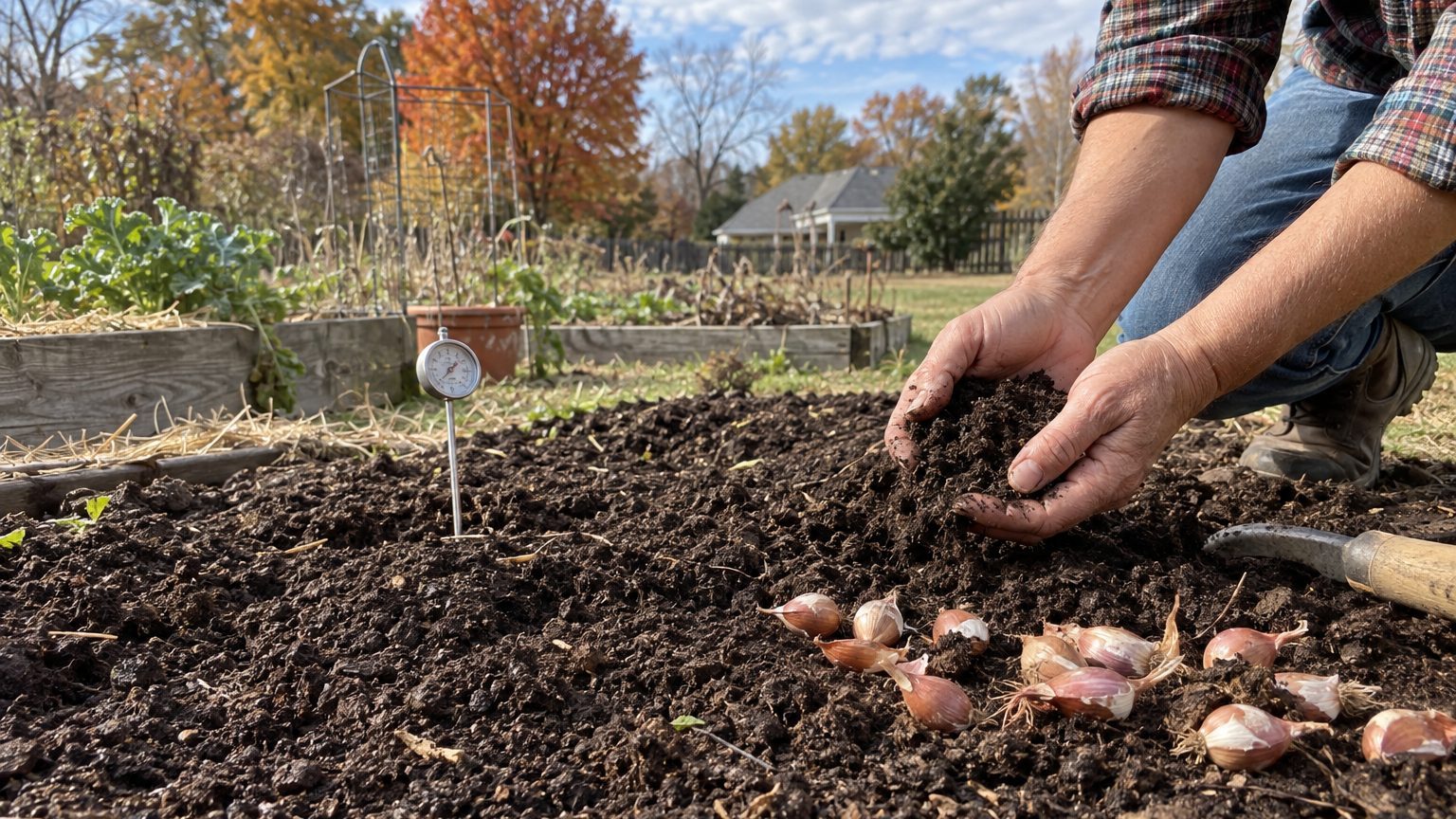

Most Nebraska gardeners should plant shallots in spring, once the soil can be worked and has stopped smearing like cold clay. Autumn planting works only in a good year and a well-drained bed. The reference city, Omaha, sees a mean January-type low of 15.2 F in its coldest month, and the USDA zone runs from 4a to 5b. That is cold enough to rot or heave a bulb that went in too early.
When the soil is warm enough in Nebraska
The date most people want is the last spring frost. At the Omaha reference station, NOAA’s U.S. Climate Normals for 1991-2020 put it between April 12 and April 23. That is the span where the odds of another 32 F freeze sit in the 30 to 70 percent band. It is a probability, not a promise, and a late freeze in the last days of April would not break any rule.
Those figures describe an airport weather station, not your yard. Suburban and rural gardens usually see the last spring frost one to two weeks later, and more than that at elevation. Check your own county’s records before you circle a date on the calendar.
Frost is a proxy, soil is the test
A frost date is only a stand-in. Shallots care about the soil, and soil warms after the frost risk ends, not at the same moment. A bed can be frost-free on paper and still be cold, saturated and slow. Sets pushed into that kind of ground sit idle, and idle bulbs in wet soil are the ones that rot.
The practical check needs no number. Take a handful from planting depth and squeeze it. If it crumbles when you poke it, the bed is ready. If it holds a slick, glossy lump, wait a few days. A rooted shallot handles a late light freeze better than most garden vegetables, so the goal is simply to get roots going in workable soil rather than to hit a perfect date. The general guide, Growing Shallots: One Bulb In, a Handful Out, covers spacing and planting depth.
What to buy and what to skip
Talk in types here, not brand names. Bulb-propagated shallots (sold as sets) are the simpler route, because each planted bulb multiplies into a cluster. Seed-grown types exist too, but they lean harder on the length of the season. The varieties that have been trialled in Nebraska soils are listed by Nebraska Extension at the University of Nebraska–Lincoln, and that list beats any variety name this page could offer.
Shallots share a lot with garlic, and the garlic guides on this site already cover autumn planting, curing, storing and allium rotation in depth. What differs for shallots is the planting depth, which is shallow, with the tip of each bulb near the surface, and the way one bulb becomes a cluster you harvest whole. Curing also needs a careful eye. Inspect every bulb: a soft neck or a moldy base ends the question, and that bulb goes in the trash, not the pantry. A firm, good-looking bulb is not proof of anything on its own.
How long the season lasts here
The same station gives the other end of the season. The first fall frost falls between October 15 and October 26 (same NOAA normals, same 30 to 70 percent band). Subtract and the arithmetic is simple. Matching the early dates, April 12 to October 15, gives 186 days. Matching the late dates, April 23 to October 26, also gives 186 days. Mixing the extremes stretches the range from 175 days to 197 days.
Call it roughly six months between the last and first freeze at the reference city. A garden outside town may lose one to two weeks at each end, which could trim that window by two to four weeks. The number to plan around is the one for your county, not Omaha’s.
What that length allows
Six months is a comfortable window for a single main planting of shallots, and it leaves slack. It is also long enough to hold a second, smaller sowing: a later round of sets or seed-grown plants harvested young for their green tops and slender bulbs. A late planting like that will not size up into a storage bulb before cold arrives, so treat it as a fresh-eating crop. The succession sowing guide on this site lays out how to stagger rounds without crowding the bed.
Window length also changes the transplant question. Starting seed-grown shallots indoors buys a head start, but every transplant risks a root check, the stall a plant suffers when disturbed roots have to rebuild. In a state with a window near 186 days, direct planting usually gives the plants enough time, so transplants are a choice rather than a necessity. If you do transplant, handle the clump gently and keep the soil evenly moist for the first week or so. In a colder state with a shorter window, the head start matters more. The page on Growing Shallots in Wisconsin shows how that tradeoff shifts further north.
Heat and water in Nebraska
This is the part of the page where the numbers are missing, and it is better to say so than to guess. The verified figures behind this article do not include a count of days above 90 F or a summer rainfall total for the reference station, so none appears here. Look up your nearest station in NOAA’s climate normals, or ask your county extension office. What can be said honestly is that summer heat and uneven rain both speed up the end of the crop. Tops yellow and fall, bulbs finish, and water swings between too much and too little.
Shallots want steady moisture while the bulbs are sizing, then a dry stretch as the tops die back so the skins can set. Mulch evens out the swings and keeps the root zone cooler. In a wet stretch, expect more foliar disease and a risk of rot in poorly drained beds. In a dry one, water deeply and less often, and quit as the tops fall over.
The winter low decides autumn versus spring
The deciding figure is cold. The mean daily minimum of the coldest month at Omaha is 15.2 F, according to NOAA’s 1991-2020 normals. That is an average of nightly lows, not a record, so single nights go well below it. The USDA Plant Hardiness Zone Map (2023, built on 1991-2020 data) puts the state at 4a to 5b, a range, not a single zone.
Where the ground freezes hard and stays wet, autumn-planted sets can rot or heave out of the soil as it freezes and thaws. In a milder winter, those same fall plantings give larger, earlier bulbs, which is the reason people plant in autumn at all. Nebraska sits between those cases.
| Factor | Autumn planting | Spring planting |
|---|---|---|
| Winter risk | Rot or heaving in wet, frozen ground | None, bulbs are not in the ground yet |
| Bulb size and timing | Larger, earlier bulbs in a mild winter | Smaller and later, but more reliable |
| Best use in Nebraska | Small trial batch in a raised, well-drained bed with mulch | Main planting for most gardens |
If you want to try autumn planting, treat it as an experiment. Plant a handful, mulch them, and keep spring-planted bulbs as your main crop. For another state that wrestles with the same decision on a colder footing, see Growing Shallots in Connecticut.
Which shallots suit Nebraska
No cultivar is named on this page, and that is the correct answer. A recommendation means something only if the variety has been grown locally, in your soil, through your winters and summers, and this page does not have those trial results. Anyone naming a “best shallot for Nebraska” without a source is guessing. The people who have the data are at Nebraska Extension, where county offices can tell you which types have been trialled and which ones failed.
You can still choose by type, using what Nebraska’s numbers tell you. The window is long, about 186 days between frosts at the reference city, but spring planting uses up part of it and a rural garden loses more. That favors earlier-maturing types for the main crop, and seed-grown types need the most room. A garden with hot afternoons and a stretch of dry weather in midsummer favors plants that get airflow and shade at the root, which means wider spacing and a layer of mulch. In wetter years, or in the more humid east, disease resistance moves to the top of the list.
When you call or visit the extension office, a short list gets you further than “what should I grow?”
- Which shallot types have been trialled in your county, and how did they handle the winter?
- Whether spring or autumn planting is the better call where you garden.
- Which types resist the foliar diseases common in your area.
- Which types cure and store well in local conditions.
Rotation is another place where shallots follow the rules the garlic pages describe. Keep them out of beds that held onions, garlic or leeks in recent seasons, since those crops share pests and diseases. The garlic guides on this site cover rotation spacing in detail.
Common questions
Can I plant shallots in the fall in Nebraska?
Sometimes. With a coldest-month mean minimum of 15.2 F at Omaha and a USDA zone of 4a to 5b, a wet, frozen bed can rot or heave fall-planted sets. Spring is the safer main planting, and autumn is best as a small trial in a well-drained, mulched bed.
When is the last spring frost in Nebraska?
At the Omaha reference station, NOAA’s 1991-2020 normals place it between April 12 and April 23. That is a probability band, and gardens outside the city often run one to two weeks later. Check your own county.
Can I grow shallots from seed here?
It is possible. The frost-to-frost window at the reference city is about 186 days, which gives seed-grown types room, but a rural garden has less. Ask your extension office which seed-grown types have been trialled near you.
How do I know my stored shallots are still good?
Inspect them, and do not trust looks alone. A soft neck or a moldy base ends the question, and the bulb should be discarded. No keeping time is promised here, because storage conditions vary from one garage or basement to the next.