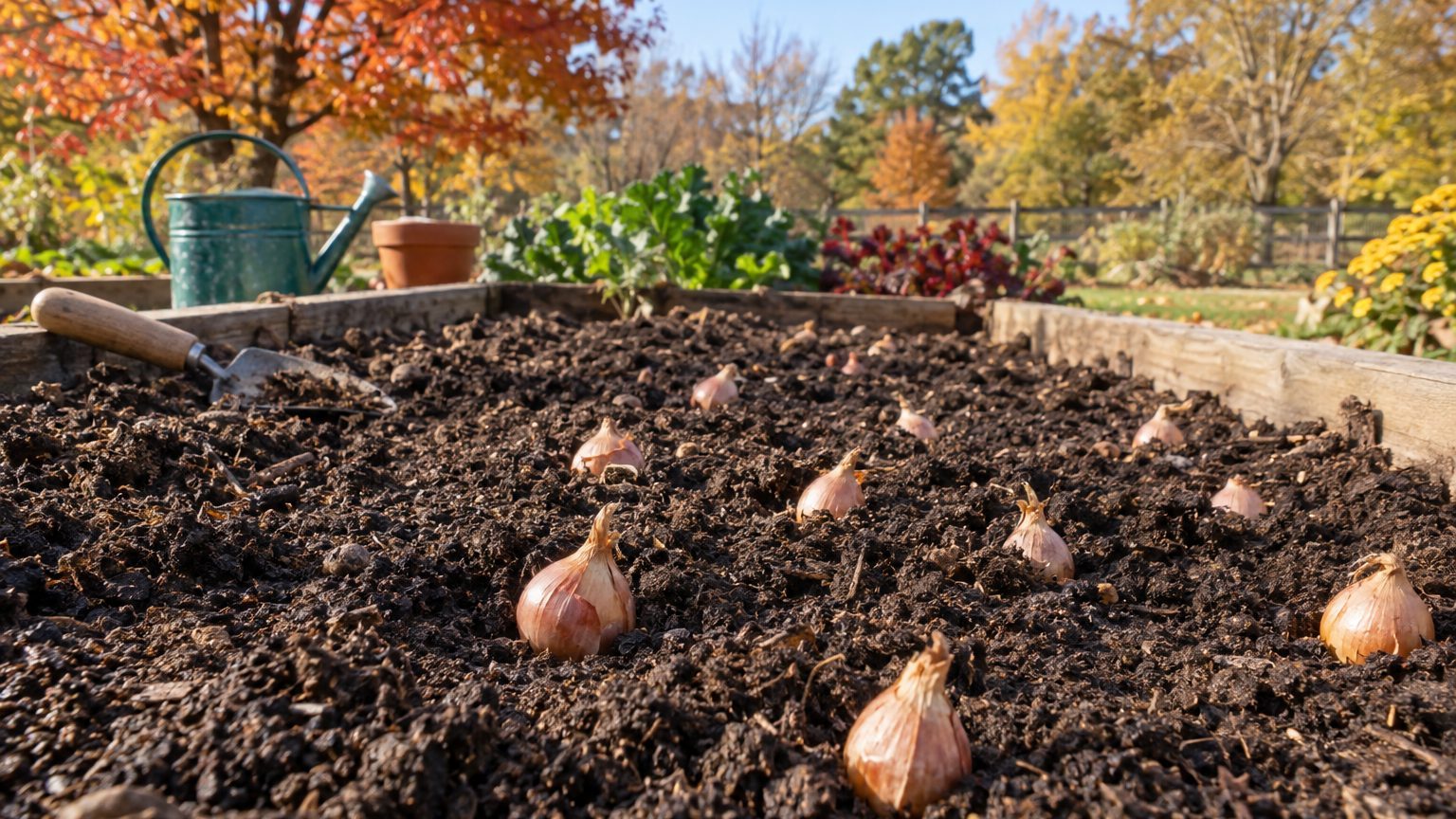

On the British Columbia coast, plant shallots in fall ahead of the November 10 average first frost, or in early spring from around the March 18 average last frost. Both dates come from the Vancouver airport weather station and are averages, not guarantees. Treat each as the middle of a window. Inland and northern gardens sit on a different calendar.
The short answer for British Columbia
The two anchor dates are an average last spring frost of March 18 and an average first fall frost of November 10. Both come from Environment and Climate Change Canada’s Canadian Climate Normals for 1981-2010, at the Vancouver International Airport station. Each is a mean date, and a mean is a midpoint. In roughly half of years, the last spring frost lands after March 18. In roughly half of years, the first fall frost arrives before November 10. Planting on the average date means accepting a coin-flip on the weather that follows.
The gap between those two dates is about 237 days. That is simple arithmetic between two averages, not a promise of frost-free weather. It does explain why this coast supports two planting seasons for shallots instead of one.
| Planting season | Anchor date (Vancouver station) | How to read it |
|---|---|---|
| Fall planting | Average first fall frost: November 10 | Get bulbs in the ground ahead of this date so roots can establish. About half of years bring frost earlier. |
| Spring planting | Average last spring frost: March 18 | Start once soil is workable, from about this date onward. About half of years bring a later last frost. |
The mild winter drives this. The mean daily minimum of the coldest month at the reference station is 0.8 °C (33.5 °F), barely above freezing. Individual nights go colder, but the average low does not stay far below zero for long. A shallot bulb in the ground is rarely threatened by cold alone in this climate. The calendar is therefore set less by survival than by timing: roots in before the worst of the wet, tops not so far along that a late cold snap stings them.
This page does not have a measured soil-temperature date for planting, so it will not invent one. Where the table gives anchor dates, it leaves the exact day to your own garden. For growing details beyond timing, see Growing Shallots in British Columbia.
What will not work here
Planting on March 18 and calling it safe will not work. That date is the midpoint, not the finish line. A gardener who sets sets out on the average date is betting on a frost-free spring that half of years do not deliver. Shallots tolerate a light frost better than most crops, but a bed that is waterlogged or crusted over by a cold snap is another matter.
Planting very early in fall is the opposite mistake. With the coldest-month average low at 0.8 °C, winter in the reference city does not shut growth down the way it does in a harder climate. Bulbs set out too soon can push a lot of green top before winter. That soft growth is what a late cold spell damages. The November 10 average is the mark to plan toward, not a reason to start in late summer.
Copying a recipe from a colder province also fails. Advice written for the Prairies or Ontario tells you to plant in spring because the ground is frozen solid for months. A Vancouver-area winter of 0.8 °C average lows does not work that way. Spring planting still works here, but treating it as the only option means skipping the fall window that this climate gives you.
Trusting the Vancouver numbers across the whole province is the biggest trap. These figures are from one airport station. A province is not one climate, and northern or upland districts run weeks behind it. A garden in the interior valleys or at altitude that follows March 18 and November 10 will plant into frozen or sodden soil in spring and run out of fall before roots settle.
One technical caution: the Canadian normals here cover 1981-2010, while US figures elsewhere on this site cover 1991-2020. The thirty-year windows differ, so do not line the two sets of dates up as though they were measured the same way. Slow, late-maturing shallot types also lose room the shorter the season gets, which matters once you leave the coast. The Best Shallots to Grow in British Columbia covers what suits which conditions.
What changes across British Columbia
The reference city for this page sits in hardiness zone 9a on Natural Resources Canada’s hardiness map, based on 1991-2020 normals. That is the Canadian system, not a USDA zone. The Canadian system draws on seven climate variables, and the USDA system on one, so the two do not convert. NRCan itself says there are no simple conversions between them. A Canadian zone 4a overlaps nine different USDA zones, from 3a to 7a.
The 9a value belongs to the reference city, not to the province. British Columbia covers coast, interior valleys, mountains and a cold north, and this page has only the one zone figure. There is no single answer for the province, and I will not make up a spread of zones that the facts do not contain. What the data does show is the direction: northern and upland districts run weeks behind Vancouver.
In practice, a reader in the north or at altitude should shift the whole calendar. Spring planting moves later, because the last frost arrives well after March 18 and the soil thaws later. Fall planting moves earlier, because the first frost arrives well before November 10. A shorter season also favors earlier-maturing types and a thick mulch over fall-planted rows. How many weeks to shift is a local question, and it is the one the next section helps you answer.
To see where your garden sits, use the zone lookup on Natural Resources Canada’s Plant Hardiness Site. Search your own municipality there instead of assuming a zone from a neighbor or a seed packet. Do not guess your zone from this page.
Where to check this for your own county
The provincial source is the British Columbia government’s agriculture and seafood pages. Look there for two things: a local planting calendar for your area, and any shallot or allium varieties that have been trialled near you. If your district has no published calendar, find the contact for regional agriculture staff from that same site and ask what planting dates local growers use.
British Columbia is organized by regional districts rather than counties, so search for your own district or valley rather than for a “county” page. Local growers, farm markets and garden clubs often know the practical dates better than any average does, and they know which sites flood or frost-pocket.
A county or district recommendation beats a state-level one, and this page is the provincial one. It rests on a single station’s averages and a single reference zone. Where a local calendar disagrees with the March 18 and November 10 dates above, trust the local calendar. It reflects your elevation, your soil and your nearest weather history, which one coastal airport station cannot.
Checking this against your own garden
Your own observations outrank every date on this page. Three are worth watching, and none needs an instrument.
- Soil warmth by feel. Push your hand into the bed in early spring. If the soil is cold and clings in a wet lump, it is not ready. If it crumbles and no longer feels chilly, it is. A bed that reaches that state early tells you your site is warm and drains well.
- The first male flowers. Note the date hazel or alder catkins open and shed pollen near you. It is not a shallot rule, but the same date each year shows how your spot compares to the coast average. If catkins come later than a neighbor’s, expect your spring to run late too.
- The first true leaves. Watch when green shoots appear from fall-planted bulbs, or when weeds put out their first real leaves. Fast, early growth in fall suggests a mild pocket where early planting runs the risk of too much top. Slow growth suggests a cooler site that needs earlier planting.
Write the dates in a notebook for two or three seasons. Those records become your own planting calendar, and they will correct this one.
Common questions
Can I plant shallots in fall in British Columbia?
On the coast, yes. The average first fall frost at the Vancouver station is November 10, so aim to have bulbs in ahead of it. Colder districts need to start earlier, by weeks.
Is March 18 a safe date for spring planting?
No. It is the average last spring frost, so in roughly half of years frost falls later. Treat it as the midpoint of a window and let your soil tell you when to start.
Is my hardiness zone 9a?
Not necessarily. 9a is the Canadian zone for the reference city only, and the province spans many climates. Look up your own municipality on the Natural Resources Canada map.
What is the coldest-month temperature at the reference station?
The mean daily minimum of the coldest month is 0.8 °C (33.5 °F). That is an average low, not a record, so individual nights can be colder.