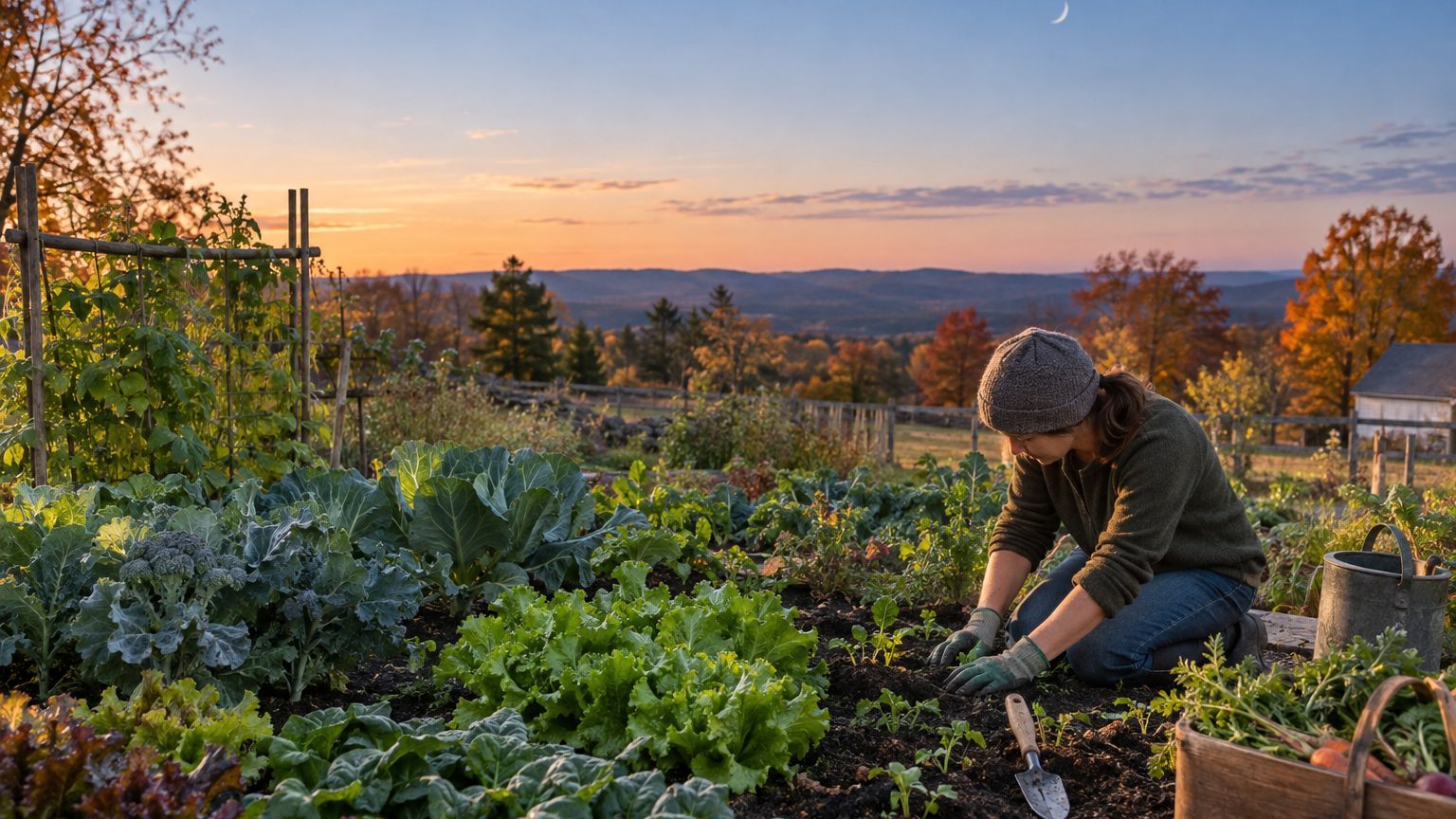

According to almanac tradition, the first quarter of the Moon is for leafy crops that bear above ground: lettuce, spinach, cabbage, broccoli and celery. The stretch runs from the new moon to the first quarter moon, and in 2026 the next one ends on October 18 at 12:12 p.m. ET. This is an old gardening convention, not a proven effect, and the sections below show how it works and how much weight it deserves.
What the tradition says about first quarter moon
The almanac rule follows the Moon’s growing light. Gardeners who plant by the Moon cut the 29.53-day phase cycle into four quarters, and the first begins at the new moon and ends at the first quarter moon. Per the tradition, that is the stretch for leafy crops that bear above ground. The tradition gives this quarter no chores. The weeding, pruning, turning the soil and composting belong to the fourth quarter, the days before the new moon. No effect of the Moon’s phase on germination or yield has been established, so everything here is a custom, offered as one.
The vocabulary trips people up. Astronomers use “first quarter” for a single moment, when the Moon has traveled a quarter of its way around us and shows a half-lit face. Planting almanacs use the same words for the whole stretch leading up to that moment. When this page says “the first quarter,” it means the stretch. When it says “first quarter moon,” it means the instant.
| Quarter | Span | What the tradition assigns |
|---|---|---|
| First | New moon to first quarter | Leafy crops that bear above ground (lettuce, spinach, cabbage, broccoli, celery) |
| Second | First quarter to full moon | Above-ground crops that bear seed inside the fruit (tomatoes, peppers, beans, squash, corn) |
| Third | Full moon to last quarter | Root crops, bulbs, perennials (potatoes, carrots, garlic, onions, beets) |
| Fourth | Last quarter to new moon | Rest: weeding, pruning, turning the soil, composting |
Many almanacs add a second filter, the Moon’s zodiac sign. The common convention labels Cancer, Scorpio and Pisces fruitful, Taurus, Libra and Capricorn semi-fruitful, and Aries, Gemini, Leo, Virgo, Sagittarius and Aquarius barren, though sources differ on Virgo, Sagittarius and Aquarius. A traditional window is the quarter plus a fruitful or semi-fruitful sign.
The two cycles do not line up. The Moon needs 27.32 days to circle the stars but 29.53 days to go through its phases, so a given phase lands in a different sign each month. The first quarter moon of October 2026 falls with the Moon in Capricorn. In November it falls with the Moon in Aquarius, which this convention labels barren.
The next first quarter moon dates
Two first quarter moons are coming. The first is October 18, 2026, at 12:12 p.m. ET, and the second is November 17, 2026, at 6:47 a.m. ET. All times on this page are Eastern. Readers in other time zones should shift them by the usual offset.
The waxing Moon, the stretch between new and full, is the one almanac gardeners associate with growing light. This October it runs from the new moon on October 10 at 11:50 a.m. to the full moon on October 26 at 12:11 a.m. (the Hunter’s Moon, in the Old Farmer’s Almanac naming). The waning stretch then runs to the new moon on November 9 at 2:02 a.m. The next waxing stretch ends at the full moon on November 24 at 9:53 a.m., the Beaver Moon. The first quarter moon sits at the midpoint of each waxing stretch, which is why the tradition splits waxing into a leafy half and a fruiting half.
Here are the traditional first-quarter windows for leafy crops, with clock times where a window only partly covers a day.
| Window | Moon sign | Clock times (ET) |
|---|---|---|
| October 10-13 | Libra, then Scorpio | From the new moon on October 10 at 11:50 a.m. until the Moon enters Sagittarius on October 13 at 8:59 p.m. |
| October 16-18 | Capricorn | From the morning of October 16 (8:57 a.m.) to the first quarter moon on October 18 at 12:12 p.m. |
| November 9 | Scorpio | From the new moon at 2:02 a.m. until the Moon enters Sagittarius on November 10 at 3:35 a.m. |
| November 13-14 | Capricorn | Moon in Capricorn from November 12 at 3:27 p.m. until November 15 at 4:24 a.m. |
Which crops this phase is for, in the tradition
The first quarter is a planting phase, not a rest phase. Almanac tradition reserves it for crops grown for their leaves, those that bear above ground and are not valued for their fruit or roots. The usual named examples are:
- Lettuce
- Spinach
- Cabbage
- Broccoli
- Celery
The logic is symbolic, and the almanac says so itself: waxing light, upward growth, leaves. A gardener who accepts the custom matches the crop type to the quarter, and the tradition has no other reasoning behind it. Whether a given crop can go into the ground at all, and when, is a question for the state planting guides, which are written for local seasons.
The Moon’s phase is also not the only system in circulation. The biodynamic calendar associated with Maria Thun ignores the quarters and sorts days by the sign alone. In that system Cancer, Scorpio and Pisces are leaf days, Taurus, Virgo and Capricorn are root days, Gemini, Libra and Aquarius are flower days, and Aries, Leo and Sagittarius are fruit days. The two approaches sometimes agree and sometimes do not. The first quarter window with the Moon in Scorpio overlaps a biodynamic leaf day. The window with the Moon in Capricorn lands on a biodynamic root day, so a gardener following both systems would hear conflicting advice.
The jobs the almanac keeps for the rest phase, weeding, pruning, turning the soil and composting, come after the last quarter. Anyone planning an almanac year should keep those separate from the first quarter list. The next rest phase begins at the last quarter on November 1 at 3:28 p.m. ET and ends at the new moon on November 9 at 2:02 a.m. ET.
How much weight to give it
The Moon’s effect on crops has never been established, and the physics argues against a simple mechanism. Using NASA’s Moon Fact Sheet constants (a 29.53-day phase cycle, a 27.32-day orbit against the stars, and a mean distance of 384,400 km, from nssdc.gsfc.nasa.gov/planetary/factsheet/moonfact.html), the Moon’s tidal pull at the Earth’s surface works out to about 1.1 millionths of a meter per second squared at its strongest. That figure is calculated, not measured on a seed. It is roughly one ten-millionth of gravity (1.1 x 10^-7 g), which is far too small to move anything as small as a seed or a root. For the wider question, see the section on whether planting by the moon holds up.
Treat the quarters as an optional way to choose among days, never as a reason to plant. Frost dates and soil temperature decide whether a crop can go in the ground at all, and the Moon, for anyone who follows it, only picks among days the local calendar already allows. Start with your state’s planting guide, find the dates it gives for the crop, and consult the Moon afterward if the custom appeals to you. A traditional window that falls outside your local season is not worth acting on.
Questions
Is the first quarter moon the same as the first quarter in a planting calendar?
No. The first quarter moon is one moment, when half of the Moon’s face is lit. The first quarter in a planting almanac is the whole stretch from the new moon up to that moment. In October 2026 the stretch starts on October 10 at 11:50 a.m. ET and the moment arrives on October 18 at 12:12 p.m. ET.
Does the Moon’s sign matter in this tradition?
In many almanacs it does. The convention labels Cancer, Scorpio and Pisces fruitful, Taurus, Libra and Capricorn semi-fruitful, and the rest barren, with sources disagreeing on Virgo, Sagittarius and Aquarius. A traditional window needs the right quarter and a fruitful or semi-fruitful sign. The labels are part of the almanac’s own code, not a property of the stars.
What does the tradition assign to the days after the first quarter moon?
The second quarter, which runs from the first quarter moon to the full moon. Almanac tradition gives it to above-ground crops that bear seed inside the fruit: tomatoes, peppers, beans, squash and corn. The root crops, bulbs and perennials come later, in the third quarter. Whether any of those crops can be planted at all depends on your state’s guide, not on the almanac. Where the two disagree, the guide wins.