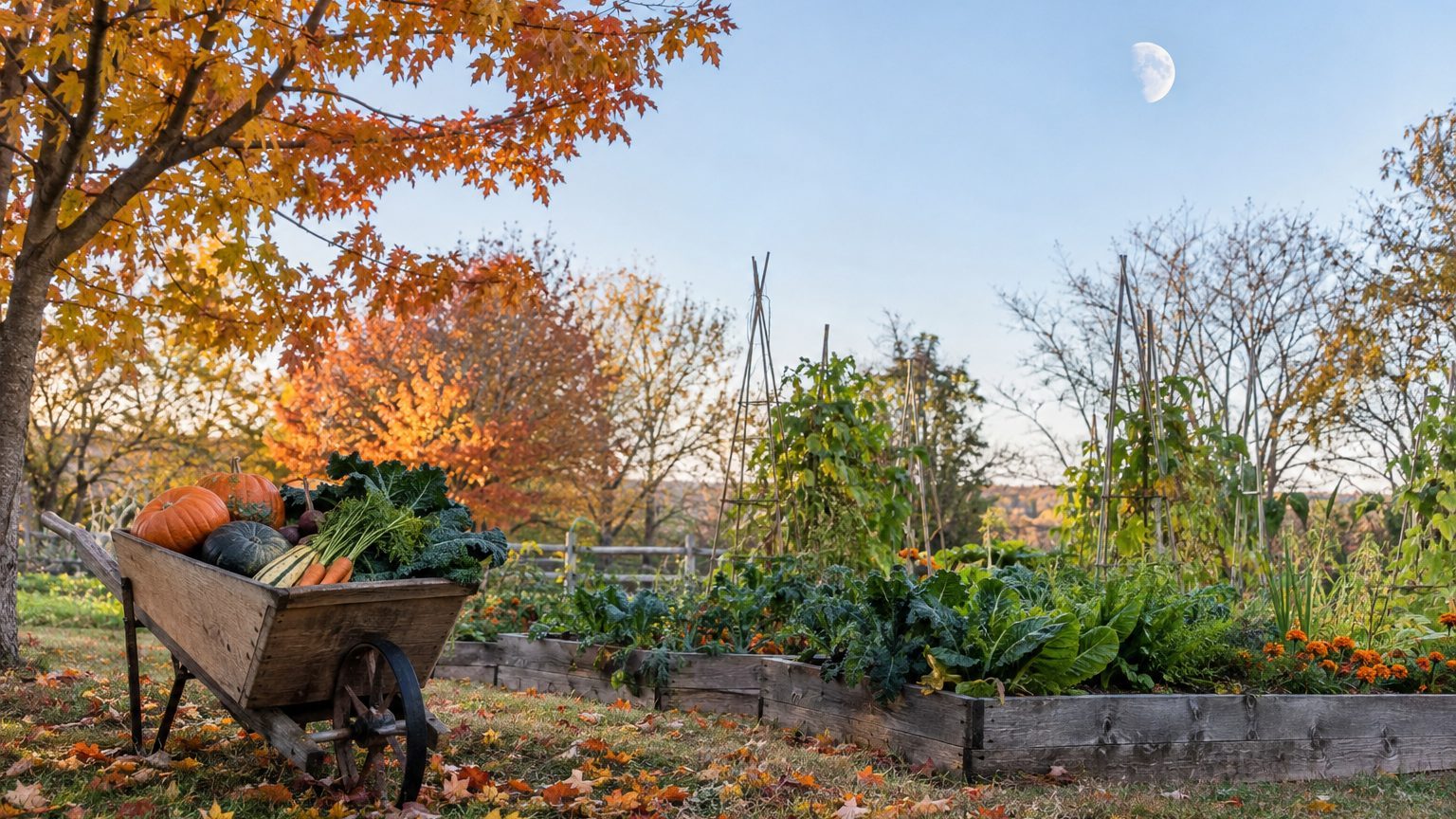

Planting by the Moon is an almanac tradition that times sowing and planting to the Moon’s phase and to the zodiac sign it is passing through. No effect of the Moon on how a crop comes up has been established, so treat every rule below as tradition. Pick your planting days from your local frost dates and your soil first, and only then let the Moon choose among the days that are already right.
What planting by the moon means

Gardeners who plant by the Moon time their sowing and transplanting to two things: the phase of the Moon, and the zodiac sign it is passing through. It is a long-running almanac tradition. The reasoning usually given is simple: according to almanac tradition, you sow what grows upward while the Moon’s light increases and what grows downward while it fades.
The main convention is the four-quarter rule. The tradition divides the lunar cycle into four quarters and assigns crop groups or garden chores to each one.
| Quarter | Phase interval | What the tradition assigns |
|---|---|---|
| First quarter | New moon to first quarter | Leafy crops that bear above ground: lettuce, spinach, cabbage, broccoli, celery |
| Second quarter | First quarter to full moon | Above-ground crops that bear seed inside the fruit: tomatoes, peppers, beans, squash, corn |
| Third quarter | Full moon to last quarter | Root crops, bulbs and perennials: potatoes, carrots, garlic, onions, beets |
| Fourth quarter | Last quarter to new moon | Rest: weeding, pruning, turning the soil, composting |
Sources differ on the edges. This page assigns corn to the second quarter, and other almanacs may classify corn, perennials and trees differently. Neither version is more official than the other.
In this convention the fourth quarter is not assigned any crops. According to almanac tradition it is the resting stretch, kept for weeding, pruning, turning the soil and composting.
In practice you do two things. You look up the quarter your crop belongs to, then you pick a day inside it. The zodiac sign, covered below, narrows that choice further. Through all of it, the Moon never overrides the planting calendar of your place. If a leafy-crop window opens when your state’s guide says it is not the time to sow, skip it and use the next one.
How the phases work, in garden terms
The cycle and its four turning points
The Moon runs through the same sequence every month: new moon, first quarter, full moon, last quarter, then new moon again. NASA’s Moon Fact Sheet puts the cycle of phases, the synodic period, at 29.53 days from one new moon to the next. One orbit against the stars is shorter, 27.32 days by the same fact sheet. That gap is why the Moon’s sign changes and its phases run on separate clocks and drift apart through the year.
Watch the vocabulary, because the almanac’s first quarter is the stretch that ends at the phase called First Quarter, not the one that begins there. Take October 2026. The New Moon falls on October 10 at 11:50 a.m. ET and the First Quarter on October 18 at 12:12 p.m. ET. The span between them is the almanac’s first quarter, the leafy-crop stretch. The second quarter then runs to the Full Moon, the third from the Full Moon to the Last Quarter, and the fourth from the Last Quarter to the next New Moon.
| Phase | October 2026 | November 2026 |
|---|---|---|
| Last Quarter | October 3, 9:25 a.m. ET | November 1, 3:28 p.m. ET |
| New Moon | October 10, 11:50 a.m. ET | November 9, 2:02 a.m. ET |
| First Quarter | October 18, 12:12 p.m. ET | November 17, 6:47 a.m. ET |
| Full Moon | October 26, 12:11 a.m. ET | November 24, 9:53 a.m. ET |
Each phase is an instant, not a whole day, so a window can open or close partway through a date. The two new moons in the table sit a little under 30 days apart. The day-by-day detail, with sign changes and the traditional windows, is on the pages for October 2026 and November 2026.
Waxing, waning and the guides
Waxing means the lit part of the Moon is growing, from new moon to full moon. Waning means the lit part is shrinking, from full moon to the next new moon. In the four-quarter rule, the first two quarters make up the waxing half and the last two make up the waning half.
Each turning point has a guide of its own. The reasoning for planting during the new moon and for planting on a full moon is set out there. First Quarter Moon Planting and Last Quarter Moon Gardening cover the two halfway points. What to Plant During a Waxing Moon, According to the Tradition and What to Plant During a Waning Moon, According to the Tradition cover the two halves of the cycle.
Does planting by the moon really work?
The effect of the Moon on crops has not been proven. Four points matter here, in this order.
The physics
The tidal explanation does not hold up for a seed. NASA’s Moon Fact Sheet gives the Moon’s mean distance as 384,400 km. Calculated from that distance and the Moon’s other constants, the tidal pull at the Earth’s surface is about 1.1 millionths of a meter per second squared at its strongest. That is roughly one ten-millionth of gravity (1.1 x 10⁻⁷ g). The figure is a calculation, not a measurement taken in a garden, and it is far too small to move anything as small as a seed or a root.
This rules out the tidal route only. It says nothing for or against other routes, and no effect of the Moon on crops has been established.
The claim made for it
One published claim for an effect appears in a 2001 review. Kollerstrom and Staudenmaier published “Evidence for Lunar-Sidereal Rhythms in Crop Yield: A Review” in Biological Agriculture & Horticulture 19(3), doi:10.1080/01448765.2001.9754928. The authors argue that crop yields follow a lunar-sidereal rhythm. Sidereal refers to the Moon’s orbit measured against the stars, not to the cycle of phases.
That is a claim made by its authors, and this site does not present it as established. Read it as an argument you can look up and weigh for yourself. It is not a verdict you can plant by.
What actually decides whether a seed comes up
This site’s state planting guides rest on local conditions: soil temperature, frost dates and moisture. Those vary from one place to the next, which is why the guides give planting dates state by state and not by lunar cycle. The Moon is not part of that calculation.
The fair position
If you choose to try the tradition, use it only to pick among days that already suit your state’s planting guidance. Write the sowing date and the Moon’s quarter in your garden notebook and look back after a few seasons. One garden over one season cannot separate the Moon from the weather, so a good year after a lunar planting proves little either way. Never delay a planting the local calendar says is due to wait for a lunar window.
Moon signs: the second layer of the tradition
Many almanacs add a second filter on top of the quarters: the zodiac sign the Moon is passing through. This is astrology-based tradition, and it rests on the same footing as the quarter rule, with no established effect behind it. The Moon spends a little over two days in each sign, so a sign change arrives every two or three days. Sources disagree about which signs suit which work, and about three signs in particular: Virgo, Sagittarius and Aquarius.
Fruitful, semi-fruitful and barren
| Class | Signs | How this page’s planting windows treat them |
|---|---|---|
| Fruitful (the water signs) | Cancer, Scorpio, Pisces | Used for planting windows |
| Semi-fruitful | Taurus, Libra, Capricorn | Used for planting windows |
| Barren | Aries, Gemini, Leo, Virgo, Sagittarius, Aquarius | Left out of planting windows |
In this convention the sign divides each quarter into shorter windows. In October 2026 the Moon enters Scorpio on October 11 at 11:21 a.m. ET and Sagittarius on October 13 at 8:59 p.m. ET. It stays in Sagittarius, a barren sign, until it enters Capricorn on October 16 at 8:57 a.m. ET. October 14 and 15 therefore fall in a barren stretch in the middle of the first quarter, and the almanac rule skips them.
The biodynamic scheme of Maria Thun sorts the same twelve signs differently. In her system root days are Taurus, Virgo and Capricorn, flower days are Gemini, Libra and Aquarius, leaf days are Cancer, Scorpio and Pisces, and fruit days are Aries, Leo and Sagittarius. Aries, Leo and Sagittarius are barren in the almanac scheme and fruit days in hers. The sign dates on this site use the tropical zodiac, and a calendar built on another convention will show different days.
moon sign gardening compares the schemes sign by sign.
Planting by the Moon calendars for 2026 and 2027
The Moon’s dates change every year, so the rules above need a calendar to be usable. Open Planting by the Moon 2026 for the current year. Open Planting by the Moon 2027 when you plan beds and seed orders over the winter. Each month also has a page of its own. Planting by the Moon in October 2026 and Planting by the Moon in November 2026 give the phase times and sign changes in Eastern time, and mark the traditional windows for leafy, fruiting and root crops.
The October 2026 windows, as the tradition would have them, combine the quarter rule with a fruitful or semi-fruitful sign:
- Leafy crops (first quarter): October 10-13 (Moon in Libra/Scorpio), October 16-18 (Moon in Capricorn)
- Fruiting crops (second quarter): October 21-23 (Moon in Pisces)
- Root crops, bulbs, perennials (third quarter): October 26-27 (Moon in Taurus), October 30-31 (Moon in Cancer)
Read the windows with the clock beside them. The Moon enters Pisces on October 21 at 8:35 a.m. ET and leaves for Aries on October 23 at 3:53 p.m. ET, so the window closes partway through its last day. The leafy window that opens on October 10 follows the New Moon at 11:50 a.m. ET that morning. November’s windows are on the November page, and the yearly calendars carry the rest.
Crop by crop
The crop guides apply the four-quarter rule to one crop at a time. They are grouped by the quarter this almanac convention assigns them to, so pick the group first and the crop second.
Leafy crops
According to the almanac tradition used here, plants grown for their green growth above ground belong to the first quarter, from the new moon to the first quarter. Herbs, cover crops and grass seed sit here too, although almanacs differ on the edges.
- When to Plant Collard Greens by the Moon
- When to Plant Kale by the Moon
- When to Plant Lettuce by the Moon
- When to Plant Spinach by the Moon
- When to Plant Broccoli by the Moon
- When to Plant Cabbage by the Moon
- When to Plant Brussels Sprouts by the Moon
- When to Plant Herbs by the Moon
- When to Plant Basil by the Moon
- When to Plant Cover Crops by the Moon
- When to Plant Grass Seed by the Moon
Fruiting crops
According to the almanac tradition used here, crops that set seed inside a fruit or a pod belong to the second quarter, from the first quarter to the full moon.
- When to Plant Tomatoes by the Moon
- When to Plant Peppers by the Moon
- When to Plant Cucumbers by the Moon
- When to Plant Pumpkins by the Moon
- When to Plant Zucchini and Summer Squash by the Moon
- When to Plant Winter Squash by the Moon
- When to Plant Sweet Corn by the Moon
- When to Plant Watermelon by the Moon
- When to Plant Cantaloupe by the Moon
- When to Plant Okra by the Moon
- When to Plant Green Beans by the Moon
- When to Plant Peas by the Moon
- When to Plant Strawberries by the Moon
Root crops and bulbs
According to the almanac tradition used here, roots, bulbs and perennials go with the third quarter, from the full moon to the last quarter. That includes garlic, onions and potatoes, as well as the woody and flowering perennials in this group.
- When to Plant Potatoes by the Moon
- When to Plant Garlic by the Moon
- When to Plant Onions by the Moon
- When to Plant Carrots by the Moon
- When to Plant Beets by the Moon
- When to Plant Sweet Potatoes by the Moon
- When to Plant Asparagus by the Moon
- When to Plant Parsnips by the Moon
- When to Plant Turnips by the Moon
- When to Plant Radishes by the Moon
- When to Plant Spring Bulbs by the Moon
- When to Plant Roses by the Moon
- When to Plant Hydrangeas by the Moon
The names of the full moons
The traditional names of the twelve full moons are Wolf, Snow, Worm, Pink, Flower, Strawberry, Buck, Sturgeon, Corn (also called Harvest), Hunter’s, Beaver and Cold. This site follows the usage of the Old Farmer’s Almanac, and other sources use other names. The names are seasonal labels, not planting instructions, and the tradition does not tie any of them to a crop.
Two fall in the months covered above. The October 2026 full moon is the Hunter’s Moon, on October 26 at 12:11 a.m. ET, with the Moon in Taurus. The November 2026 full moon is the Beaver Moon, on November 24 at 9:53 a.m. ET, with the Moon in Gemini. In the almanac convention used here, Taurus is classed as semi-fruitful and Gemini as barren, so the Hunter’s Moon starts a traditional third-quarter root window and the Beaver Moon does not.
The guide titled Full Moon Names and Meanings goes through all twelve in order. Start from full moon names to see where each one falls in the year.
Common questions
Is planting by the moon a real thing?
It is an almanac tradition, not a proven method. The Moon’s tidal pull at the surface is far too small to act on a seed, and the 2001 review by Kollerstrom and Staudenmaier remains an argument by its authors and not a settled result. Keep your frost dates and your soil in charge of the calendar.
What is the best moon phase for planting vegetables according to the tradition?
According to the tradition there is no single best phase, because it depends on the crop. Leafy crops go in during the first quarter, from the new moon to the first quarter. Fruiting crops go in during the second quarter, up to the full moon. Root crops, bulbs and perennials go in during the third quarter, after the full moon. The fourth quarter is for weeding, pruning, turning the soil and composting. Adding the sign narrows the choice to days when the Moon is in a fruitful or semi-fruitful sign.
Do you plant root crops when the moon is waxing or waning?
Waning, according to the tradition. Root crops, bulbs and perennials belong to the third quarter, which runs from the full moon to the last quarter and is the first stretch of the waning half. The above-ground crops belong to the waxing half. In October 2026 the almanac root windows are October 26-27 and October 30-31, both after the Full Moon of October 26.
Can I plant by the moon in Canada?
The Moon’s phases are the same everywhere, but the planting calendar of the place decides the season. A Canadian garden follows its own frost dates and soil, and the Moon only chooses among the days that are already right. A phase is the same instant everywhere, but the date it lands on depends on your time zone. An event just after midnight Eastern falls on the previous evening further west. Shift each time on this page to your own clock before you pick a day.