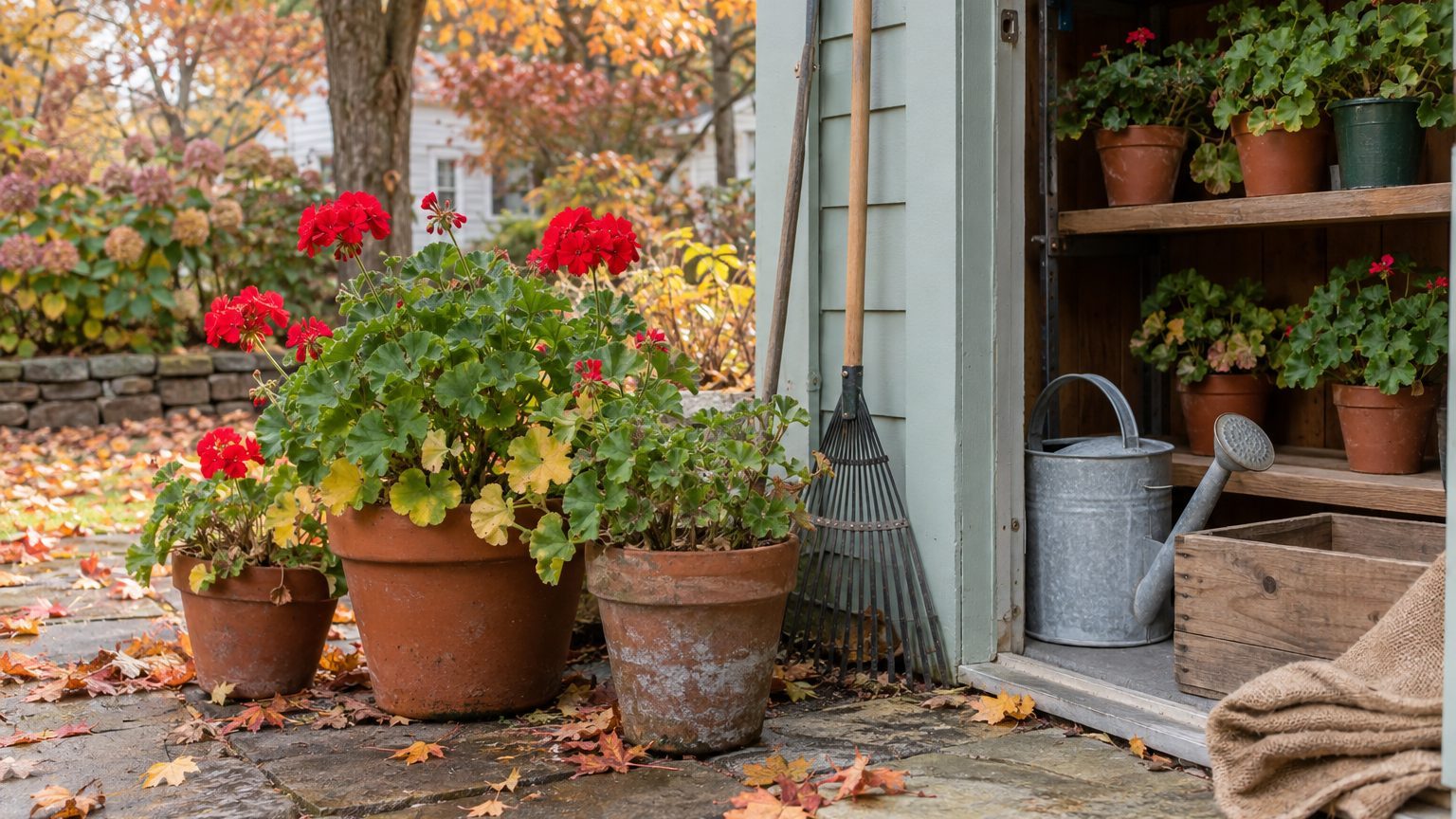

Your geraniums will die at the first hard frost, so the decision has to come before it. A healthy plant can spend winter indoors in its pot, hang bare-root, or be replaced by a few rooted cuttings. Check each plant for disease and pests now, then pick one of those three methods for it.
Bring geraniums in before the first hard frost

Iowa State Extension states it plainly: the first hard frost kills outdoor geraniums, but healthy, disease-free plants can be overwintered indoors. You can keep the plant itself, or you can keep a copy of it. Penn State Extension notes that geraniums are easily carried from one year to the next by propagating through rooting stem cuttings, and the Missouri Botanical Garden says cuttings may be taken from favorite plants in late summer for overwintering. “Geraniums” here means the common garden pelargonium, the kind sold in pots each spring.
Let your own frost date set the deadline
No calendar date works for everyone. Your deadline is the first hard frost where you garden, which swings widely from one county to the next. Look up your region on the first and last frost dates by state page, then watch your local forecast as that window opens. Readers in Canada should lean on Canadian frost guidance and local extension advice wherever it differs from the US sources quoted here.
The word that matters in the Iowa State sentence is healthy. A plant with leaf spots, wilting stems or visible insects will bring those problems into the house. Check the undersides of leaves and the stems near the soil. Weak plants are better replaced in spring than nursed through winter.
Three ways to carry a plant over
| Method | What you keep | What the sources say about care |
|---|---|---|
| Potted indoors | The whole plant, in soil | Water when the soil surface becomes dry (Iowa State Extension) |
| Bare-root | The whole plant, roots out of soil | Soak the roots 1 to 2 hours once a month (Iowa State Extension) |
| Cuttings | New plants rooted from stems | Take from favorites in late summer (Missouri Botanical Garden) |
The next three sections take these in turn. Choose one method per plant before frost arrives, because all three need a little preparation while the weather is still mild.
Keep them in pots indoors
The simplest route is to bring the potted plant inside and treat it as a houseplant for the winter. Plants growing in the ground can be lifted and potted, but only if they are healthy, since you are moving the whole root system and everything living on the foliage into your home. Give each plant its own pot with drainage holes, and move it indoors before the hard frost, not after.
Watering by the soil, not the calendar
Iowa State Extension advises that during their stay indoors you water plants when the soil surface becomes dry. That is a test you run with a fingertip, not a schedule. Indoor conditions vary from a sunny kitchen to a cool back room, so two pots in the same house can dry at different speeds. Check each one separately. When the surface is dry, water. When it is still damp, leave it alone and look again later.
Empty any saucer after watering so the pot does not stand in runoff.
Cutting back in March
The same Iowa State Extension source gives one pruning instruction for stored plants: in March, prune or cut back each plant. That timing comes from an Iowa extension service, so treat it as a reference point and not a rule for every climate. Gardeners in much milder or much colder places should compare it with their own state or provincial extension advice.
Your county extension office can supply those for your region.
Store them bare-root
Bare-root storage means the plant spends winter without soil around its roots. It saves pot space, which matters when you are keeping a dozen plants in a small house. The catch is that the plant has no soil to hold moisture, so the care shifts from watering to soaking.
The monthly soak
Iowa State Extension gives this instruction: once a month during winter, soak the roots of each plant in water for 1 to 2 hours. That is the only watering a bare-root plant gets in this method, and it replaces the dry-surface test used for potted plants. Both rules come from Iowa State, but they apply to different methods, so do not combine them. A bare-root plant gets the soak, and a potted plant gets watered when the surface dries.
Because the soak comes only once a month, it is easy to forget. Put a reminder somewhere you will see it, and keep the plants where you will pass them. Do not leave the roots in water longer than the range given, since a plant that has been soaking for hours beyond that is being treated differently from the method Iowa State describes.
Pruning and what the sources leave out
The Iowa State Extension page on bare-root plants adds one more step: in March, prune or cut back each plant. As with potted plants, that timing reflects Iowa, and your own extension service may name a different point in your calendar.
The bare-root method has gaps in what the sources describe. They say nothing about where to hang or box the plants, what temperature to hold them at, or how to prepare the roots for storage. Those details matter, and guessing them is how plants get lost. Read the full Iowa State Extension article on overwintering geraniums and its FAQ on bare-root plants before you pull your first plant, or ask your county extension office for a local version. If the details are unclear, keep that plant potted instead.
Or take cuttings
If you lack room for full-sized plants, keep only pieces of them. Penn State Extension says geraniums are easily carried from one year to the next by propagating through rooting stem cuttings. The Missouri Botanical Garden’s entry for Pelargonium × hortorum says cuttings may also be taken from favorite plants in late summer for overwintering.
Choose the parent plant while it is still growing
Decide which plants are worth copying while they are in bloom and full leaf, not after the first frost warning. A cutting inherits the flower color and habit of its parent, which is the whole point of the method. Take cuttings only from healthy plants. Mark the parents with a tag so you do not have to pick again from memory.
Cuttings can also sit alongside the other methods. You might pot up your best plant for the winter and root a few cuttings of it as insurance, in case the parent declines indoors.
What the sources do not say
Neither the Penn State nor the Missouri Botanical Garden line gives a cutting length, a rooting medium or a recommendation on rooting hormone. Ask your county extension office, or read the Penn State Extension manual on tropical plants to overwinter, where the technique is covered in more depth.
Cuttings suit the reader who wants variety for next year at low cost. Other tender plants can be kept the same way, and gardeners who grow herbs may find the page on overwintering perennial herbs helpful, since several of those plants face the same indoor winter.
Common questions
Can I leave my geraniums outside for winter?
Not where hard frost arrives. Iowa State Extension says the first hard frost kills outdoor geraniums. For plants that stay in the ground, see our page on winter protection.
Should I bother saving a geranium that has spots on the leaves?
Probably not. The Iowa State Extension guidance applies to healthy, disease-free plants, and a sick plant brought indoors can spread its trouble. Replace it in spring, or take cuttings only from the cleanest growth on a healthier plant.
Are geraniums perennials or annuals?
Both labels get used. Iowa State Extension titles its guide “Growing Annual Geraniums,” while the Missouri Botanical Garden describes scented geraniums as tender perennials typically grown in the St. Louis area. Either way, they are frost-tender, and keeping them over winter is what turns an annual habit into a perennial one.
What if a hard frost hits before I bring them in?
Then that plant is lost. Iowa State Extension says a hard frost kills outdoor geraniums, and the overwintering advice applies to healthy plants brought in beforehand. Next year, watch the forecast as your region’s frost window opens and take cuttings from favorites in late summer as insurance.
Overwintering advice varies by region and by source, so confirm timing and method with your state or provincial extension service before you act.