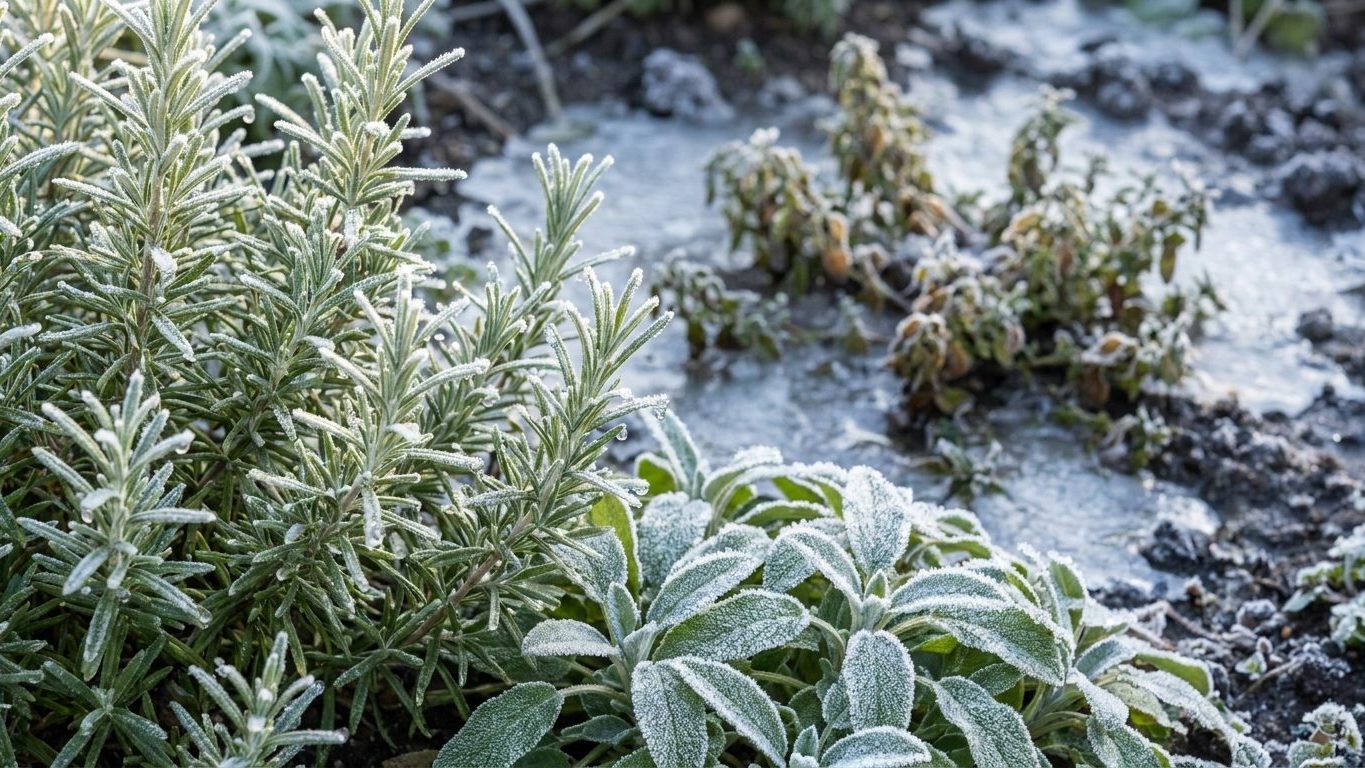

Rosemary, sage, thyme, oregano, and mint don’t die from cold. Most of the time they die from wet feet, wind, or a false spring that tricks them into growth right before a hard freeze finishes them off. Getting perennial herbs through the winter is less about wrapping them up and more about managing drainage, timing, and which species even belong in the ground where you live.
What is actually going on
The thing to understand here is wet plus cold. A Mediterranean herb like rosemary, sage, or thyme evolved in rocky, fast-draining soil with dry summers and mild, damp winters, not the freeze-thaw slop of a Midwest or Northeast backyard. Drop the same plant into heavy clay that stays saturated for weeks, then freeze that soaked soil solid, and the roots suffocate and rot before the cold even gets credit for killing them. A gardener in coastal Virginia can watch a rosemary shrub sail through a 15-degree night that would have finished off the same plant sitting in a low, poorly drained bed two towns over.
Ice inside plant tissue is only part of the story. When water freezes inside a cell, it expands and ruptures the cell wall, which is why a plant that looked fine on Tuesday turns to black mush by Friday. But most established perennial herbs have some natural tolerance for this, built up gradually as temperatures drop through fall. That gradual process is called hardening off, and it’s the second thing that goes wrong for a lot of gardeners: a late-season flush of new, tender growth (often triggered by a warm spell, or by fertilizing too late in the season) has no time to harden before a hard freeze arrives, and that soft growth is what dies back first.
Wind adds a third layer. Evergreen perennial herbs like rosemary, sage, and lavender keep their leaves through winter, which means they keep losing moisture through those leaves even while the ground is frozen and the roots can’t replace it. This is called winter desiccation, and it’s a different failure mode than freeze damage. A plant can be perfectly cold-hardy on paper and still turn brown and crispy because it dried out standing in a west-facing spot that catches every gust off an open field.
The species also matters more than most catalog tags suggest. Thyme, oregano, chives, and winter savory tend to be genuinely woody and tough once established. Rosemary and bay are borderline in a lot of the country, reliable outdoors in mild climates and a gamble everywhere else. Basil isn’t part of this conversation at all: it’s a tender annual killed by the first light frost, not a candidate for overwintering outdoors under any strategy.
In the garden
Some of this is prevention that happens months before the first freeze. Some of it is triage once cold weather is already on the way. Either way, the mistakes tend to repeat themselves in predictable ways.
| What helps | Why it works | What happens when it’s skipped |
|---|---|---|
| Plant in raised beds, mounds, or amended soil with grit or coarse sand mixed in | Water drains away from the crown and roots instead of sitting there | Roots sit in cold, saturated soil and rot from the inside, often invisibly until the whole plant collapses in spring |
| Stop fertilizing and heavy watering by late summer | Growth slows and stems have time to harden before frost | A late flush of soft, tender growth freezes first and can take the whole stem down with it |
| Apply a loose mulch of straw or shredded leaves after the ground starts to cool, not before | Insulates roots and buffers freeze-thaw swings without trapping summer heat and moisture against the crown | Mulch applied too early traps warmth and moisture, inviting rot and pests right at the base of the plant |
| Shelter evergreen types from prevailing winter wind, or site them near a south- or east-facing wall | Reduces moisture loss from leaves while the frozen ground can’t resupply water to the roots | Foliage desiccates and turns brown or crispy, even on a plant that was technically cold-hardy enough to survive |
| Lift borderline or tender types into pots and move them somewhere protected | Removes the plant from ground-level cold and wet entirely | Left in the ground, a marginal plant in a marginal climate simply doesn’t come back, and by the time you notice in April it’s too late to do anything but replant |
That last row is worth sitting with, because it’s the option most gardeners skip out of habit rather than a real evaluation of their climate. Rosemary, bay, and sometimes lavender or tender types of sage are good candidates for container life through the cold months, kept in an unheated garage, enclosed porch, or cool basement near a window, watered sparingly since a dormant or semi-dormant plant needs very little. Mint, chives, thyme, oregano, and sage generally don’t need this treatment where they’re already suited to the climate. They can be cut back after they die down naturally and left alone, and mulch does the rest of the work.
One more failure mode belongs here: cutting a perennial herb back hard in fall, thinking it tidies the bed for winter. On woody types especially, that fresh cut is an entry point for cold and moisture right into the stem, and it removes the very growth that would have sheltered the crown. Cleanup and hard pruning are spring jobs, done once new growth shows where the plant is actually still alive.
What it depends on where you are
Everything above is mechanism, and mechanism travels. The specifics don’t. How long your ground actually freezes, how many freeze-thaw cycles you get in a typical winter, how wet your winters run, and how much wind exposure a given yard has all change which of these herbs need protection and how much. A rosemary bush that overwinters outdoors without a second thought along the Gulf Coast or in coastal California is a container plant, full stop, in Minnesota or Vermont. Even within a single state, a garden in a low spot that collects cold air and standing water behaves nothing like a raised bed on a slope two miles away.
Summer conditions matter almost as much as winter ones, even though that seems backward. A herb that spent summer in heavy, poorly drained soil goes into winter with weaker roots and less stored energy than the same plant grown in well-drained soil, and it has a harder time surviving cold regardless of how it’s mulched or wrapped. Rainfall patterns matter too: a wet fall followed by an early freeze is a worse combination than a dry fall followed by the same freeze, because the soil that’s already saturated has nowhere for the ice to expand except into the roots.
This is where a general guide reaches its limit on purpose. The state-specific pages on this site walk through which herbs reliably overwinter outdoors in a given region, when the first hard freeze typically arrives, and what local gardeners actually do differently because of it. Beyond that, the county-level Cooperative Extension office in your area, run through the state’s land-grant university system, has soil and climate data specific to your zip code that no national article can replicate. That’s not a brush-off. It’s the honest answer to a question this page genuinely can’t answer for you.
The mistake that costs the most
The single most expensive mistake, in dead plants per year, isn’t skipping mulch or forgetting to move a pot indoors. It’s leaving a Mediterranean herb in soil that never drained well to begin with, and then blaming the cold when it dies. Gardeners troubleshoot winter losses by reaching for more insulation: thicker mulch, a wrapped burlap cover, a sheltered corner. All reasonable moves. None of them fix a plant sitting in a bed that turns to standing water every time it rains.
The fix isn’t a winter fix at all. It’s a planting-day decision, made months before the first freeze is even a forecast. Rosemary, sage, thyme, and their relatives need soil that drains fast, which usually means raised beds, mounded rows, or a generous mix of grit, coarse sand, or fine gravel worked into heavy clay before the plant ever goes in the ground. If that ship has sailed and a herb is already established in soil that stays soggy, the more realistic move is to dig it up in early fall and pot it up in a fast-draining potting mix, rather than trying to out-mulch a drainage problem that mulch was never going to solve.
Cold is the visible cause. Wet soil is the actual one. A gardener who fixes drainage before worrying about frost dates will lose far fewer plants than one who piles on protection against the cold and never touches what’s happening underground.