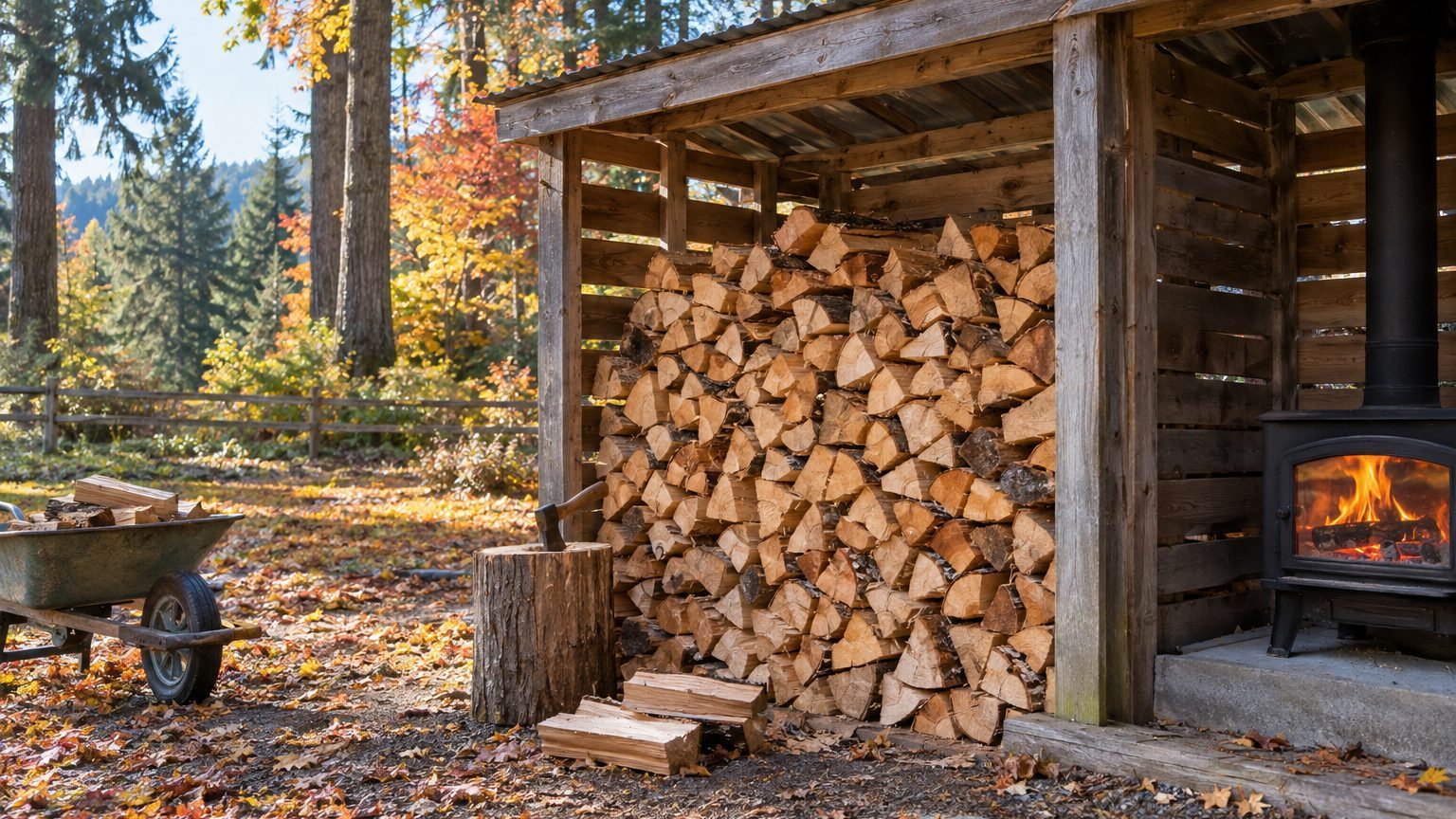

Douglas-fir firewood delivers 20.7 million BTU per cord of seasoned wood, according to Utah State University Extension. That is mid-range on this site: no bragging rights, no apology needed. The source does not document how this species smokes or throws sparks, so those parts remain open questions. And a modest wood seasoned well will outheat a premium wood burned wet.
How much heat Douglas-fir gives
The figure comes from Table 1, Firewood Facts, in the Utah State University Extension publication “Wood Heating”: 20.7 million BTU per cord of seasoned wood. That is the number used throughout this page. Other published tables list somewhat different values for the same species, because moisture content, density and testing method all vary from one source to the next. Pick one source and stay with it when you compare woods. Blending two tables produces a number nobody measured.
A single figure means little without a range around it. Across common firewood species the spread is wide: oak gives nearly twice what cottonwood gives from the same stacked cord. Douglas-fir lands in the middle of that spread. It will not match the dense hardwoods that people burn through a long northern winter, and it clearly outperforms the lightest woods.
The reason species differ at all is counterintuitive. Pound for pound, nearly every species gives roughly the same heat. What changes is density. A cord is a fixed volume (a stack of 128 cubic feet), so a dense wood packs more pounds into it, and a light wood packs fewer. You buy volume, but you burn weight. That is why a cord of a mid-density wood like this one costs less per load than premium hardwood yet needs refilling more often.
In practice, expect to feed the stove somewhat more frequently than you would with a heavier wood, and to haul and stack more volume for the same number of cold nights. If you heat mostly in fall and spring, that hardly matters. If wood is your primary heat source through January, plan your woodshed with extra room.
One factor outranks the whole table: seasoning. Green wood spends its heat boiling off its own water before it can warm a room, so a green oak burns worse than a seasoned aspen. Someone who buys the hottest species and burns it wet gets less warmth than someone who seasons a modest one properly. The 20.7 million BTU applies to seasoned wood only.
Smoke, sparks, and which stove suits it
Here is the gap in the record. The Utah State University Extension table gives a heat value for Douglas-fir, but it does not publish smoke or spark ratings for this species. Density says nothing reliable about either, and a related species behaving one way does not tell you this one does the same. So this page will not guess. What follows is the decision framework, and how to fill in the missing piece yourself.
Species and appliance work as a pair. A wood that throws many sparks is dangerous in an open fireplace, where a popping ember can land on a rug, and harmless in a closed stove with the door latched. A wood that smokes heavily can heat as well as the best species and still be unpleasant indoors, especially in a leaky fireplace that vents poorly. Neither trait makes a wood bad. It makes the wood a poor match for one appliance and a fine match for another.
Since you already own the appliance, you can run the test the table never did:
- Closed stove or insert: burn a small, well-seasoned load first and watch the glass and the chimney top. Light smoke from the stack after the fire is established is a good sign.
- Open fireplace: keep a fitted screen in place, clear the hearth of anything flammable, and stay in the room during the first few fires with this wood.
- Outdoor fire pit: sparks matter for dry grass, roofs and neighbors’ fences. Check local burn restrictions, since many Western states call them in dry months.
Keep the first trial small. If the wood pops or sends embers out, shift it to the stove and save the fireplace for something calmer. If it smokes in one appliance and not another, the draft or the moisture may be the cause rather than the species, which brings us to seasoning.
Chimney upkeep belongs in this conversation too. Any wood burned unseasoned deposits creosote, and an annual sweep is cheap compared with a flue fire. That holds for every species on Firewood by Species, this one included.
How long it takes to season

Wood must sit below about 20 percent moisture before it gives its rated heat. Until then, part of every fire goes to boiling water out of the log, and that is energy you wanted for the room. The smoke from damp wood is also heavier, and the glass on a stove door clouds faster.
Species dry at different speeds. Some dry slowly because of their cell structure, which holds water and releases it reluctantly. The source for this page does not publish a seasoning time for Douglas-fir, so no month count will appear here. Treat any confident number you see with caution and rely on the wood itself.
Two tests work without a moisture meter. First, look at the end grain: cracks radiating from the center of the log show the wood has been losing water. Fresh-cut ends look smooth and tight. Second, try the bark. On seasoned wood it often lifts by hand or peels away easily, while green bark clings. A third check costs nothing: knock two pieces together. Dry wood gives a sharp, hollow crack, and wet wood gives a dull thud.
A moisture meter, usually under $30 at a hardware store, removes the doubt. Split a piece, then test the freshly exposed inside face, not the surface, which dries first and misleads.
How you stack matters as much as how long. Split pieces dry far faster than rounds, since water leaves mostly through the ends and cut faces. Raise the stack off the ground on pallets or rails, leave gaps between rows for air, and cover only the top so the sides catch wind. A full tarp wrapped around the pile traps moisture and slows everything down.
Getting hold of it
Douglas-fir is a Western tree, abundant across the Pacific Northwest and much of the northern Rockies, so in Washington, Oregon and northern California it is often easy to find from local sellers and tree services. Outside that range you may see it less often, and if a seller is trucking it across several states, ask why before you pay.
Local sourcing is not a matter of price alone. Transported firewood is how the emerald ash borer reached the Midwest, and the insect has since killed more than fifty million ash trees. Insects and fungi hide in bark and under it, and a cord moved a few hundred miles can carry them to a woodlot that had no defense. Buying within a short drive of where you burn is the simplest safeguard. Many states restrict moving firewood across county or state lines, so check your state forestry agency before you load a truck.
When you buy, count on volume rather than a vague “load.” A full cord is 128 cubic feet, a stack roughly 4 feet high, 4 feet wide and 8 feet long. Ask whether the wood is seasoned, how long it has been split and stacked, and whether it has been kept covered. Then apply the end-grain and bark tests above before you accept delivery.
If you cannot find Douglas-fir nearby, a neighboring species may serve better. Compare the Pacific Northwest hardwood on Red alder as Firewood: Heat, Smoke and Sparks, or an eastern softwood on Eastern white pine as Firewood: Heat, Smoke and Sparks, and match whatever your region supplies.
Common questions
Is Douglas-fir good firewood?
It is a mid-range heat source. Utah State University Extension lists 20.7 million BTU per cord of seasoned wood. Whether it suits your setup depends on seasoning and on your appliance, since smoke and spark behavior are not documented in that source.
Can I burn Douglas-fir in an open fireplace?
The source does not publish spark ratings for this species, so there is no documented answer. Use a fitted screen, keep the hearth clear, and test with a small, dry load while you watch it. A closed stove is the safer place for any wood with unknown spark behavior.
How do I know if it is seasoned enough?
Look for cracks in the end grain, bark that lifts by hand, and a sharp crack when two pieces knock together. A meter reading below about 20 percent, taken on a freshly split face, confirms it.
Does a hotter species make seasoning less important?
No. Green wood spends its heat boiling off its own water, so a green oak burns worse than a seasoned aspen. Dry wood of a middling species beats wet wood of the best one.