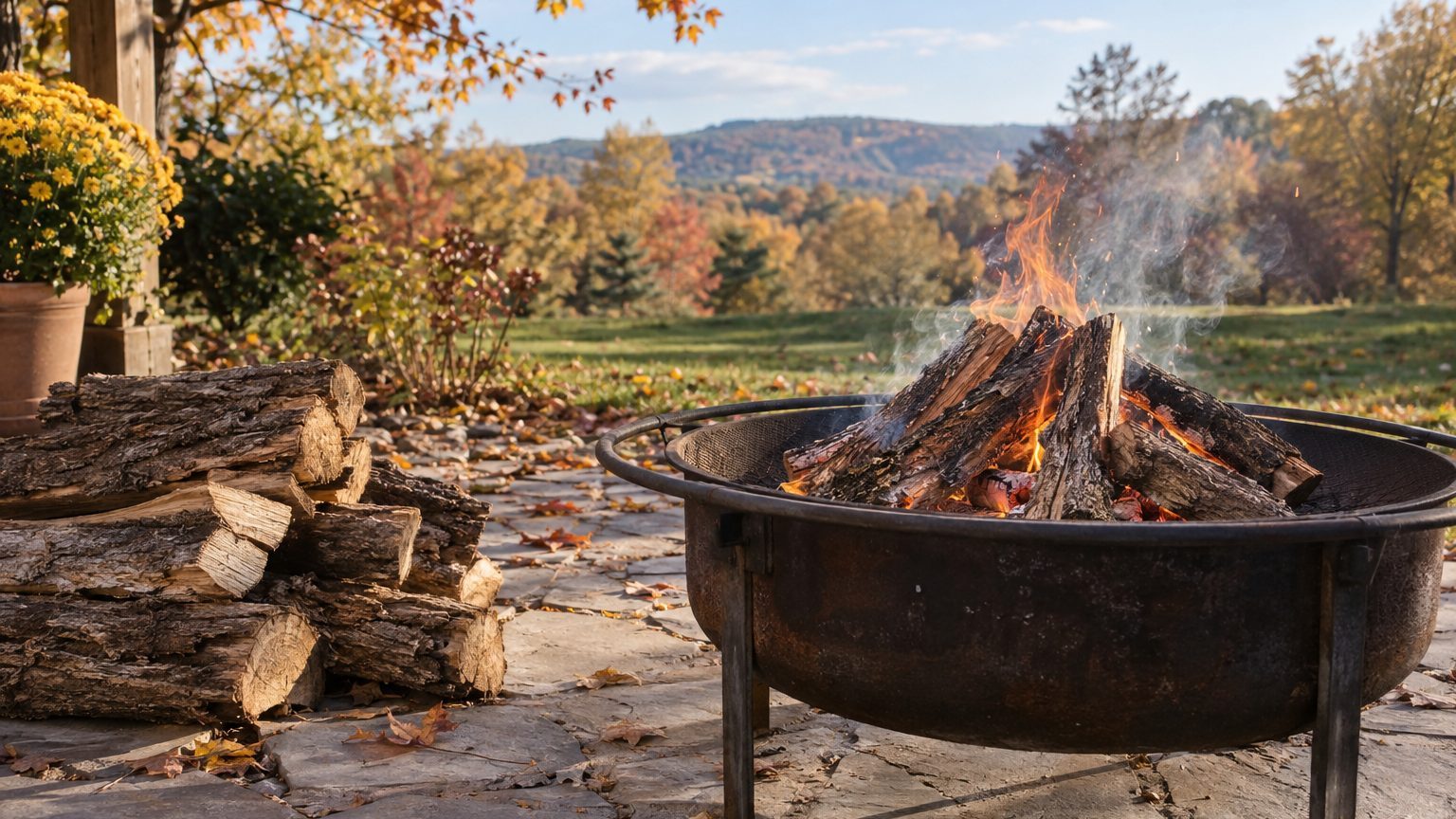

Mesquite carries a barbecue reputation, and people assume a wood that pops and flares on the grill will spit embers onto the hearth rug. It doesn’t. Its spark rating is none and its smoke is moderate, so it is safe in an open fireplace and tolerable in a closed stove, provided it is dry. Buy a small load first, split one piece down the middle and check the end grain for cracks before you commit to a full cord.
How much heat Mesquite gives
The heat rating for mesquite is not in the figures this page is allowed to use, so you will not find a BTU number here. New Mexico State University’s Guide G-102 (revised September 2012) is the source for the smoke and spark ratings below, and it is the place to look for the heat table. Read that table for the exact value rather than trusting a number from a random chart, because published figures for the same species disagree. Moisture content, wood density and the test method all differ from one lab to the next, and averaging two charts produces a number nobody measured.
Where mesquite sits in the range
What you can rely on is the principle behind the table. Heat per cord follows density, and mesquite is a dense, heavy hardwood with a twisted grain. That puts it in the upper part of the range across species, well above the light, fast-burning woods such as cottonwood and aspen. The spread between the top and the bottom of any BTU table is large. A cord of dense oak gives far more heat than a cord of cottonwood, and a cord of mesquite belongs on the oak side of that gap.
A dense wood also burns slowly. A few heavy splits hold a fire through the evening where light wood needs feeding every hour. That is the practical benefit of a high heat rating, and it matters more to most households than the peak temperature.
Seasoning outranks the table
Seasoning beats species. Green wood spends its heat boiling off its own water before it can warm a room, so a green oak burns worse than a seasoned aspen. Mesquite is no exception. A load of freshly cut mesquite will hiss, sulk and give less heat than a modest wood that has dried for a full year. If you compare loads at the yard, pick the drier one even when the species is lower on the chart.
For a wider comparison across the woods you might find near you, the Firewood by Species index lists each one against the same measures. Madrone is another dense Western hardwood, and Pacific madrone as Firewood: Heat, Smoke and Sparks shows how it compares on smoke and sparks.
Smoke, sparks, and which stove suits it
New Mexico State University’s Guide G-102 rates mesquite moderate for smoke and none for sparks. Those two words decide which appliance the wood suits, and a heat chart never tells you either.
Sparks: the open fireplace is fine
Spark-throwing woods are dangerous in an open fireplace, where a popping ember can land on the carpet or a nearby cushion. Mesquite does not do that. With a rating of none, it is one of the easier woods to burn on an open hearth. A screen is still sensible with any fire you leave for a minute, but the wood itself is not the hazard.
In a closed stove or insert, sparks never matter, because the door keeps everything inside. The spark rating only becomes a decision in the open fireplace and the open fire pit, and mesquite passes both.
Smoke: the damper is what you control
Moderate smoke means mesquite is neither the cleanest wood nor the worst. Smoke depends heavily on how you burn it. Wet wood, or dry wood choked down with the air control almost shut, smolders and produces far more smoke than the rating suggests. Dense wood is especially prone to this, because a fire starved of air never reaches temperature and the smoke condenses in the flue as creosote. Burn mesquite hot, keep the air open until the splits are alight, and it behaves.
| Appliance | Spark risk with mesquite | Smoke concern | Verdict |
|—|—|—|—|
| Open fireplace | None, per the rating | Moderate. Let the draft pull it up the flue. | Good choice when dry |
| Closed stove or insert | Irrelevant, door stays shut | Moderate. Do not damp the air right down. | Good choice, long burns |
| Outdoor fire pit | None, per the rating | Moderate. Sit upwind. | Suits it |
The species is also a decision about kindling. Mesquite is hard to light from cold, so start with a lighter wood and add mesquite once the fire has a bed of coals. Tulip poplar is the classic example of a light hardwood that catches quickly but burns out fast, and Tulip poplar (yellow-poplar) as Firewood: Heat, Smoke and Sparks covers where it fits alongside a dense wood like this one.
How long it takes to season

Firewood has to fall below about 20 percent moisture before it gives real heat. Until then, the fire has to boil the water out first, and that uses the energy you wanted for the room. It is also the reason wet wood smokes so much and coats the chimney.
Why mesquite takes patience
Mesquite is dense and tight-grained, and dense woods give up water slowly. Most of the moisture leaves through the cut ends, so a long, thick, knotty piece dries far slower than a small split of a light wood. Mesquite trunks are often crooked and forked, which makes them awkward to split and awkward to stack with the ends open to the air. Plan on a longer drying time than you would allow for a softer wood, and never assume that a piece cut this spring will be ready by autumn. Do not put a number on it until you have tested the wood yourself.
Two tests that need no meter
A moisture meter is the accurate answer, but you can judge a stack by eye and by hand.
- Look at the end grain. Cracks radiating from the center mean the wood has lost water.
- Try the bark. On seasoned mesquite it lifts or peels by hand, where green bark clings.
- Compare weight. A dry piece feels light for its size next to a green one.
Split a few pieces open and look at the inside. If the fresh face is dark and cool to the touch, the wood is still wet in the middle, whatever the surface says. Stack it off the ground, cover the top only, and leave the sides open so the wind can carry moisture away.
Getting hold of it
Mesquite is a Southwestern wood. In Texas, New Mexico, Arizona and neighboring states it grows as brush and small trees, and landowners clear it, so you can often buy it by the cord from local dealers or cut it yourself with permission. Elsewhere it is rare. Outside its range you will mostly meet it as bagged chunks sold for cooking, which cost far too much per unit of heat to be worth burning for warmth.
Why local wood matters
Buy wood from close to where you will burn it. Transported firewood is how the emerald ash borer reached the Midwest and killed ash trees across the region. The insects and fungi travel inside the logs, and the wood looks perfectly healthy. The FACTS for this page do not name a source for the scale of that loss, so check your state department of agriculture or forestry for current figures and for any rules on moving firewood. Mesquite itself is not an ash, but the same logic applies to any wood hauled a long way.
What to ask a dealer
Ask where the wood was cut and when. A seller who cannot answer either question is selling green wood. Ask to see the end grain of a few pieces, and look for the cracks described above. Buy by the cord rather than the pickup load, so the volume is a known quantity, and get the seller to stack it if you can. A cord of mesquite is heavy, so plan for the weight on a trailer or in a truck bed.
Common questions
Can I burn mesquite in an open fireplace?
Yes. New Mexico State University’s Guide G-102 rates it none for sparks, so it does not throw embers onto the hearth. Keep the wood dry and the damper open, because moderate smoke turns heavy when the wood is wet.
Why is my mesquite hissing and smoking?
Almost always because it is still wet. The hiss is water escaping from the ends of the splits. Set the pieces aside to dry longer and check the end grain for cracks before you burn them.
Can I mix mesquite with a lighter wood?
Yes, and it helps. A light wood lights easily and builds coals, and mesquite then carries the fire for hours. Keep both seasoned, or the lighter wood will not do its job either.
Is firewood mesquite fine for cooking?
It is the same wood, but only use clean, seasoned pieces that have not touched treated lumber or been stored in chemicals. Firewood sold for heating is not checked for cooking, so buy a bagged cooking product if you are unsure where a load came from.