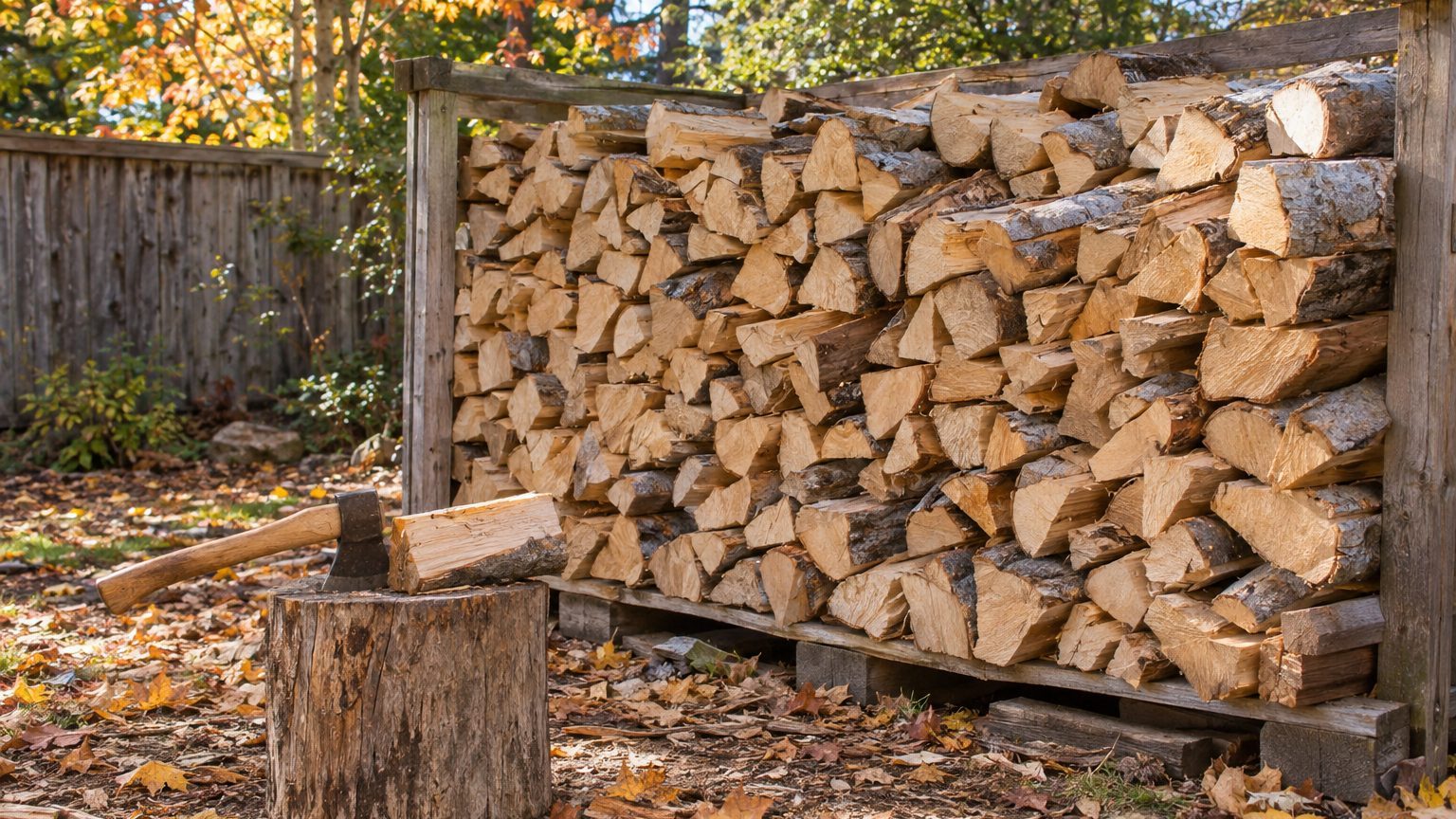

Red alder firewood delivers 17.4 million BTU per cord of seasoned wood, according to the USDA Forest Service publication PNW-GTR-810, “Firewood” (April 2010). That puts it at the low end of the range. It’s excellent for starting a fire and not enough to hold one through a night. The same source doesn’t document how red alder smokes or throws sparks, so this page says so rather than guessing. Seasoning matters more than any of it.
How much heat Red alder gives
The figure is 17.4 million BTU per cord, measured on air-dried wood. That comes from the USDA Forest Service publication PNW-GTR-810, “Firewood” (April 2010), which lists million BTU per air-dried cord. It’s the number used throughout this page, and it isn’t averaged with anyone else’s.
A single number tells you little until you see the spread around it. Across common North American species, the gap between the bottom and top of the chart is large. Oak delivers nearly twice what cottonwood does from the same stack. Red alder sits toward the cottonwood end, at the low end of the range on this site. You can see the whole spread on the Firewood by Species page.
The mechanism behind that spread is counterintuitive. Pound for pound, nearly every species gives roughly the same heat. What changes is density. A cord is a fixed volume (a stack 4 feet high, 4 feet wide and 8 feet long, or 128 cubic feet counting air gaps), so a dense wood packs more pounds into it than a light one. You buy volume and you burn weight. A cord of red alder is not “weaker” wood in any chemical sense. It simply puts less wood into the same space, so the stove has less to work with per load.
In practice, that means two things. Loads burn down faster, and a stove that would stay warm until morning on a dense species needs refilling sooner on this one. Where red alder earns its place is at the front end of a fire: lighting up, bringing a cold stove to temperature, taking the chill off a shoulder-season evening.
Published figures differ from one source to the next for the same species. Moisture content, density samples and testing method all vary, and two respectable tables can disagree by a point or two. That’s why this page sticks to one source and names it. If you see 17.4 elsewhere shifted by a little, that’s method, not error.
One more point outranks the whole table: seasoning. Green wood spends its heat boiling off its own water before it can warm a room. A green oak burns worse than a seasoned aspen. Someone who buys the hottest species on the chart and burns it wet gets less heat than someone who seasons a modest wood properly.
Smoke, sparks, and which stove suits it
The source that gives the heat value for red alder doesn’t publish smoke or spark behavior for it. There’s no rating to turn into a rule, and inferring one from density or from a related species would be guesswork. So the honest answer on smoke and sparks is “not documented here.”
That doesn’t leave you stuck. The useful question is how the species crosses with the appliance you already own, because the same wood can be harmless in one and a problem in another. Sparks are the clearest example. A wood that pops and throws embers is a real hazard in an open fireplace, where embers can land on a rug. Behind the closed glass of a stove, the same wood does nothing worse than crackle. Smoke works the same way in reverse: a wood can heat as well as the best and still be unpleasant to be around if the appliance leaks smoke into the room.
With red alder, you’re the one finding out, so treat it carefully until you’ve watched how your lot behaves:
- Open fireplace: use a fitted spark screen, keep the hearth clear of anything flammable, and burn a small test load while you’re in the room.
- Closed wood stove or insert: the door contains any popping, so the main thing to watch is the chimney. Check for smoke at the cap and for how the glass looks after a few burns.
- Outdoor fire pit: keep an eye on wind and nearby dry vegetation, and don’t leave it unattended.
The heat figure does tell you how to use it in a stove. At 17.4 million BTU per cord, red alder is a good opener and a poor night shift. A common approach is to start the fire with it and then load denser wood for the long burn, or to rely on it in mild weather when you want a few hours of warmth and not a full night. If you’re weighing it against other woods you’re likely to find in the same region, the pages on Silver maple as Firewood: Heat, Smoke and Sparks and Douglas-fir as Firewood: Heat, Smoke and Sparks follow the same format, so you can compare like for like.
None of this makes red alder “bad firewood.” It’s low in heat per cord, which makes it a poor choice for round-the-clock heating, and its smoke and spark behavior is simply unrecorded in this source. Those are different things, and only the first one is a number.
How long it takes to season

Wood has to drop below about 20 percent moisture before it gives its heat, because the water has to boil off first and that consumes the energy you wanted. Above that line, a fire runs cooler, smokes more and leaves more creosote in the chimney. That holds for every species on this site.
Species do differ in how fast they get there. Some dry slowly because of their cell structure, while others shed water quickly. The USDA Forest Service source doesn’t give a drying time for red alder, so there is no honest month count to offer here. Drying depends heavily on climate, on how small you split it and on how you stack it. A damp coastal yard and a dry inland one can differ by a full season.
Checking dryness without a meter
A moisture meter is the surest way to check, but you can get a good read without one. Look at the end grain of a split piece. Seasoned wood shows cracks radiating from the center, and the ends look gray or darkened, not fresh and pale. Next, try the bark. On dry wood it often lifts or peels away by hand. Fresh-cut wood holds its bark firmly.
Two more checks help. Dry pieces feel noticeably lighter than green ones of the same size. When you knock two pieces together, dry wood gives a hollow crack and wet wood gives a dull thud. Split a piece open and feel the inside too: if it’s cool and damp to the touch, it isn’t ready.
For the stack itself, split the wood (whole rounds dry slowly because the bark slows evaporation), keep it off the ground on pallets or rails, cover only the top, and leave the sides open to wind. Test pieces from the middle of the pile before you burn it, since the outside dries first. Trust the tests, not the calendar.
Getting hold of it
Red alder is a western tree, most common in the Pacific Northwest, especially west of the Cascades in Washington and Oregon and up the coast. If you live there, you’ll probably find it from local sellers and as cut-and-haul wood from land-clearing work. Elsewhere in the country it’s uncommon, and a bundle sold in a Midwest or Eastern store likely traveled a long way.
That distance is the reason to insist on local wood. Moving firewood is how the emerald ash borer reached the Midwest, and the insect has since killed more than fifty million ash trees. Bugs and diseases ride in bark and under it, and a single load can start an infestation hundreds of miles from the source. Many states restrict how far firewood can be moved, so check your state’s agriculture or forestry department before hauling any across a line.
When you buy, ask where the tree was cut. A seller who can answer in one sentence is usually a good sign. Ask for a full cord (128 cubic feet of stacked wood) and not a “rick” or “face cord,” whose sizes vary by seller. Ask whether the wood is seasoned, then run the checks above on a few pieces before you pay. A cord of unseasoned red alder is a cord you will pay to store for a long time before it’s worth burning.
Common questions
Is red alder good firewood?
It depends on the job. At 17.4 million BTU per cord of seasoned wood (USDA Forest Service, PNW-GTR-810), it sits at the low end of the range. It starts fires well but won’t hold one through a night.
Is red alder safe in an open fireplace?
Its spark behavior isn’t documented in the source used here, so there’s no rating to rely on. Use a spark screen, clear the hearth and stay in the room for the first few burns. A closed stove is the lower-risk setting while you find out.
How dry does it need to be?
Below about 20 percent moisture. Without a meter, look for cracks in the end grain, bark that lifts by hand, and pieces that feel light and sound hollow when knocked together.
Can I mix it with denser wood?
Yes, and it’s a sensible way to use it. Start the fire with red alder, then add a denser species for the long burn. The two don’t interfere, since each does the job its density suits.
One last practical point: the 17.4 figure assumes air-dried wood, so it describes the best case. A cord stacked and covered poorly, or burned early, delivers less than that on the day you light it.