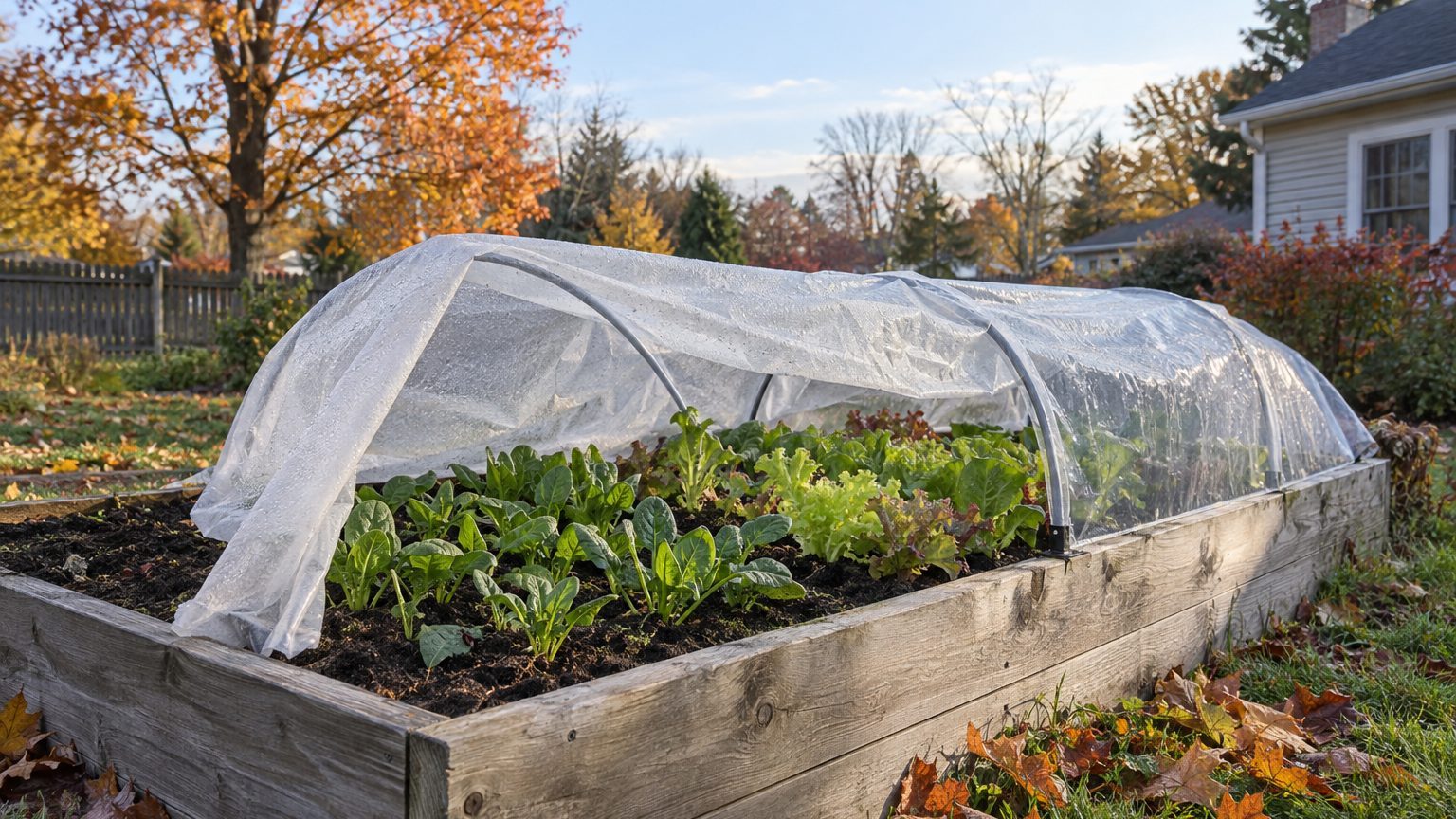

Around Montreal, the average last spring frost is May 6 and the average first fall frost is October 5. Covers push both edges of that window outward. They cannot move the real starting line, which is warm soil rather than a frost-free night. Quebec is also a huge province, and northern and upland districts run weeks behind the Montreal figures used here.
When the soil is warm enough in Quebec
The date most gardeners want is May 6. It is the average last spring frost at the MONTREAL/ST-HUBERT A station, from Environment and Climate Change Canada’s Canadian Climate Normals for 1981-2010. Read it as the midpoint of a window. In one year out of two, the last frost lands later than May 6, and a frost date is a probability, not a promise.
Frost is a proxy, soil is the real signal
Frost tells you when the air stops threatening to kill tissue. It says little about whether a seed will sprout or a transplant will root. Soil lags the air by a good margin, because a bed full of cold, wet earth takes far longer to warm than the air above it. So the soil warms after the frost risk ends, not with it. A bed sown on May 6 because the calendar allowed it can sit for weeks without a visible seedling.
A cheap soil thermometer settles the question better than any date. Push it in at seeding depth in the morning, when the ground is at its coldest, and compare the reading with the minimum germination temperature printed on the seed packet. Different crops want different minimums, so there is no single go signal. Spring peas and spinach tolerate chilly ground. Beans, squash and tomatoes do not, and a transplant set into cold soil stalls even if the air is mild.
This is where season extension earns its keep. A bed covered with fabric or clear sheeting some days before planting warms faster than an open one, which moves the soil-ready date earlier without touching the frost date.
What a cover does on a cold night
The mechanism is passive and simple. During the day the soil absorbs heat. At night it radiates that heat back out, and a cover traps part of it, holds the air still around the plants, and slows the loss. A second layer, such as fabric laid inside a hooped tunnel, adds another pocket of still air. The gain is real, but it varies with the material, the night, the wind, and whether the ground was warm to begin with. A calm, clear night after a cold, cloudy week is the case where a cover helps least, because there is little stored heat to trap.
So a cover shifts the limit. It does not remove it. A bed under fabric is not frost-proof, and a hard freeze after a mild stretch can still take the whole planting. Keep a plan for the nights when the forecast turns sharply colder than the week before.
Ventilation is not optional for any closed structure. A closed cold frame in spring sun can cook its contents in about an hour, even on a day that feels cool outside. Prop the lid open every sunny morning and close it again as the afternoon cools.
How long the season lasts here
The two Montreal/St-Hubert averages, May 6 for the last spring frost and October 5 for the first fall frost, leave a frost-free window of about 152 days. That is a little over five months. Both dates are means from the 1981-2010 normals, so in a given year the window can run shorter or longer. It is also measured at one station, and Quebec districts farther north or at higher elevation start later and finish earlier.
The number matters less than what it allows. A window of this length gives a first sowing and, for fast crops, a second one. Radishes, lettuce, spinach and other quick leafy crops can go in again in midsummer and still reach harvest size before cold arrives. The planting guide for staggered sowings, the succession sowing guide on this site, walks through how to space those dates backward from the fall frost.
Long-season crops are a different matter. Tomatoes, peppers and winter squash need most of those 152 days, and the real working time is shorter, since the soil warms after May 6 and growth slows as autumn light fades before October 5. Direct seeding them is a gamble with this calendar. Starting them indoors and transplanting is the better bet, with one catch: every transplant takes a root check when it moves, and the crops that sulk after being disturbed lose back some of the time the head start bought.
Season extension works at both ends of the window. In spring, a cover lets the first sowing go in earlier. In fall, it keeps tender leaves alive past the first frost, though it cannot make them grow once light drops. For contrasts in how other climates handle the same trade-off, Extending the Growing Season in Iowa covers a continental interior with its own frost pattern, and Extending the Growing Season in Oregon covers a milder, maritime one.
Heat and water in Quebec
What summer weather means for plants
A count like that would describe a single reference station anyway, not the whole of Quebec. Rather than guess, the more useful point is what changes when summers are not scorching: foliage that stays damp, cool nights that slow ripening, and disease pressure. Mildew thrives on crowded, wet leaves. Fruit set and ripening drag when the nights stay cool. Under a closed cover, humidity climbs even faster, which is another reason airflow is non-negotiable.
Light and cold set the limits
Two facts govern the season more than heat. The first is latitude. The reference station here, Montreal/Pierre Elliott Trudeau Intl, sits at 45.47 degrees north. Quebec spans many more degrees than that, so a gardener far north of Montreal should look up their own latitude. Latitude sets the date in autumn when daylight falls below what a crop needs to grow. After that date, a cover holds a crop alive rather than growing it. Anything meant for fall or winter harvest should reach harvest size before that point, not after it.
The second fact is the coldest month. At the Montreal reference station, the mean daily minimum of the coldest month is -14.1 °C (6.7 °F), from the 1981-2010 normals. That is an average of nightly lows, not the record low, so individual nights run colder. It decides what kind of protection is enough. A light fabric over hoops can shift the limit in spring and fall, but at those winter lows it is not enough to carry a crop through midwinter. Only a framed structure, ideally with fabric as a second layer inside it, has a chance of keeping hardy greens alive. Even that shifts the limit rather than erasing it, and a closed frame still has to be opened on sunny days.
For perennials and orchard crops, the relevant number is the hardiness zone. Natural Resources Canada places Montreal in zone 5b, using the Canadian hardiness system and its 1991-2020 normals. That is not a USDA zone, and it does not convert to one. The Canadian system uses seven climate variables where the USDA system uses one, so use it as a Canadian reference only.
Which season extension suit Quebec
Reason from the territory’s facts, and choose by type. A short window, the roughly 152 days between mean frost dates, favors the earliest types: low fabric tunnels and cold frames that warm the soil before planting and protect the first sowing. A humid or cool-damp summer makes disease resistance and airflow the first criteria, so any closed structure should open easily and vent from both ends. Hot-climate choices such as shade cloth and root-zone cooling are secondary here, since the page’s reference numbers point to cold and light as the limiting factors.
| Type of cover | Where it helps in Quebec | What to watch |
|---|---|---|
| Fabric over hoops | Early spring sowings and fall protection of tender leaves | Gain varies with the night and wind; not frost-proof |
| Cold frame | Hardening off, early greens, holding crops late in the season | Must be vented on every sunny day, or contents overheat |
| Framed tunnel with a second inner layer | Hardy greens held into the cold months | Still a shifted limit; humidity and disease build if closed |
| Clear sheeting laid on the bed before planting | Warming cold, wet soil ahead of the first sowing | Remove or vent once seedlings need air |
None of these types heats anything. Everything on that list is passive, and it should stay that way: no heaters, lamps or candles inside a covered structure, because the fire and carbon monoxide risks are real. For the general logic of what a cover buys and where it stops, see Extending the Season: What a Cover Buys, and What It Cannot.
Varieties depend on local conditions. A cultivar’s performance depends on local frost dates, soil and disease pressure, and the only recommendation that means anything is one from trials run in your own region. Quebec’s agriculture ministry, MAPAQ, is the place to start, along with local agricultural advisers who know what has actually grown in your district. Ask them which varieties have been trialled for short seasons and cool, damp summers, and favor those with documented disease resistance.
Common questions
Is May 6 a safe planting date for tender crops in Quebec?
No. May 6 is the average last frost at the Montreal/St-Hubert A station, so frost falls later than that in about half of all years. Soil also lags the air, so tender crops such as tomatoes and squash usually wait until the ground has warmed, which comes after the frost risk ends. A covered bed buys some margin, not a guarantee.
How long is the growing window near Montreal?
About 152 days, counting from the average last spring frost on May 6 to the average first fall frost on October 5, both from the 1981-2010 normals at the Montreal/St-Hubert A station. Districts farther north or higher up have shorter windows.
Can a cover carry crops through a Quebec winter?
Light fabric alone will not. The mean daily minimum of the coldest month at the Montreal reference station is -14.1 °C (6.7 °F), and individual nights run colder. Hardy greens have a better chance in a framed structure with a second inner layer, though it shifts the limit rather than removing it. Open it on sunny days to prevent overheating, and never add a heater or flame inside.
Is Quebec’s zone 5b the same as USDA zone 5b?
No. Montreal sits in zone 5b of the Canadian hardiness system, which draws on seven climate variables and 1991-2020 normals. The USDA map uses one variable, and the two do not convert. Note too that the frost dates cited here come from 1981-2010 normals, a different period from the 1991-2020 figures used for US pages on this site.