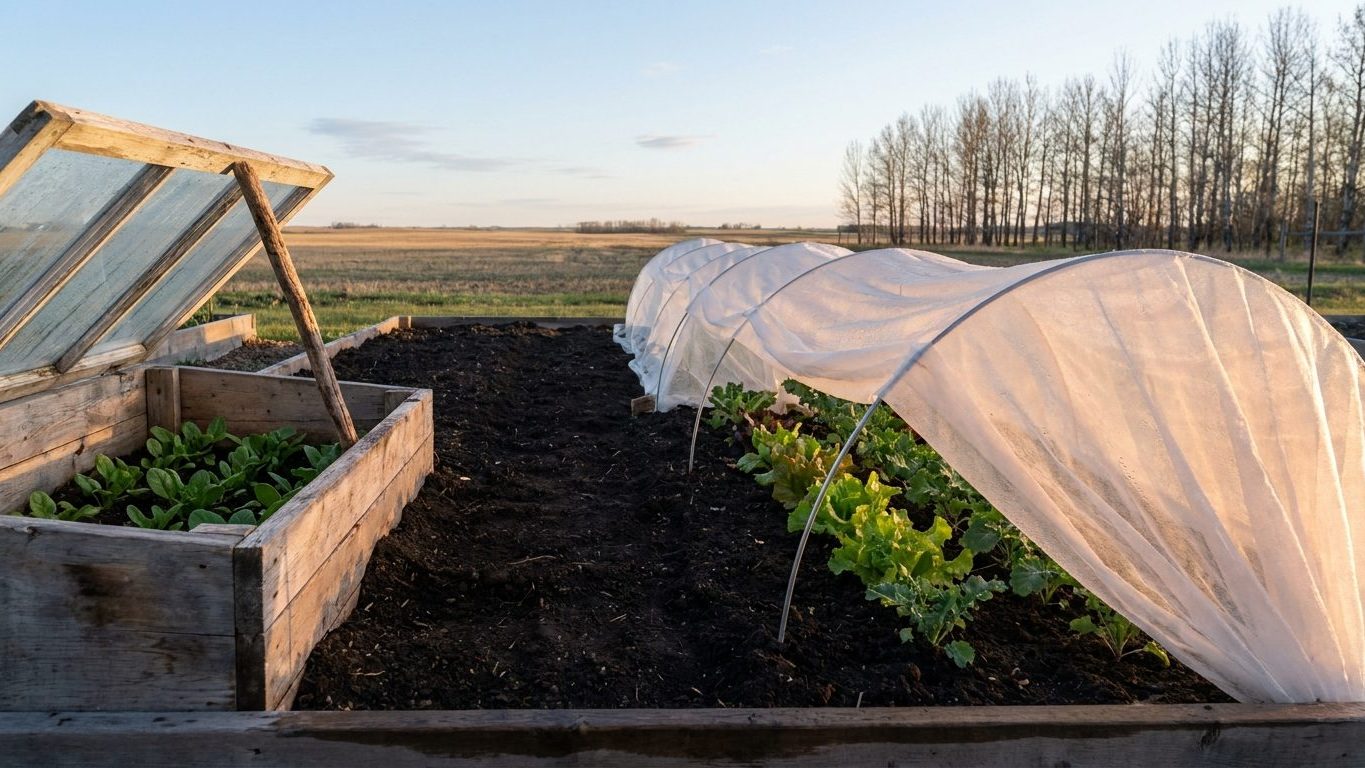

Floating row cover, low tunnels and cold frames do most of the work in Rhode Island. They add a few weeks at each end of the season, which suits a mild coastal spring and a long, slow fall. Unheated hoop structures carry hardy greens through winter. Heated greenhouses and heavy plastic left on in summer rarely repay the effort here.
The short answer for Rhode Island
Use lightweight row cover and low tunnels first, add a cold frame for hardening off and winter greens, and treat a high tunnel as the step up only if you garden seriously. Those three cover nearly every gap the state’s climate leaves open. The reference figures come from Providence, where the last spring freeze at 32°F falls between April 7 and April 17 and the first fall freeze between October 24 and November 3. Both ranges mark the 30 to 70 percent band of probability for a 32°F freeze, so a freeze can still arrive after the later spring date or before the earlier fall one.
The Providence station sits frost-free from mid-April to the end of October on average. That is a decent season for tomatoes, squash and beans, yet it leaves spring and fall cold snaps on both sides. Covers fit those edges. A single layer of fabric over a bed adds a few degrees of protection on a frosty night, enough to carry seedlings through a late April dip or a pepper plant through the first October frost. It will not rescue a tender crop from a hard freeze.
The coldest month averages a daily minimum of 22.1°F in Providence. That number decides what can stay out through winter under cover: spinach, kale, mâche, carrots, scallions and similar hardy crops, protected from wind and wet snow rather than heated. Tomatoes, basil and cucumbers belong to the frost-free months, with covers only stretching the shoulders.
Which extender suits which job?
| Extender | Best use in Rhode Island | Main limit |
|---|---|---|
| Lightweight row cover | Late April frost nights, early fall frost, insect screening | Little protection in a hard freeze |
| Low tunnel (hoops plus fabric or plastic) | Early spring sowings, fall greens into December | Needs venting on sunny days; hoops bend under wet snow |
| Cold frame | Hardening off, lettuce and spinach through winter | Overheats fast on a sunny day if unvented |
| Walls of water and cloches | Single tomato or pepper plants set out in mid-spring | Covers one plant at a time |
| High tunnel | Winter harvest and early planting at scale | Cost, snow load, summer heat |
For a broader look at how these tools fit together, see Extending the Growing Season in Rhode Island.
What will not work here
A thin sheet of clear plastic over a bed, closed up and left alone from April through October, fails first. Rhode Island summers are humid, and sealed plastic holds that moisture against the plants. Leaf diseases build up quickly under it, and slugs thrive in the damp shade a cover creates. Fabric lets air and water through, and plastic has to be vented or removed once the weather settles.
Planting tender crops on April 7 because that date appears on a chart is the second mistake. That date belongs to the Providence airport station and marks only the start of a window that runs to April 17, with a 30 to 70 percent chance of a freeze at 32°F around it. Suburban and rural gardens usually see the last spring frost later than the city does, often by one to two weeks, and more at elevation. A tomato set out on the airport date in a hollow in the northwest hills is gambling against that gap. Covers help, but they are a backup for a surprise cold night, not a license to plant early.
Heated greenhouses rarely pay off for home gardeners in this state. With a coldest-month mean minimum of 22.1°F, the cold is real but not severe enough to justify heating a structure just to keep spinach alive. Unheated protection handles that temperature with ease. At 41.72 degrees north (Providence), midwinter daylight is thin enough that growth nearly stops under any cover, however warm. What cover does in winter is hold finished plants in good condition for harvest, not make new growth. Sow fall crops early enough to be nearly full size by the time the days shorten.
Snow is the third problem. New England storms drop heavy, wet snow, and a low tunnel with widely spaced hoops of thin wire can collapse under it. Close the hoop spacing, use stiffer material, and brush snow off or take the cover down before a big storm. Coastal wind is similar: a loose cover will lift and shred unless it is pinned down with soil, boards or sandbags along every edge.
The last failure is trying to rescue summer crops far past the first fall freeze. The window between October 24 and November 3 is the reference-city range, and rural gardens can see frost a week or two sooner. A cover will hold a pepper plant for a few extra weeks, but by November the light is too weak and the soil too cool for tomatoes to ripen. Spend that effort on hardy fall crops instead. For timing specifics on when to put covers on, read When to Cover Your Garden in Rhode Island.
What changes across Rhode Island
No single zone describes the state. USDA hardiness zones here run from 6a to 7b under the USDA Plant Hardiness Zone Map 2023, built on the average annual extreme minimum temperature. That is a spread of several steps, and it follows geography. Gardens close to Narragansett Bay and the ocean sit at the warmer end, moderated by water that holds heat into fall and cools slowly in spring. Gardens inland and in the northwest corner sit at the colder end, with sharper winter lows and later springs.
A reader near the coast can often count on the longer end of the season, and overwintered hardy crops under a tunnel face the least stress there. The trade-off is wind and salt spray, which make anchoring covers a bigger task. A reader in the colder, higher interior should shift everything later in spring and earlier in fall. Plan to put out covers a week or two sooner in autumn and keep them on a week or two longer in spring. Walls of water and cold frames earn their keep more there, because a single frosty morning in mid-May is a real possibility.
Cold air drains downhill and pools in low spots, so a garden at the bottom of a slope can be several degrees colder on a still night than one thirty feet higher. Frost dates from Providence are a reference point only.
To learn which zone your own garden falls in, look up your address on the USDA Plant Hardiness Zone Map instead of assuming. Zone numbers describe winter survival of perennials, while frost dates govern when tender crops can go out. A garden can be a mild zone and still have a late spring frost, so check both.
Where to check this for your own county
University of Rhode Island Cooperative Extension is the place to start. It is the state’s land-grant extension service, and its staff and master gardeners know local conditions that no statewide chart captures. Look there for two things: a planting calendar written for your part of the state, and the vegetable varieties that have been trialled in conditions like yours. A variety that thrives near the coast may sulk in the cooler hills, and trial results tell you which is which.
Local advice beats state figures, including the Providence frost dates above, which average over a lot of different ground. When the two disagree, go with the local source.
Ask extension staff specific questions. When does frost typically arrive where you live compared with Providence? Which cover fabrics hold up in coastal wind? How do they handle snow load on hoop houses? Many extension offices also run soil testing and answer garden questions by phone or email, and their seasonal fact sheets often cover row cover, cold frames and fall crops in detail. Check what is available before spending money on a structure, since the right choice depends on your site.
Checking this against your own garden
Your own observations outrank every date in this article. A few simple habits will tell you more about your garden’s microclimate than a chart can.
- Soil warmth by feel. Push your hand a few inches into a bed in spring. If it feels cold enough to ache after a few seconds, tender seeds will sit and rot. Test beds under cover against open ground. A bed that feels clearly warmer is giving you a real head start, and one that feels the same means the cover is not earning its place.
- Where frost lingers. On a frosty morning, walk the garden and note where white stays on the grass longest. Those spots are your cold pockets, and they need covers sooner and longer than the rest of the yard.
- First true leaves. After sowing a test row of lettuce, spinach or beans, watch for the first true leaves, the ones that look like the adult plant after the seed leaves. Quick, even emergence means conditions suit the crop. Slow, uneven or yellowing growth means it is still too cold, wet or shaded.
Keep a few lines in a notebook. After two or three seasons, those notes will predict your garden better than any airport station.
Common questions
Is row cover enough to protect plants from a frost in Rhode Island?
For a light frost, yes. A single layer adds a few degrees of protection on a clear, still night, which is enough for seedlings and many hardy crops. In a hard freeze it is not enough, so add a second layer or a tunnel over the fabric, or bring potted plants indoors.
Can I grow vegetables through winter in Rhode Island without heat?
Hardy crops such as spinach, kale, mâche, carrots and scallions can stay in the ground under a cold frame or tunnel. Plants hold in good condition rather than grow, because winter days are short. Sow in late summer so they reach near full size before the light fades.
When is it safe to take covers off in spring?
Watch the forecast more than the calendar. At the Providence reference station the last 32°F freeze falls between April 7 and April 17, but gardens farther inland and uphill often see it a week or two later. Vent covers on sunny days first, then remove them once nights stay well above freezing.
Does a cold frame work in Rhode Island’s humid weather?
Yes, with attention to ventilation. Crack the lid on sunny days so heat and moisture escape, and close it before evening. A sealed frame overheats and holds damp air that encourages leaf disease.