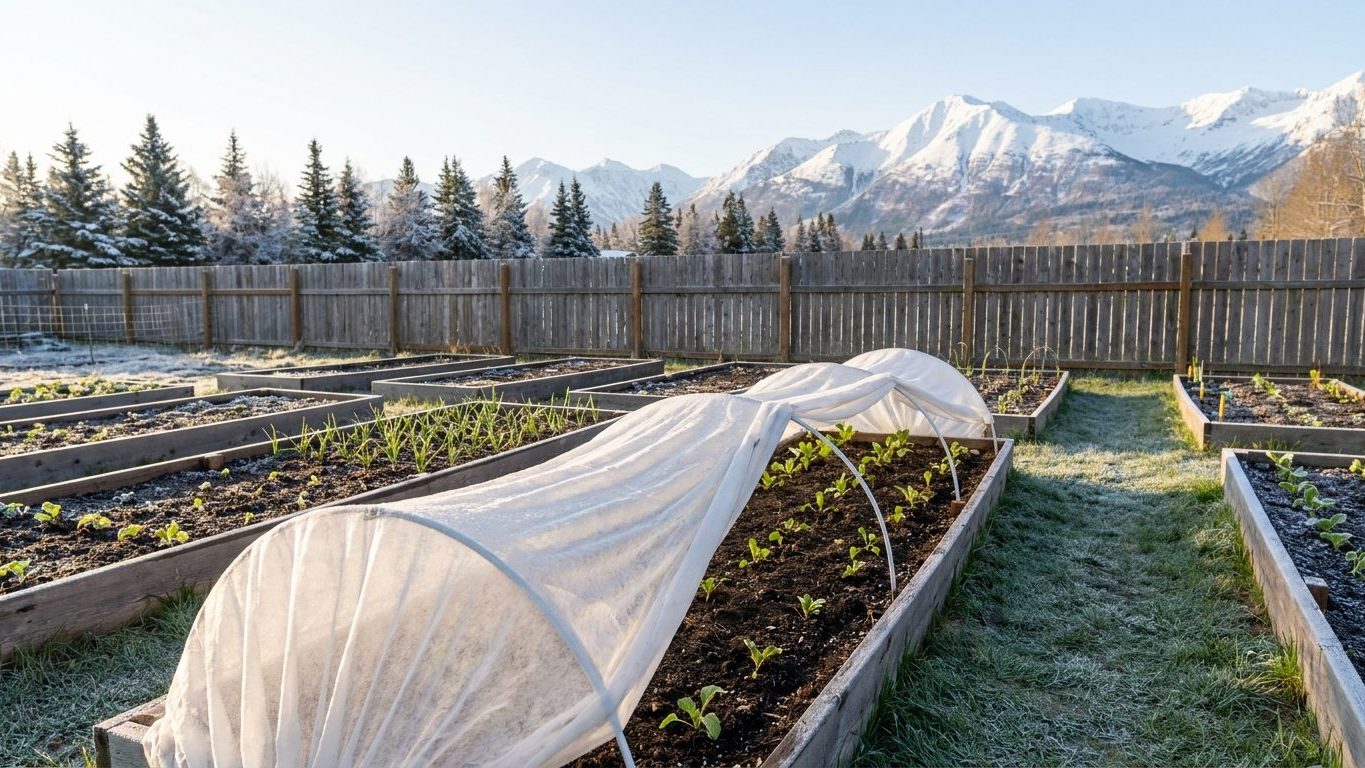

Cover the garden on any night the forecast shows temperatures near 0 °C, starting before the mean last spring frost of May 6 and again before the mean first fall frost of October 5. Those dates come from the Montreal/St-Hubert station. Tender crops need cover until nights settle above freezing, while hardy crops can go under cover earlier in spring and stay out later in fall.
The short answer for Quebec
Cover tender crops such as tomatoes, peppers, squash, cucumbers and beans on every night forecast near 0 °C, from the day they go outside until the nights stay reliably above freezing. In fall, put the cover back on as October 5 approaches. Hardy crops such as spinach, lettuce, kale and peas tolerate light frost on their own, so cover them mainly for hard freezes and to speed growth in cold spring soil.
What do the May 6 and October 5 dates actually mean?
Environment and Climate Change Canada’s 1981-2010 normals for the Montreal/St-Hubert A station put the last spring frost on average on May 6 and the first fall frost on average on October 5. The reference station has about 152 frost-free days between those two dates. Both are averages. In one year out of two, the last frost falls after May 6, and in one year out of two the first fall frost arrives before October 5. Treat each date as the middle of a window that runs a couple of weeks either way, never as a safe date.
Canadian normals cover 1981-2010, while US figures on this site cover 1991-2020, so a comparison across the border is only approximate. A province is also not one climate. These numbers describe the Montreal area, and northern or upland districts run weeks behind.
When should each type of crop go under cover?
A cover holds the heat the soil gave off during the day and keeps a thin layer of warmer air around the plants. That is enough to turn a light frost into a non-event. It is not enough to save plants from a hard freeze. The table gives the working rule by crop group.
| Crop group | Spring | Fall |
|---|---|---|
| Hardy (spinach, lettuce, kale, peas) | Sow early and cover to warm the soil. Keep a cover handy for hard freezes. | Cover for hard freezes and keep harvesting well past October 5. |
| Tender (tomatoes, peppers, squash, cucumbers, beans) | Set out after May 6 has passed, with cover on any night near freezing. | Cover on the first frost forecast to buy extra weeks of harvest. |
The simplest habit is to check the overnight low every evening from late April through May, and again through all of September and October. If the low is within a couple of degrees of freezing, cover. The cloth costs far less than replacing a tray of transplants.
What will not work here
The short season rules out the slowest crops, even with extension. About 152 frost-free days is enough for tomatoes, beans and most squash, but long-season melons, sweet potatoes and big winter squash have little margin. A tunnel or cover gains a couple of weeks on each end, and those crops can need all of it. Pick the earliest varieties of anything that wants a long, hot summer.
Cold is the other limit. The mean daily minimum of the coldest month, at the Montreal reference station, is -14.1 °C (6.7 °F). At that temperature a single layer of lightweight row cover does almost nothing. It will not keep a salad crop growing in January, and an unheated plastic tunnel only buffers a few degrees of that cold. Winter harvests need heavier structures, and even then, short winter days at about 45.5 degrees north limit growth. Hardy greens hold in a protected frame, but they do not put on new leaves.
Which covering mistakes do the most damage?
Clear plastic left closed on a sunny April day can overheat a tunnel in an hour, and seedlings that were fine at dawn wilt by noon. Vent plastic on any bright day, and pull it back on again before sundown. Humid Quebec summers add a second problem: a sealed tunnel in July stays damp, which invites fungal disease on tomatoes and cucumbers. Leave the ends open and let air move through.
Lightweight cover also blows away unless every edge is pinned down with soil, boards or landscape staples. Wind lifts the edge, cold air gets underneath, and the protection is gone. In winter, snow adds weight that a thin hoop frame will not carry. Brush heavy snow off hoops after each storm, or take the plastic off for the season.
Finally, cover that goes on after the frost has already hit does not reverse the damage. It goes on in the evening, before the temperature drops, and comes off the next morning once things warm up. For a more detailed look at which materials suit which job, see Which Season Extenders Work in Quebec.
What changes across Quebec
Montreal sits in Canadian hardiness zone 5b, according to Natural Resources Canada’s 1991-2020 data for the reference city. That is a Canadian zone, built from seven climate variables, and it does not convert to a USDA zone. Natural Resources Canada states that there are no simple conversions between the systems. Canadian zone 4a alone overlaps nine USDA zones, from 3a to 7a, so never carry a zone number across the border.
Zone 5b describes one city, and the province is much bigger. Quebec stretches from the milder southwest to the cold north, so there is no single answer for the whole province. A gardener in the Eastern Townships, the Laurentians, the Saguenay or the Gaspé works with a different calendar than Montreal’s. Northern and upland gardens run weeks behind the May 6 and October 5 dates, which narrows the growing season on both ends.
The practical shift is simple. In colder or higher districts, the last spring frost comes later and the first fall frost comes sooner, so the window for tender crops is shorter. Cover earns more there, but it also has to start earlier in fall and stay on later in spring. Expect to rely on low tunnels and cold frames for a bigger share of the season, and lean on fast varieties.
To find your zone, use Natural Resources Canada’s Plant Hardiness Site and look up your own municipality. Do not assume your zone from a neighbor or from the nearest big city. For the wider picture, start with Extending the Growing Season in Quebec.
Where to check this for your own county
A provincial date is a starting point. The guidance for your own county or regional municipality (MRC) beats it, because it reflects the soil, elevation and frost pockets nearby. The timing given above is the provincial rule of thumb, drawn from one station, and local advice should override it where the two disagree.
The place to start is MAPAQ, Quebec’s agriculture department, and the regional agricultural advisors it points to. Two things are worth looking for. The first is a local planting calendar with dates for your area: when the soil can be worked, when tender crops can go out, and when the first fall frost usually arrives. The second is a list of varieties trialled in your region, which matters more than it sounds. A tomato that ripens reliably near Montreal may stall in a colder district, and regional trials show which ones finish.
Checking this against your own garden
Your own observations outrank every date above. Two things are easy to watch, and neither needs equipment.
- Soil warmth by feel. Push your hand a couple of inches into the bed in the morning. If it feels cold enough to make you pull back, the soil is too cool for tender transplants. A bed that warms sooner than a neighbor’s tells you about drainage and sun exposure, and a raised bed on a south-facing slope will usually lead.
- The first male squash flowers. Squash and cucumbers open male flowers a week or so before female ones. When they appear, the plant is responding to sustained warmth, which tells you the garden has turned the corner.
Walk the yard on a clear, still morning after a cold night. Frost on the lawn in one corner and none in another shows where cold air collects, and those low spots need cover first. A south-facing wall tells the opposite story, because it holds heat and may be the best place for the earliest tender crops. Write the dates down year after year, and within a few seasons the garden has its own calendar.
Common questions
Should I cover plants if the forecast low is 2 °C?
Yes, for tender crops. Clear, calm nights can drop several degrees below the forecast low at ground level, especially in low spots. A light cover costs little and adds a few degrees of margin.
Is it safe to plant tomatoes outside on May 6?
Only with protection. May 6 is the average last frost, and in one year out of two the last frost comes later. Wait until the forecast shows nights above freezing, or keep cover ready for every night that might dip close.
How late in fall can I keep covering crops?
Hardy greens such as spinach, kale and lettuce can keep going well past the October 5 average first frost with a cover. Tender crops will not grow more once nights stay cold, but a cover can protect fruit already on the plant for a few extra weeks.
Does row cover work in winter in Quebec?
Light row cover does not keep plants growing when the coldest month averages a daily minimum of -14.1 °C. It can help hardy crops survive in a protected frame, but expect them to hold, not to grow. Heavier structures and snow management are required for any winter harvest.