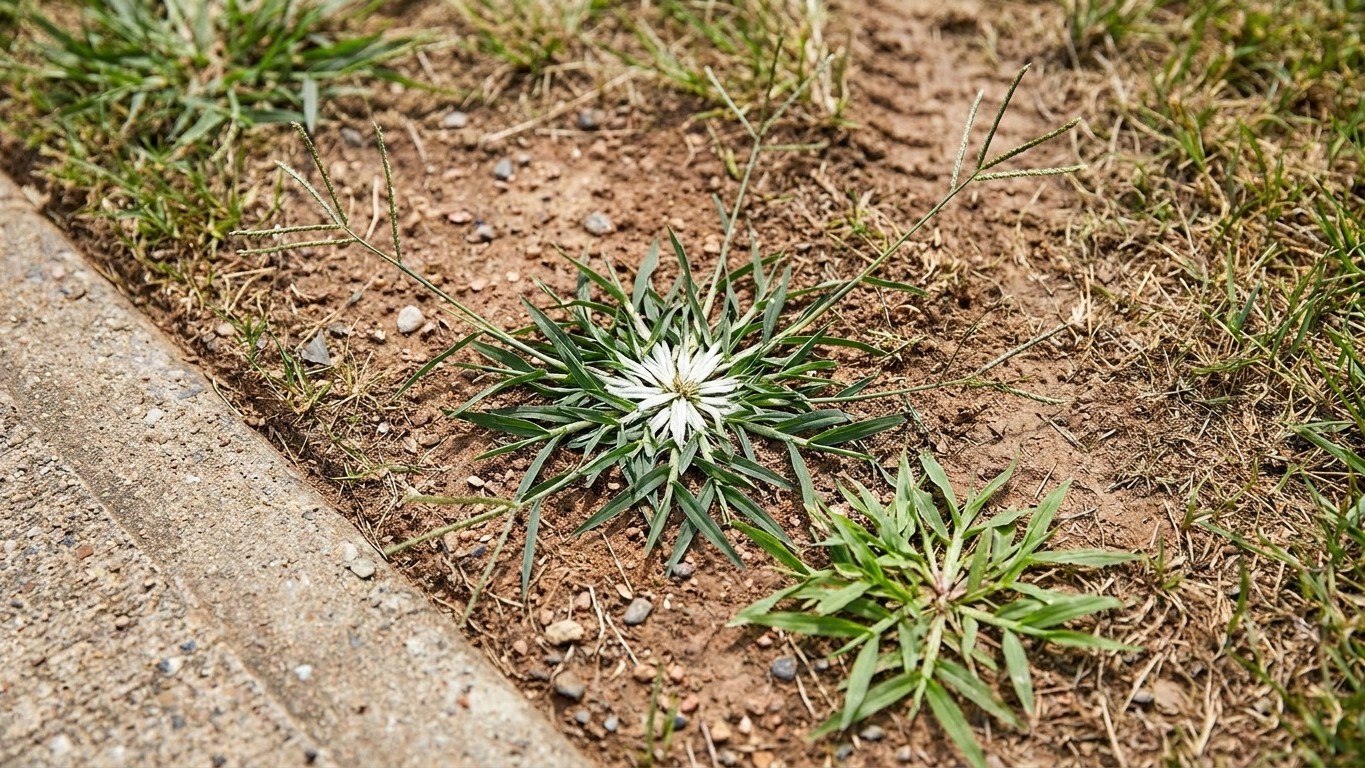

Sow cool-season grass seed in Michigan from late August to mid September, and finish at least 45 days before your first fall frost. For zone 6a, MSU Extension lists that frost between October 6 and October 21. Spring seeding is the fallback, once soil two inches down reaches 50 to 65 °F. It is October 10 as you read this, so most lawns have already missed the fall window, and the section on the last workable date explains what that means.
The best time to sow grass seed in Michigan
Soil temperature decides it, not the calendar
Cool-season grass seed germinates in soil between 50 and 65 °F. Measure at two inches down, mid-morning, with a probe or a meat thermometer. Air temperature misleads you because soil lags behind it in both directions. In late summer the ground is still warm from July and cools into the germination range just as the days shorten. In spring it works in reverse, so seed sown too early sits cold and idle.
Frost dates give you a rough frame. MSU Extension puts the last spring frost around April 30 in the Detroit area, and early to mid May across most of the Lower Peninsula. Those are single-region figures, and they do not carry to the Upper Peninsula.
Late summer wins for a practical reason. Seedlings sown in August and September get warm days to grow and cool nights that keep them from baking. Seed sown in May has the opposite problem: roots are barely down when July heat arrives. Spring seeding can work, but it asks more of your watering hose.
Which grasses belong in a Michigan lawn
Five cool-season species are recommended here, and seed mixes are usually built from them:
- Fine fescues
- Kentucky bluegrass
- Perennial ryegrass
- Rough bluegrass
- Tall fescue
Warm-season grasses are left off the list on purpose. They are built for long, hot summers, grow hardest when soil is well above the cool-season range, and go dormant when it cools. Michigan’s warm season is short and its winters are long, so a warm-season lawn greens up late and browns early. Seeding one means waiting for heat that arrives too late to give it a full season of roots. Even a stand that survives looks tired for much of the year.
For a broader walk through the process, see Starting a New Lawn From Seed.
The last date that still works
Seed needs about 45 days of growing weather before the first fall freeze. Sown later than that, it germinates, then dies over winter. The seedlings are up but have too little root to survive frozen ground. You find the deadline by counting back from your first fall frost date.
Using the MSU Extension Michigan Garden Calendar range for zone 6a, with the frost date standing in for the freeze date, the arithmetic looks like this:
| First fall frost | Count back 45 days | Last sowing date |
|---|---|---|
| October 6 (early end) | 45 days | August 22 |
| October 21 (late end) | 45 days | September 6 |
Read it as a window with a hard edge. Late August is safe almost anywhere in the zone, and early September is safe only where frost holds off toward the later date. Frost can land at the early end of the range, which is why the earlier date is the safer target. Nobody can promise which end of that range a given year will hit.
Michigan is long and its climate varies with latitude and distance from the lakes. The zone 6a range does not describe the northern Lower Peninsula or the Upper Peninsula. Neither region has a published frost range here. If you garden up north, find your own first frost date and count back 45 days from it. Expect your deadline to fall earlier than the August 22 to September 6 window above.
If you are reading this in October, as of this year’s October 10, the window has closed for most lawns. Resist the urge to scatter seed anyway. It will germinate, look promising for a few weeks, then vanish. Wait for spring and watch soil temperature, not the calendar. Neighbors in other northern states face the same arithmetic with different dates, which you can compare in When to Plant Grass Seed in Massachusetts and When to Plant Grass Seed in Vermont.
Seed rate and soil preparation
What Michigan’s state soil says about your yard
Michigan’s official state soil, named by state law in 1990, is the Kalkaska series. It is a Spodosol: sandy, acid, strongly leached, and typically found under conifers. USDA records for its surface layer show a pH of about 4.7, which is strongly acid. The mix is 86 percent sand, 5 percent clay, and 9 percent silt. It is somewhat excessively drained, so water runs through it quickly.
Treat that as a tendency, not a description of your lot. Michigan has hundreds of soil series, and river bottoms, clay-heavy ground, and any yard a builder has scraped or filled will behave differently. The 75 percent organic matter in the USDA figure is a natural forest-litter layer, not something a cultivated lawn bed has. Never read the 4.7 as your own pH. What the series suggests is that sandy ground in this state tends to drain fast and run acid, so watering and lime questions come up often. A soil test gives you the real number, and MSU Extension can point you to testing options.
How much seed, and how deep
Rates below are pounds per 1,000 square feet for a new lawn. Overseeding an existing lawn takes half.
| Species | New lawn (lb per 1,000 sq ft) | Overseeding (half) |
|---|---|---|
| Tall fescue | 6 to 8 | 3 to 4 |
| Fine fescues | 4 to 6 | 2 to 3 |
| Rough bluegrass | 2 to 3 | 1 to 1.5 |
| Kentucky bluegrass | 1 to 3 | 0.5 to 1.5 |
| Perennial ryegrass | 4 to 10 | 2 to 5 |
Take a 5,000-square-foot yard of straight tall fescue: that is 30 to 40 pounds. More seed does not insure against thin spots. Seedlings crowd each other, compete for water, and thin themselves out.
Depth matters more than most people expect. Cover seed with no more than 0.25 inch of soil, and press it so each seed touches the ground. Seed buried deeper often never emerges, and it is the single most common reason a new lawn comes up patchy. Rake lightly, roll or tamp, and stop. On fast-draining sandy ground, good seed-to-soil contact also helps the seed hold moisture.
Watering a new lawn until it holds
The first weeks decide the lawn. Seed that swells with water and then dries out is lost, and that happens easily on a sunny afternoon in September. Keep the seedbed from drying out between waterings. Because sandy Michigan ground drains quickly, that usually means short, frequent passes at first, not one long soaking.
Ground that holds water behaves differently. Heavy or compacted soil, common where a builder has scraped a lot, stays wet longer and can puddle. There, shorter and less frequent watering prevents rot and washout. Check the surface with your finger, not the clock. A lawn on sand and a lawn on fill dirt need different schedules even if they were seeded the same day.
As seedlings fill in, shift gradually toward deeper, less frequent watering. That pushes roots down, which is what carries a lawn through its first winter. The 45-day growing window is the period when roots do that work. In the weeks before frost, roots are what stand between a lawn and winterkill, so keep watering after the grass looks established.
A hard rain right after sowing can wash seed into low spots or float it off a slope. If that happens, rake the seed back and re-cover it lightly. On a slope, a thin mulch layer keeps seed in place. For mowing heights and first-mow timing, check MSU Extension for the species in your mix.
Common questions
Can I plant grass seed in Michigan in October?
Only early in the month, and only in the mildest areas. Seed needs about 45 days of growing weather before the first fall freeze. With zone 6a frost listed between October 6 and October 21, October sowing leaves too little time. Seed sown that late germinates and then dies over winter. Wait for spring.
Is spring or fall better for seeding in Michigan?
Fall, because late-summer soil sits in the germination range while days stay warm enough to grow. Spring works too once soil two inches down reaches 50 to 65 °F, but summer heat arrives soon after, so seedlings have less time to root.
What grass types grow best in Michigan?
Cool-season species: fine fescues, Kentucky bluegrass, perennial ryegrass, rough bluegrass, and tall fescue. Warm-season grasses are not recommended, since they stay dormant through much of Michigan’s long cool season and cannot establish well from seed in a short warm one.
How much grass seed do I need per 1,000 square feet?
It depends on the species. A new lawn takes 6 to 8 pounds of tall fescue, 4 to 6 of fine fescues, 2 to 3 of rough bluegrass, 1 to 3 of Kentucky bluegrass, or 4 to 10 of perennial ryegrass. Mixes vary, so follow the bag. Overseeding takes half of these rates.
If you follow the almanac, here is when to plant grass seed by the moon. It is a tradition, not a proven method.