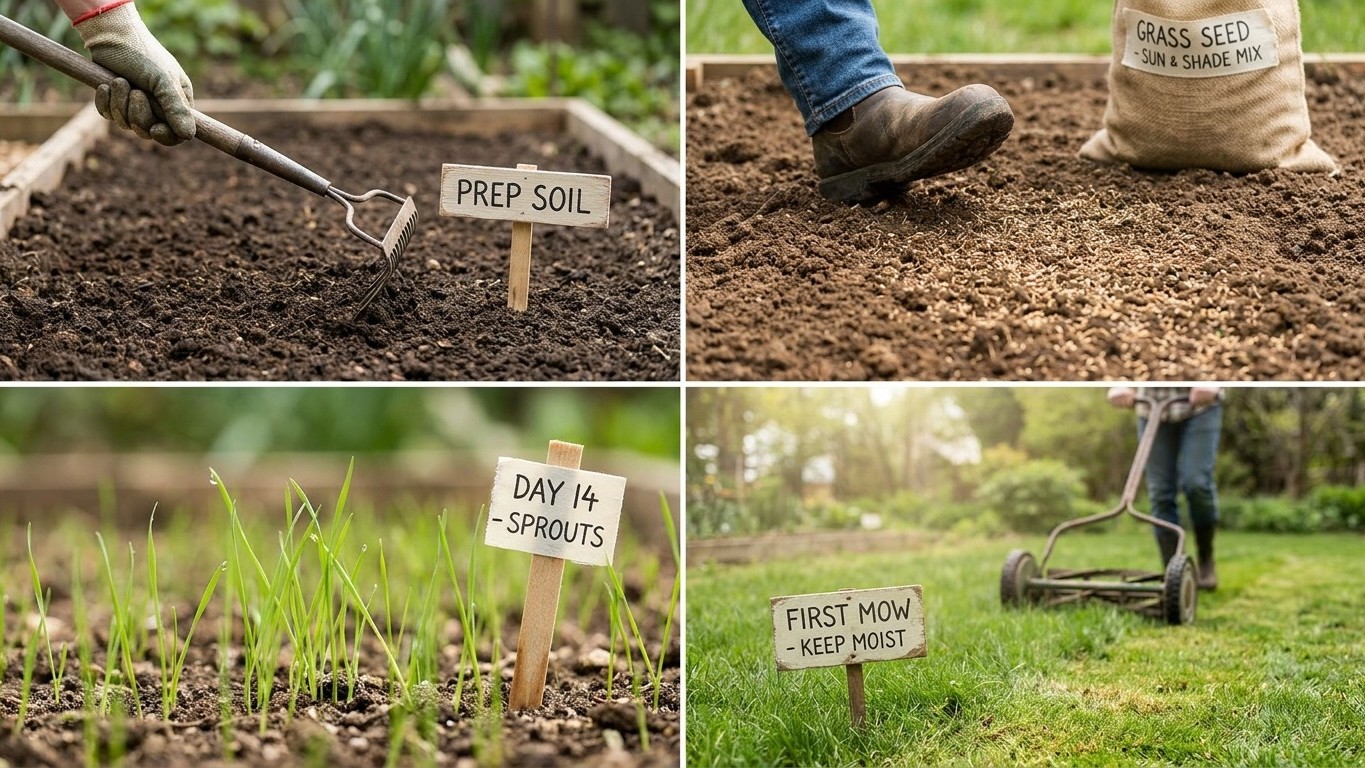

When’s the right time to mow a new lawn for the first time? Once the grass blades reach the top of the mowing height range for whatever species you planted, not just when it looks green from the porch. Cutting sooner than that pulls seedlings straight out of the loose soil before their roots have grabbed hold, and a lawn that looked thick at three weeks can go patchy again at five. So before you do anything else, go find out what species you seeded and what its target height actually is — that number is what tells you when to make the first pass.
Why this matters
Skip a step in ground prep and the lawn does not tell you right away. Seed germinates unevenly over compacted soil or low spots, and the failure shows up as bare, weedy patches weeks after you thought the job was finished, not the day you scattered the seed. By then a cool-season lawn may have already lost its fall growing window, and a warm-season lawn its summer one. If you have not decided between seed and an established start, the broader choices in Lawn Care are worth settling first, since the steps below assume you have already picked seed over sod.
Grading the soil before seed goes down is the step growers skip most often, because a rough site looks fine to the eye. It only reveals itself in the first heavy rain, when water pools in the low spots and carries seed into the gutter or against a foundation. A lawn seeded on an ungraded, uncompacted bed also roots shallow, so it wilts sooner than a properly prepared one and shows drought stress earlier in its first summer.
The other quiet failure is mowing too soon. New seedlings pull out of loose soil under a mower’s wheels before their roots have anchored, and a lawn that looked full at three weeks can look thin again at five. Waiting for the grass to reach the top of its species’ mowing height, not just some green fuzz you can see from the porch, is what protects the stand through that first cut.
When to do it
Cool-season grasses and warm-season grasses grow on opposite calendars, and the seeding window follows the growing season, not a fixed month. Cool-season species such as Kentucky bluegrass, perennial ryegrass, fine fescues, and rough bluegrass, all covered by Penn State Extension’s lawn establishment guidance, do their growing in cooler weather and are seeded when that cooler growth is ahead of them rather than behind them. Warm-season species such as bermudagrass, zoysiagrass, centipedegrass, St. Augustinegrass, bahiagrass, carpetgrass, and seashore paspalum, all covered by Clemson Cooperative Extension HGIC 1214, grow through the heat of the year and are seeded once that heat has arrived and soil temperatures have caught up with it.
Tall fescue sits in an odd spot on this list. Clemson HGIC 1214 classifies it as cool-season, and HGIC 1219, the Tall Fescue Maintenance Calendar, lays out its yearly rhythm in more detail than the general establishment sheet does. If you are growing tall fescue in a region where summers run hot, that maintenance calendar is worth reading alongside your local extension office’s seeding dates, because tall fescue’s cool-season habit and a hot climate pull in different directions.
No calendar date holds across a whole state. Frost dates and soil-warming dates shift by weeks between a coastal county and an inland one, so the only reliable move is to check the seeding window your own state extension service publishes for your area, then work backward from there for soil prep and starter fertilizer application.
How to do it

Grading, testing, and the seedbed
Start with a soil test through your state extension service or a private lab. Clemson HGIC 1203 recommends testing before establishment specifically because lime and phosphorus, unlike nitrogen, need time worked into the root zone and do little good spread on top of finished turf later. Grade the site so water runs away from the house and off the low spots, then loosen the top few inches with a rake or a rented dethatcher so the seed has something to root into besides a crust.
Apply a starter fertilizer at the rate printed on its bag label, given in pounds of product per 1000 square feet, as described in HGIC 1201, Fertilizing Lawns. Rates vary by the fertilizer’s nitrogen, phosphorus, and potassium content, so the bag’s own math is the one to follow. Sow at the seeding rate on the seed label, also given per 1000 square feet, and keep the seed shallow. Covered too deep, cool-season and warm-season seed alike simply fails to emerge.
Setting the mower height for the species you planted
The mowing height you are working toward is not one number. It depends on the species, and the ranges below come from Penn State Extension’s lawn establishment sheet for the cool-season grasses and Clemson HGIC 1214 for the warm-season ones.
| Grass | Season | Mowing height | Shade tolerance | Drought tolerance |
|---|---|---|---|---|
| Fine fescues | Cool | 2.5 to 3.5 in | Excellent | Good |
| Kentucky bluegrass | Cool | 2 to 3 in | Fair | Fair |
| Perennial ryegrass | Cool | 2 to 3 in | Fair | Fair |
| Rough bluegrass | Cool | 2 to 3 in | Excellent | Poor |
| Tall fescue | Cool | 2.5 to 3.5 in | Good | Fair |
| Bermudagrass | Warm | 0.75 to 1.5 in | Very poor | Excellent |
| Zoysiagrass | Warm | 0.75 to 2 in | Excellent | Good |
| Centipedegrass | Warm | 1.5 to 2 in | Fair | Fair |
| St. Augustinegrass | Warm | 2.5 to 4 in | Excellent | Good |
| Bahiagrass | Warm | 3 to 4 in | Poor | Excellent |
| Carpetgrass | Warm | 1 to 2 in | Fair | Very poor |
| Seashore paspalum | Warm | 1 to 1.5 in | Poor to fair | Fair to good |
Let the seedlings grow to the top of that range before the first mow, then cut back to the middle of it. Clemson HGIC 1205, Mowing Lawns, is the source to check for the general mowing practices that apply once the lawn is established, including how much leaf tissue to remove per pass.
What goes wrong
Failures at the seedbed and germination stage
Seed washed into low spots or storm drains is the most common early failure, and it shows up within days as bare streaks running downhill from where the seed actually landed. The fix is regrading and reseeding those streaks, not more seed scattered on top of the same slope.
A crusted seedbed, where the topsoil dried into a hard skin before germination finished, shows up as patchy, thin emergence rather than a clean failure. Light, frequent watering during germination is what Clemson HGIC 1203 recommends specifically to prevent that crust from forming in the first place.
Failures after germination
- Scalping: cutting more than the top growth off in one pass, visible within a week as yellow-brown stubble where green blades were.
- Mowing before rooting: seedlings pull loose under the mower’s wheels, visible as bare tracks in the mowing pattern.
- Underfed turf: a starter fertilizer skipped or under-applied shows up as pale, slow-thickening grass over several weeks rather than a sudden problem.
- Uneven stands mistaken for disease: thin patches that never filled in are sometimes pest damage rather than a seeding failure, and the symptoms in Lawn Pests: The Damage Each One Leaves Behind are worth checking against what you’re seeing before you reseed the same spot twice.
Remember that brown is not dead. Both cool-season and warm-season grasses go dormant under stress and often recover once conditions improve, so a lawn that browns off in its first hard summer or first hard frost is not necessarily a failed establishment. If a section stays bare rather than just brown through a full growing season, that is the point to reseed or consider Laying Sod: What It Buys You and What It Costs for that patch instead of waiting on seed a second time.
How this changes across the country
A grower in Pennsylvania, working with Kentucky bluegrass, perennial ryegrass, or fine fescue under Penn State Extension’s guidance, is timing establishment around a cool growing season and can expect shade tolerance from fine fescue that a warm-season lawn in the same yard would not offer. A grower in South Carolina choosing among the warm-season species in Clemson HGIC 1214, bermudagrass, zoysiagrass, centipedegrass, St. Augustinegrass, bahiagrass, carpetgrass, or seashore paspalum, is timing establishment around summer heat instead, and trading shade tolerance for drought and wear tolerance depending on which species they pick.
The transition zone, the band of the country where neither a purely cool-season nor a purely warm-season lawn performs reliably, is where tall fescue does most of its work. Clemson classes it cool-season, but its maintenance calendar, HGIC 1219, is written for growers dealing with more heat stress than a straightforward cool-season lawn further north would see. A grower in that zone is often choosing tall fescue specifically because bermudagrass or zoysiagrass would struggle with winter cold there, while Kentucky bluegrass would struggle with summer heat.
Whichever half of that divide you are on, the mowing height and species traits in the table above do not shift with geography. Shade tolerance, drought tolerance, and the mowing height range for zoysiagrass are the same in South Carolina as they are anywhere else zoysiagrass is grown, per Clemson HGIC 1214. What does shift by state and even by county is the calendar: when the soil is warm enough, when the last frost has passed, and when your particular fall is arriving. Those dates belong to your state extension service’s own lawn establishment or maintenance calendar, not to a national fact sheet.
Common questions
How long before grass seed comes up?
It depends heavily on species and soil temperature, and none of the fact sheets used here give a single day count that holds everywhere. Watch for the seedbed staying consistently moist rather than counting days, and check your state extension’s establishment guide for a typical range for your chosen species.
Can I walk on a new lawn before the first mow?
Avoid it if you can. Foot traffic on ungerminated or freshly germinated seed compacts the loosened soil right back down and can uproot seedlings that have not anchored yet, which is the same reason the first mow waits until the grass reaches the top of its mowing height range.
Do I need starter fertilizer if my soil test came back fine?
A good soil test result changes the rate, not whether you fertilize at all. Clemson HGIC 1201 covers starter fertilizer as a step in establishment specifically, separate from the maintenance feeding schedule for an already-established lawn, so follow the bag rate for your test results rather than skipping the step.
Why did half my new lawn come in thick and the other half stayed thin?
Uneven grading is the most common cause, since low spots collect water and wash seed while high spots dry out and crust over before germination finishes. Check the site’s slope with a level or even a garden hose full of water before assuming it is a seed or fertilizer problem.