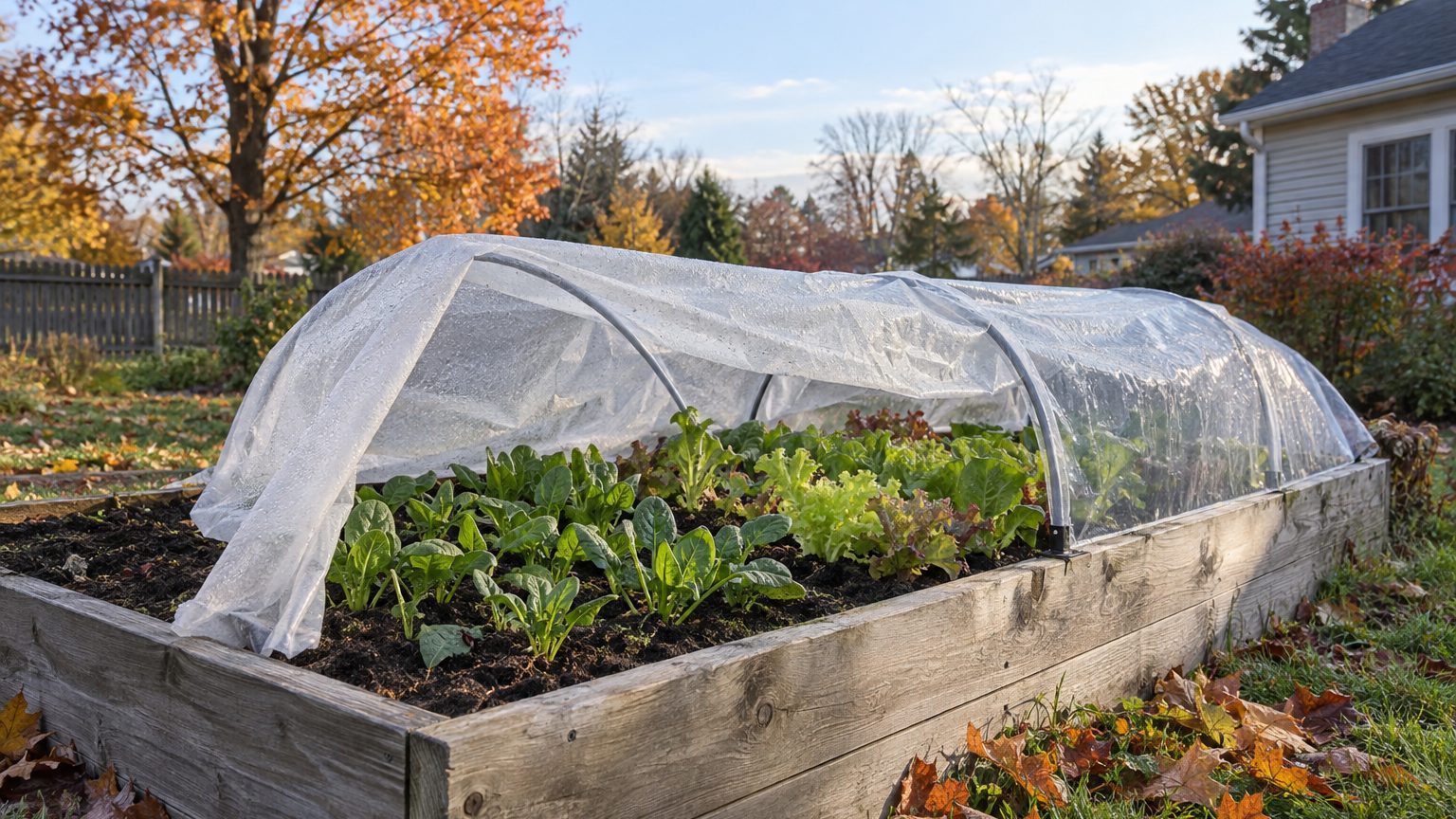

In Saskatoon, the average last spring frost falls on May 18 and the average first fall frost on September 18. That leaves a window of 123 days. A cover stretches that window at both ends, but by a margin that depends on the material, the weather and your site, and it never removes the limit. The real date to watch is the one when the soil, not the air, is ready.
When the soil is warm enough in Saskatchewan
The date most gardeners want is the last frost, and the Saskatoon SRC station gives it as May 18 on average (Environment and Climate Change Canada, Canadian Climate Normals 1981-2010). That is a mean, so in one year out of two the last frost lands later. Treat it as the middle of a window, not a safe date. Northern and upland districts of the province run weeks behind Saskatoon, so a reader outside the city should expect a later window.
Why frost is only a proxy
Frost date tells you when freezing air stops being a threat. It says little about whether seeds will germinate or transplants will root. Soil warms more slowly than air, and it warms after the frost risk ends, not alongside it. A bed can be frost-free in late May and still be cold enough to leave bean seed rotting and squash seedlings sulking. A soil thermometer pushed a couple of inches down, read in the morning, tells you more than the calendar. Seed packets list the minimum soil temperature for each crop.
The 1981-2010 normals are also a few decades old. Recent springs may not match them, which is one more reason to trust the thermometer over the average.
What a cover does to the soil
A cover works on the soil first. Clear plastic or fabric laid over bare ground for a week or two before sowing traps the warmth the soil gathers by day, and the soil hands some of it back overnight. Under a hoop or inside a frame the air is also stilled, so that warmth is not carried off by wind. A second layer, such as a fabric draped inside a tunnel, adds another pocket of still air. The gain is real, but it varies with the material, the night, the wind and whether the ground was warm to begin with. On a clear, calm night with a hard frost, it can be too little.
That is why a cover shifts the limit and does not erase it. One clear night after a mild week can still take a bed that was counted as safe. Everything described here is passive, using sun, soil and trapped air, and nothing should ever be burned or plugged in under a cover.
Any closed structure, a cold frame above all, needs ventilation. On a bright spring day it can cook its contents within an hour, even when the air outside is cold. Prop the lid open in the morning and close it again when the sun drops.
How long the season lasts here
Subtract May 18 from September 18 and you get 123 days. Both figures are means from the same station, so the window in any given year can be shorter or longer. A late spring frost and an early fall one can squeeze it noticeably, and half the years will fall on the wrong side of each date. Plan on the average and keep a margin.
What 123 days allows
A window that long gives the garden one main season, with room for a second round of quick crops. Radishes, lettuce, spinach and other fast growers can be sown again in July for fall harvest, and the late sowing is the one a fall cover protects best. Long crops that need most of the window, such as tomatoes, peppers and winter squash, get one go. Their sowing date is the date that matters, and that is where covers and transplanting do the most good.
For those long crops, transplanting is usually worth it, because a start that was sown indoors weeks earlier saves part of the window. The catch is the root check. A seedling held too long in a small pot circles its roots, and one planted into cold soil can sit stunned for a week or more and lose its head start. Before planting, slide a plant out of its pot and look. White, loose roots mean go. A dense mat means loosen it gently, or accept that it will stall. Warming the bed under a cover for a week or two beforehand takes some of the sting out of transplanting early.
Fast crops, by contrast, are usually better sown direct, because the cost of a transplant check is greater than the days saved. How to space those later sowings is covered in the succession sowing guide on this site, and it pairs well with the cover timing here. For the general logic of what a cover buys across all territories, read Extending the Season: What a Cover Buys, and What It Cannot.
Heat and water in Saskatchewan
This page does not carry a verified count of days above 90 °F (32 °C) or a summer rainfall figure for Saskatoon, so it will not guess at them. They are also not the governing facts here. Light and cold together decide what a cover can do in Saskatchewan.
The Saskatoon reference station sits at 52.17 degrees north. That latitude determines how quickly daylight shrinks after the fall equinox, and day length, more than warmth, tells many plants what to do. An onion, for example, stops making leaves and starts making a bulb in response to the hours of light, not the temperature. A commonly used rule of thumb puts the growing threshold at about 10 hours of daylight. At this latitude, daylight drops below it roughly in the third week of October. After that point a cover holds a crop alive rather than growing it. Hardy greens under a frame will stay edible, but they will not put on much new leaf until the light returns. If you live well north or south of Saskatoon, check your own latitude, because the date shifts with it.
Cold is the second half of the picture. The mean daily minimum of the coldest month at the Saskatoon reference station is -20.7 °C (-5.3 °F). The city sits in Canadian hardiness zone 3a (Natural Resources Canada, 1991-2020 normals). That is a Canadian zone, built on seven climate variables, and it does not convert to a USDA zone. At -20.7 °C a light fabric alone will not carry a crop through a cold spell. In deep winter only a framed structure with a second layer of cover inside has a chance, and even that is holding crops rather than growing them. Snow load matters too, so frames need to be sturdy or cleared after a heavy fall.
Summers bring a different risk than heat. A cool, damp summer brings mildew, slow ripening and disease, and a cover left closed in that weather traps humidity around the leaves. Open the sides and ends whenever the weather allows. Heat is a far larger worry in places like Kentucky, where the same covers are used for shade and airflow, which is covered in Extending the Growing Season in Kentucky. The closest comparison is the neighbouring province: Extending the Growing Season in Alberta shares much of the same light-and-cold logic.
Which season extension suit Saskatchewan
Choose by type, and match the type to what this territory is short of: warm days at the start and end of the season, and light in deep fall and winter.
- Floating fabric over hoops or directly on the crop: the lightest option, good for a margin of frost protection in spring and early fall. It is not enough for deep cold.
- Low tunnels with a second layer inside: the extra layer of still air gives a bigger margin on cold nights and suits the shoulder seasons.
- Cold frames: a framed, closed structure suited to hardening off and to holding hardy greens late. It must be vented on any sunny day or the crop will overheat.
- Soil-warming covers laid on bare ground before sowing: cheap and useful in a short season, since the soil warms later than the air.
A short season favours the earliest-maturing types of each crop, and quick crops fit the 123-day window better than slow ones. Where summers run cool and damp, disease resistance comes before everything else, so choose resistant types and give them airflow. Heat tolerance matters far less here than in the south.
The ones that work are the ones trialled locally. A cultivar that thrives in Ontario or Minnesota says little about a Saskatoon garden. For varieties and local timing, go to the Government of Saskatchewan agriculture pages, which are the right place to look for regionally tested recommendations.
Common questions
Can I plant before May 18 if I use a cover?
You can, but May 18 is only the average last frost at Saskatoon SRC, so frost can come later in about half of years. A cover shifts the limit without removing it, and a clear night can still damage what is under it. Check the soil temperature and keep spare cover ready.
How long is the growing window in Saskatoon?
It is 123 days between the average last spring frost (May 18) and the average first fall frost (September 18), both from the 1981-2010 normals at Saskatoon SRC. Real years will be longer or shorter.
Is zone 3a the same as USDA zone 3a?
No. Saskatoon is in Canadian hardiness zone 3a, which is built on seven climate variables. NRCan states that there is no simple conversion between the Canadian and USDA systems, so do not use a USDA chart to choose plants.
Do I really need to vent a cold frame?
Yes. A closed frame in spring sun can overheat its contents in about an hour, even when the air outside is cool. Vent it on sunny days, including cold ones, and close it as the light fades.