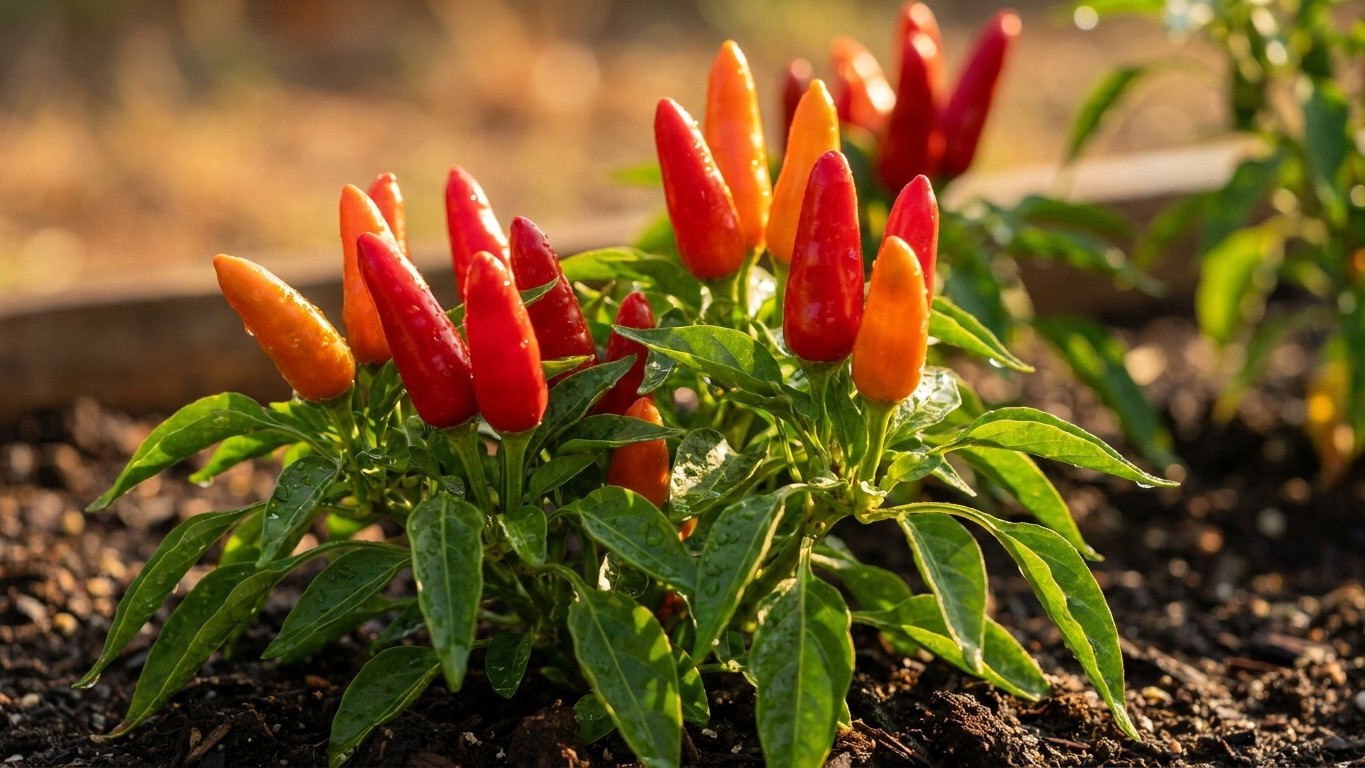

Pick peppers when the fruit has reached full size for its type and feels firm and glossy, usually 70 to 85 days after transplanting. Then keep them out of the refrigerator. Whole peppers stored below about 45 °F develop pits and go soft, a problem called chilling injury. A cool room that stays near 50 °F treats them far better than the crisper drawer.
How do you know when a pepper is ready to pick?
The calendar starts at the transplant, and the transplant starts with frost. Seedlings need 8 to 10 weeks indoors, and they go outside when the soil reaches 60 °F, after the last frost. At Burlington, on Lake Champlain, NOAA’s climate normals put the last spring freeze between April 30 and May 10. Burlington is the mildest corner of Vermont. The Green Mountains and the Northeast Kingdom run substantially shorter, so a hill-town gardener should wait longer than the lake-valley schedule suggests.
Clemson Cooperative Extension says peppers should be ready for harvest about 70 to 85 days after transplanting. One set out in mid-June gets there in late August or early September. Those are the days to a usable fruit, and varieties differ. A fruit that is meant to turn red, orange or yellow needs more time on the plant than a green one.
What decides whether the plants make fruit at all?
Peppers drop their blossoms at both ends of the thermometer. Utah State University Extension says fruit set fails when nights fall below 55 °F or when days climb above 90 °F. Burlington averages 5.4 days a year at 90 °F or higher, according to NOAA NCEI, so the hot end rarely stalls a Vermont crop. The cool end is a different matter. Summer night lows vary a great deal from one hollow or hillside to the next, so put a min-max thermometer at plant height and read it each morning. If blossoms keep falling, Why Peppers Fail to Set Fruit in Vermont goes through the causes one at a time.
Once fruit has formed, the plant tells you the rest. Pick when the skin is smooth, shiny and firm, and the fruit has reached the size typical for its variety. Use pruners or scissors and leave a short stub of stem, because pulling snags branches that snap easily. Picking regularly keeps the plant producing. Check the fruit as you go, too, since chewed or scarred peppers are easier to catch early. What Eats Pepper in Vermont, and When covers what to look for.
The end of the season has its own rule. When a frost shows up in the forecast, pick every fruit of usable size that evening. Peppers do not tolerate frost, and the plant will not finish the job after a freeze. For the full season plan, see Growing Peppers in Vermont.
Keeping them, and for how long
Clemson Cooperative Extension’s Home & Garden Information Center gives the storage conditions for harvested peppers: “The optimal conditions for storage are temperatures of 45 to 50 °F and 80- to 90-percent relative humidity for two to three weeks.” That is a single recipe with three numbers. If you write one thing on a sticky note for the pantry door, make it 45 to 50 °F with 80 to 90 percent relative humidity.
Is two to three weeks a promise?
No. It is the ceiling under optimal conditions. A pepper that was bruised, picked in the heat of the afternoon or already a little soft at the stem will not reach it. Fruit picked at the peak of firmness and kept right at the recommended range gets the full time at best. Most home kitchens will see less. Check the stored fruit every few days, and use the softest ones first.
The humidity number matters as much as the temperature. Peppers are mostly water, and dry air pulls it out through the skin. The fruit wrinkles and goes limp well before it spoils. A loose, perforated bag or a lined container holds in moisture without trapping so much that mold starts. Do not wash the peppers before storing them. Wet skin invites rot, so rinse each one only when you are ready to eat it.
Why does the fridge ruin peppers?
The range of 45 to 50 °F is warmer than a domestic refrigerator runs. Below about 45 °F, peppers pit and soften, which is chilling injury. Small sunken spots appear on the skin and the flesh goes mushy. The fruit often looks fine in the cold and breaks down once it comes back to room temperature. Dark pits are a common place for decay to start, and the fridge also speeds that along. Nearly everyone puts whole peppers in the crisper drawer by habit. It is the most common storage mistake with this crop.
Peppers are a warm-season crop from start to finish. They sulk in cool soil in spring, they drop blossoms on cold nights in summer, and they dislike cold storage in fall. The same sensitivity runs through the whole season.
Where in the house that actually is
Few rooms land inside 45 to 50 °F, so the job is finding the closest one. The kitchen counter is far too warm. So is any room with a heating vent, a woodstove or a sunny south window. Peppers there soften and shrivel within days. The garage is the opposite problem. It follows the weather, so a day that is mild at noon can be freezing at 3 a.m. in a Vermont autumn. A frozen pepper thaws into mush. The refrigerator is simply too cold for whole fruit kept more than a short while.
The best candidate in most houses is an unheated or barely heated space that stays steady: a basement, a root cellar, a cool pantry on an inside wall, or an enclosed mudroom that holds above freezing. A basement or cellar also tends to be more humid than the rest of the house, which helps with the 80 to 90 percent target. Which of those lands closest depends on the house. Insulation, a furnace nearby and the stone or concrete of the foundation all change the reading.
Guessing is the weak point. Set a thermometer in the spot you plan to use for several days before you load it with peppers, and read it morning and late afternoon. A min-max thermometer is the best tool because it also catches the overnight low. A small hygrometer, which is inexpensive, will tell you whether the air is anywhere near the humidity range. If a location swings by more than a few degrees, or sits well above 50 °F, you will lose fruit faster than the two to three weeks suggests.
When nothing in the house fits, the fridge can still serve as a short-term fallback. Plan to eat those peppers within a few days. Pull them out and use them rather than letting them sit.
Common questions
Can I pick peppers green and let them turn red indoors?
Fruit that has already started to show color will usually keep coloring after picking. Fruit that is still fully green and glossy tends to stay green. A green pepper is safe and good to eat, though the flavor is sharper than a ripe one. If a frost is coming, bring in everything and use the greenest fruit first.
Is it all right to refrigerate cut peppers?
Yes. Once a pepper is sliced or cooked, it needs the refrigerator for food safety, and it will be eaten within days. The chilling injury concern applies to whole fruit kept cold for a long stretch. Keep cut pieces in a covered container and use them in a few days.
Why are my plants flowering but not setting fruit?
Fruit set fails when nights fall below 55 °F or days climb above 90 °F, according to Utah State University Extension. At Burlington, 90 °F days average only 5.4 a year, so heat is the lesser risk. Track your own nights with a min-max thermometer at plant height, since cool nights are the more likely cause.
When should I transplant peppers in Vermont?
Wait until the last frost has passed and the soil has reached 60 °F. At Burlington the last freeze falls between April 30 and May 10, but the Green Mountains and the Northeast Kingdom have substantially shorter seasons. Start seed 8 to 10 weeks before the date you expect to transplant. Your county extension office can tell you what is typical for your town.