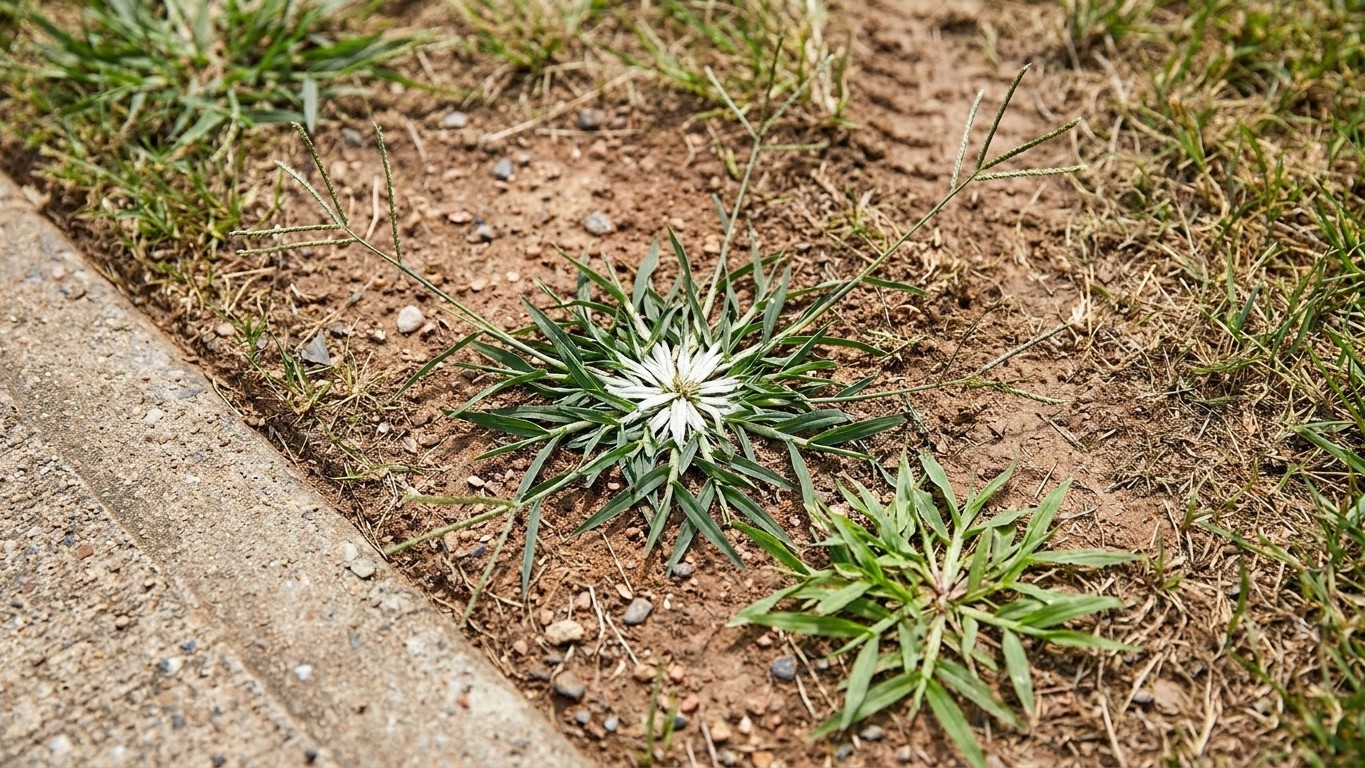

For most Michigan lawns, the answer is 3 inches. That height falls inside the recommended range for Kentucky bluegrass, fine fescues and tall fescue, and it works as a safe default when you don’t know what is growing in your yard. Ryegrass and rough bluegrass want a shorter cut, and tall fescue does best slightly taller. Below you’ll find the height for each species, how to adjust in July heat, and when to make the first and last cuts.
The mowing height for Michigan lawns
A grass blade is a solar panel. Cut it short and the plant has less surface to feed itself, so it pulls energy from the roots to regrow. A taller blade shades the soil, keeps it cooler, and crowds out the crabgrass and clover that move into thin turf. That is the whole mechanism, and it explains why the right height changes from one species to the next: each one grows its leaves differently.
Height by species
The five cool-season species recommended for Michigan do not share one number, and they are not close enough to be interchangeable. Mow a perennial ryegrass lawn at 3.5 inches and it flops over. Mow a tall fescue lawn at 1.5 inches and you will lose it.
| Grass | Mowing height |
|---|---|
| Tall Fescue | 3 to 3.5 inches |
| Fine Fescues | 2 to 3 inches |
| Kentucky Bluegrass | 2 to 3 inches |
| Rough Bluegrass | 1.5 to 2.5 inches |
| Perennial Ryegrass | 1.5 to 2.5 inches |
These ranges come from the overlap of several land-grant extension sources, including Purdue, the University of Illinois and K-State. Most home lawns are blends, and a deck set to 3 inches sits inside the range for tall fescue, fine fescues and Kentucky bluegrass at once. If your lawn is mostly ryegrass, drop toward 2.5 inches. If you can’t tell what you have, 3 inches is the safer error, because scalping does more damage than a lawn that is a bit shaggy.
Why a warm-season grass will not hold here
Bermudagrass and zoysia are the usual temptation, since they look great in a Georgia photo. They grow in heat and shut down in cold, and a Michigan year hands them very little of the first and plenty of the second. Frost arrives in October, returns around the end of April or May, and in between the turf sits brown and dormant. A warm-season lawn here spends much of the year looking dead, and a hard winter can finish the job. The cool-season species above stay green through the cold, which is the reason they are the recommended group. For a comparison with another state, see How High to Mow a Lawn in Massachusetts, or How High to Mow a Lawn in Utah for a drier case.
Raising the deck when the heat comes
Summer is when the height matters most. Move to the top of your species range as June ends: 3.5 inches for tall fescue, 3 inches for Kentucky bluegrass and fine fescues, 2.5 inches for ryegrass and rough bluegrass. The extra leaf shades the crown and soil, and the roots stay deeper where moisture lasts longer.
What the rainfall numbers say
Michigan does not look like a drought state on paper. At the NOAA NCEI reference station used here (USW00094847, 1991-2020 normals), June brings 3.26 inches, July 3.51 and August 3.26, about 10.0 inches across the summer out of 34.3 for the year. August is the driest summer month, tied with June.
Those figures are normals for one station. They describe what the region can usually expect, not a forecast and not your yard. A slope, a city block or a lake effect can change them, so a cheap rain gauge on your own plot settles the question better than any table.
Why rain on paper is not rain in the soil
Cross that rainfall with two other things. The first is soil. A sandy lawn lets an inch of rain through within the day, while clay holds it for a week. A wet summer on sand can still mean watering every second day, and a wet summer on clay may mean you rarely need to. The second is heat. Days at or above 90°F drive evaporation hard, and rain that arrives as a single thunderstorm mostly runs off instead of soaking in. Ten inches delivered in a handful of downpours does less for the roots than ten inches spread out.
So in a hot spell, hold the tall setting, water deeply and less often rather than a little each day, and let the lawn go a touch dormant if it needs to. A tall lawn that browns in August usually recovers in September. A short lawn in the same heat often thins out.
The one-third rule, and why it is not arbitrary
Never remove more than one third of the blade height in a single mowing. The rule has a physical basis: the leaves feed the roots, and a big cut starves them while the plant rebuilds its leaf area. Roots stop growing for a while, and a stressed lawn is the one that picks up disease and weeds.
The math at each height
The rule tells you when to mow, not only how. Mow when the grass reaches about half again your cutting height:
- Cut at 3 inches, mow when the grass reaches 4.5 inches.
- Cut at 3.5 inches (tall fescue), mow at 5.25 inches.
- Cut at 2.5 inches, mow at 3.75 inches.
- Cut at 2 inches, mow at 3 inches.
- Cut at 1.5 inches, mow at 2.25 inches.
A shorter lawn forces a tighter schedule. Mowing at 1.5 inches in a wet June can mean cutting every few days, while a 3-inch lawn gives you more room. For general technique beyond Michigan, see Mowing a Lawn.
When you miss a week
Rain followed by warm weather can push growth faster than your schedule. If the grass is well past the limit, do not drop straight to your usual height. Raise the deck, cut, then lower it to the normal setting after a few days. The lawn handles two moderate cuts better than one severe one. Leave clippings on the lawn when they are short, since they return nutrients, and bag or rake only if they clump into mats.
The first and last cut of the year
Michigan’s frost dates bracket the mowing season, and they move with location. In the Detroit area the last spring frost falls around April 30, and across most of the Lower Peninsula it comes in early to mid May, according to MSU Extension. The dates are not one statewide truth, so check the figure for your own county.
The first mow
Start when the grass is actually growing and has enough height to cut, not on a calendar date. Set the deck at the top of your species range for the first mow. Spring turf is recovering from winter, and a high first cut leaves more leaf to restart the root system. Saving the lower setting for later never costs anything, while scalping a soft spring lawn can leave bare patches.
The last mow
The MSU Extension Michigan Garden Calendar puts the first fall frost between October 6 and October 21 for zone 6a. Your yard may fall outside that window, so treat it as a guide. Frost slows growth but does not end it at once, so keep mowing at your normal height while the grass is still growing. For the final cut, you can go to the bottom of your species range, but stay inside it. Long grass under fallen leaves or snow can mat down and invite disease, and a scalped lawn heads into winter with little reserve.
Leaves count as part of the job. Run the mower over a light layer and the shredded pieces disappear into the turf, but a thick blanket left whole will smother the grass beneath it.
Common questions
What is the best mowing height for a Michigan lawn?
It depends on the grass. Tall fescue wants 3 to 3.5 inches, Kentucky bluegrass and fine fescues 2 to 3 inches, and perennial ryegrass and rough bluegrass 1.5 to 2.5 inches. If you don’t know the species, 3 inches is the safest single setting for a mixed lawn.
Should I mow shorter in spring to get ahead of growth?
No. A short cut on soft spring turf removes leaf the plant needs. Begin at the top of your species range and apply the one-third rule so you never take more than a third of the blade at once.
How often should I water in a Michigan summer?
Summer averages about 10.0 inches of rain across June, July and August at the reference station, but sandy soil drains within the day and clay holds water for a week. Heat above 90°F and storm runoff change it further. A rain gauge in your own yard tells you more than the regional average.
When should I stop mowing in the fall?
Stop when growth stops. The first fall frost typically lands between October 6 and October 21 in zone 6a, so keep mowing at normal height until then, and for as long afterward as the grass keeps growing.