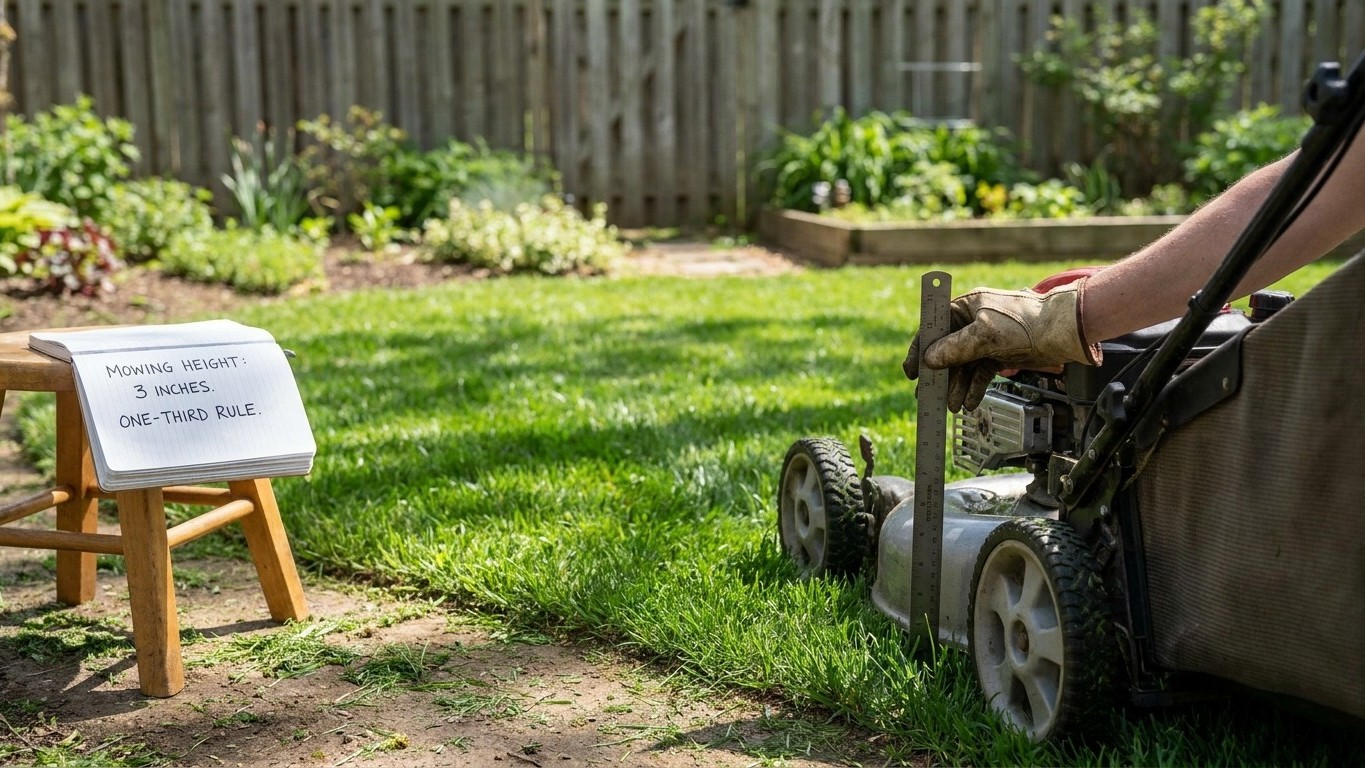

How high should you cut your grass, and how often should you do it? Mow it at the height your specific grass type needs, and never take off more than a third of the blade length at once — that’s the whole rule, and it matters more than any date on a calendar. Before you mow again, hold a ruler to the mower deck and check the real cutting height, because the dial setting lies more often than you’d think, and that mismatch is usually where lawn trouble starts.
Why this matters
A lawn does not show a bad mow the day it happens. It shows it two to three weeks later, when the grass that lost too much leaf in one pass has burned through the sugar reserves stored in its roots and crowns, and now has a thin, pale patch it cannot quickly refill. By the time you notice, the damage is already done and the fix is measured in weeks of recovery mowing, not a single correction. This is why the one-third rule matters more than the target height itself: cutting a 4-inch lawn down to 3 inches in one pass is fine, but cutting a 6-inch lawn down to 3 inches removes half the leaf and stresses the plant the same way a drought would.
Mowing too short also changes how the lawn handles water and weeds, which is really the whole point of lawn care as an ongoing practice rather than a once-a-year chore. A shorter canopy means more bare soil exposed to sun, which dries out faster and gives weed seed the light it needs to germinate. A lawn scalped in June often needs a different watering schedule than the same lawn mowed correctly, simply because it is losing more moisture from soil that used to be shaded by its own leaf blades. The mowing height you choose today decides how much water this lawn needs next month, more than any single feeding or irrigation change will.
When to do it
Cool-season grasses, including Kentucky bluegrass, perennial ryegrass, fine fescues, rough bluegrass and tall fescue, do most of their growing in spring and fall, according to Penn State Extension’s lawn establishment guidance, and slow down or stall in summer heat. Warm-season grasses, including bermudagrass, zoysiagrass, centipedegrass, St. Augustinegrass, bahiagrass, carpetgrass and seashore paspalum, do the opposite: they grow fastest through the heat of summer and go dormant in cool weather, per Clemson Cooperative Extension’s HGIC 1214 fact sheet on selecting a lawn grass. That single fact decides your mowing calendar more than the month printed on it does. A cool-season lawn needs its most frequent mowing in the weeks around spring green-up and again in early fall, while a warm-season lawn needs it in the height of summer.
Matching frequency to growth, not to a date
Because growth rate swings with temperature and rainfall, the right mowing interval is whatever keeps you inside the one-third rule that week, not a fixed number of days. In a fast-growth week that can mean mowing every four or five days. In a slow week, especially during a cool-season grass’s summer slump or a warm-season grass’s winter dormancy, it can mean going two or three weeks between cuts. Clemson publishes species-specific maintenance calendars, such as HGIC 1216 for bermudagrass, HGIC 1217 for zoysiagrass, HGIC 1218 for St. Augustinegrass, HGIC 1219 for tall fescue and HGIC 1215 for centipedegrass, that lay out the mowing frequency window across a full growing year for each species. If you just installed a new lawn, hold off on the first mow until the grass has rooted in, a step covered in our guide to laying sod, since a mower can shear sod loose before the roots have anchored it.
How to do it

Start with the height your species is built for. Clemson Cooperative Extension’s HGIC 1214 fact sheet and Penn State Extension’s lawn establishment guidance publish these ranges for the most common lawn grasses grown in the United States:
| Grass | Season | Mow height | Shade | Drought | Wear |
|---|---|---|---|---|---|
| Bermudagrass | Warm-season | 0.75 to 1.5 in | Very poor | Excellent | Excellent |
| Zoysiagrass | Warm-season | 0.75 to 2 in | Excellent | Good | Very good |
| Seashore Paspalum | Warm-season | 1 to 1.5 in | Poor to fair | Fair to good | Good |
| Carpetgrass | Warm-season | 1 to 2 in | Fair | Very poor | Poor |
| Centipedegrass | Warm-season | 1.5 to 2 in | Fair | Fair | Poor |
| Kentucky Bluegrass | Cool-season | 2 to 3 in | Fair | Fair | Good |
| Perennial Ryegrass | Cool-season | 2 to 3 in | Fair | Fair | Good |
| Rough Bluegrass | Cool-season | 2 to 3 in | Excellent | Poor | Poor |
| Tall Fescue | Cool-season | 2.5 to 3.5 in | Good | Fair | Fair |
| Fine Fescues | Cool-season | 2.5 to 3.5 in | Excellent | Good | Poor |
| St. Augustinegrass | Warm-season | 2.5 to 4 in | Excellent | Good | Fair |
| Bahiagrass | Warm-season | 3 to 4 in | Poor | Excellent | Good |
Once you know the target height, set the frequency around it, not the other way around. If your species is cut at the low end of its range, say 1 inch for bermudagrass, you need to mow before it reaches 1.5 inches to respect the one-third rule. If it’s cut at the high end of a taller species like tall fescue at 3.5 inches, you have more room, since the plant can grow to nearly 5.25 inches before that same one-third limit is reached. Keep the mower blade sharp: a dull blade tears the leaf tip instead of slicing it, and a torn tip turns brown and ragged within a day or two, which reads as disease even when it is only a blunt blade.
Leave the clippings on the lawn when you can. Short clippings from a mow that respects the one-third rule break down quickly and return nitrogen to the soil, which is part of why HGIC 1201, Clemson’s fertilizing lawns fact sheet, treats mowing practice as connected to the feeding program rather than separate from it. Bag clippings only when the lawn has gotten away from you and the clumps are heavy enough to smother the grass underneath, or when you’re managing a lawn disease and want to remove infected leaf tissue from the site.
What goes wrong
Scalping is the most common mistake, and it happens whenever the mowed height drops the lawn below what the one-third rule allows for that week’s growth, usually after skipping a mow during a rainy stretch and then trying to catch up in one pass. The tell shows up within a few days as a yellow-brown cast across the whole lawn, followed a week or two later by thin patches where the crown was cut into rather than just the leaf. The fix is to raise the deck back up and lower it gradually over two or three mows rather than dropping straight back to target height.
Dormancy versus death
A lawn that goes brown is not necessarily dying. Both cool-season and warm-season grasses go dormant on a schedule tied to temperature, cool-season species in summer heat and warm-season species in cool weather, and a dormant lawn typically greens back up once conditions turn. The mistake is treating dormancy like a mowing problem and cutting a stressed, brown lawn short to “clean it up,” which removes the little leaf area the plant has left to photosynthesize with and slows the recovery instead of speeding it.
Mowing wet grass is a second common error. Wet clippings clump instead of scattering, and clumped grass smothers the lawn underneath within about a week, showing up as yellow patches shaped like the clump itself. Mowing in the same direction every time is a smaller but real problem too: it compacts the same soil ridges repeatedly and can lean the grass into a consistent grain, both of which show up as faint striping in the lawn a few mows later. Rotating your mowing direction and waiting for the grass to dry avoid both problems at no extra cost in time.
How this changes across the country
A grower with a cool-season lawn, Kentucky bluegrass or tall fescue for instance, times the season’s heaviest mowing around spring and fall growth spurts and expects a summer slowdown, following the pattern Penn State Extension describes for cool-season turf. A grower with a warm-season lawn, bermudagrass or centipedegrass, does the reverse: light mowing in cool weather, then the heaviest schedule through the hottest stretch of summer, per Clemson Cooperative Extension’s guidance for warm-season species grown widely across South Carolina and the rest of the Southeast.
The transition zone, the band of states across the middle of the country where summers are too hot for reliable cool-season turf but winters are too cold for warm-season turf to hold up, doesn’t get a clean answer from either camp. Growers there often settle for a cool-season species like tall fescue that tolerates heat better than bluegrass does, or a warm-season species like zoysiagrass that holds color longer into cool weather than bermudagrass does, and accept some off-season browning either way. There’s no single fix for the transition zone published in the fact sheets used here, which is exactly why growers in that band should check with their own state’s cooperative extension office for a species recommendation suited to their specific county rather than relying on a national rule of thumb.
Shade tolerance also splits the map. St. Augustinegrass and zoysiagrass, both rated excellent for shade in Clemson’s HGIC 1214 fact sheet, are common choices under tree canopy in the Southeast, while bermudagrass, rated very poor for shade in the same fact sheet, struggles in exactly those same yards and needs full sun to hold density.
Common questions
How short should I cut my lawn for the first mow of spring?
Cut it at the low end of your species’ normal range, not shorter, so you remove old winter leaf tissue without violating the one-third rule on a plant that hasn’t started growing fast yet. If the lawn grew tall over winter, bring the height down gradually over two mows instead of one.
Can I mow a dormant lawn?
You can, but there is little reason to since dormant grass barely grows and mowing it offers no benefit beyond tidying up seed heads or fallen leaves. Keep the deck at the high end of your species’ range if you do mow, since a dormant plant has less leaf area to spare.
Do I need to mow in a different pattern each time?
Yes, alternating direction prevents the soil compaction and grain effect that comes from the mower wheels running the same path every time. Switching between a couple of patterns, straight one week and diagonal the next, is enough to avoid visible striping.
Why does my lawn look lighter right after mowing even when I didn’t cut it too short?
That pale cast is usually the cut leaf tip showing its lighter internal tissue, and it fades within a day as the cut heals over. If the lightness turns brown and stays past three or four days, check the mower blade for dullness before assuming it’s a height problem.