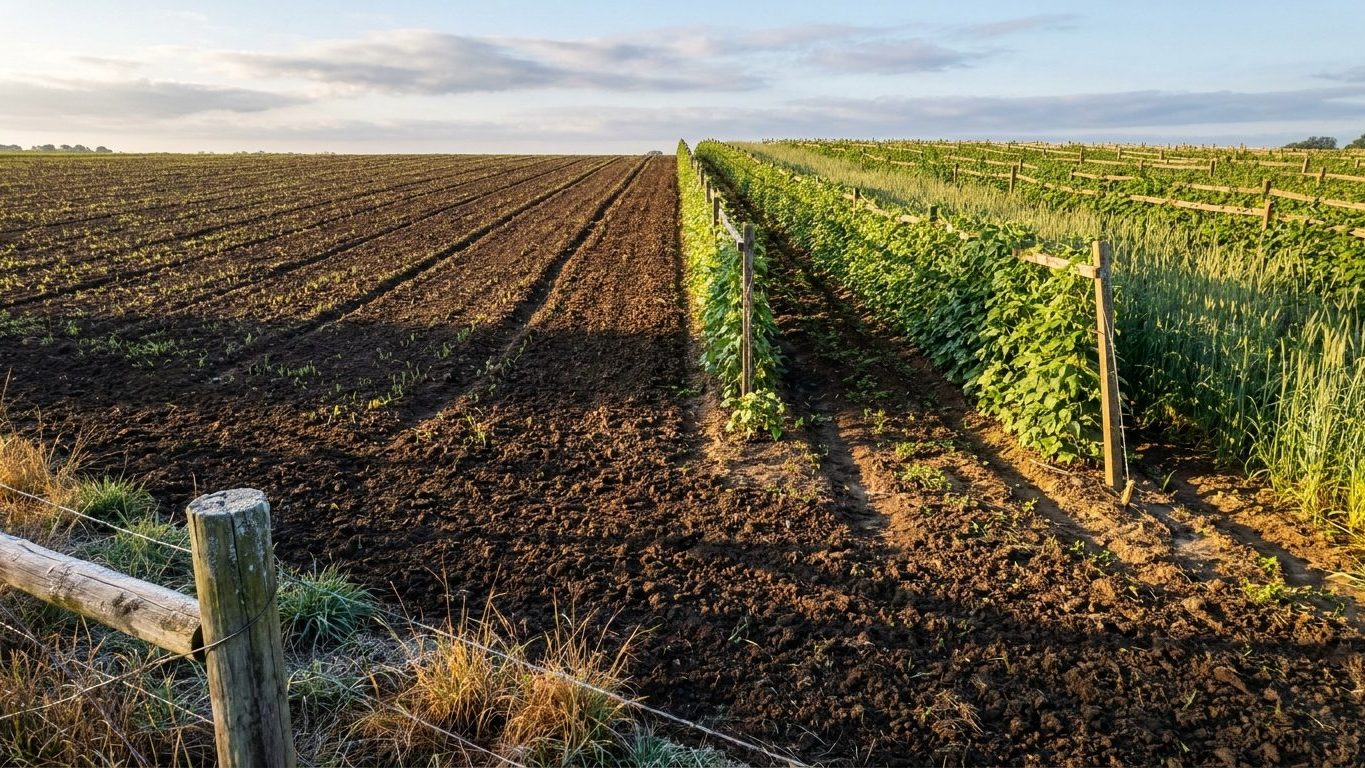

Sow hardy cover crops in fall, ahead of the first frost. At the Baltimore reference station, the chance of a 32°F freeze in fall reaches the 30-70% band between October 26 and November 5. Frost-tender crops go in after the last-frost band of April 3 to April 16. Those are probabilities, and they shift across the state. Crop choices are covered in Cover Crops for Maryland Gardens.
The short answer for Maryland
Fall sowing is the anchor of the Maryland calendar, and it is set by the October 26 to November 5 band. Spring and summer sowing is set by the April 3 to April 16 band. Both come from NOAA’s 1991-2020 Climate Normals, and both mark the dates when the probability of a 32°F freeze sits between 30 and 70 percent. They do not mark the last or first frost you will ever see.
The distinction matters. A date in that band is closer to a coin flip than a deadline. On April 3 the odds of another freeze are still roughly even, and by April 16 you are still not in the clear. A freeze after the band is less likely, but nothing in the data rules it out. The same logic runs in reverse in the fall.
Counting from the edges of those bands, the frost-free stretch runs from about 193 days (April 16 to October 26) to about 216 days (April 3 to November 5). That is the working season for anything that cannot take a freeze. The cold season that follows is real but not severe. The mean daily minimum of the coldest month at the Baltimore reference station is 25.4°F, which is the figure that decides what survives winter outdoors.
How the calendar breaks down
| Season | Anchor date | What it favors |
|---|---|---|
| Spring | After the April 3 to April 16 band | Frost-tender crops; hardy crops can go in earlier |
| Summer | Between the two bands | Warm-season crops filling a bare bed |
| Fall | Before the October 26 to November 5 band | Hardy crops that carry through winter |
This page gives the windows, not crop-by-crop sowing dates, because the verified figures here stop at the frost bands. For which species suit which window, see The Best Cover Crops for Maryland.
What will not work here
Sowing a frost-tender cover crop on April 3 because the soil looks workable. That date sits at the front edge of a band where a 32°F freeze is still a 30 to 70 percent proposition. A stand that emerges into a freeze is a stand you pay for twice, in seed and in time.
Fall is where most Maryland plantings fail, and they fail quietly. A hardy crop sown after the November 5 edge of the band has less time to put down roots before the cold sets in. It will often survive, but it arrives in spring thin, and a thin stand suppresses few weeds and adds little organic matter. The plants live while the benefit quietly disappears. Anyone who treats Thanksgiving as the planting deadline should expect modest results.
The 25.4°F figure rules out a different set of plans. A coldest-month mean minimum below freezing means ground-level cold is a regular feature of the winter, not an occasional visitor. Frost-tender cover crops sown in fall will not carry through. That is fine if you want a crop that dies on its own and leaves a mulch behind. It is a failure if you were counting on it to be alive in March.
Copying the Baltimore dates into the mountains is the third mistake. The source flags that Western Maryland, meaning Garrett and Allegany counties, is mountainous and runs weeks later. A gardener there who sows on the Baltimore fall date is already behind. The same gardener sowing a tender crop on the Baltimore spring date is running ahead of the frost.
The last gap is one of honesty. This page has no verified figures for summer heat or rainfall in Maryland, so it does not make claims about drought-stressed or waterlogged summer plantings. If summer sowing is part of your plan, check county guidance before committing seed to it.
What changes across Maryland
Maryland is not one garden. The USDA Plant Hardiness Zone Map (2023 edition, built on 1991-2020 normals) places the state in zones 5b to 8a. That system rests on one variable, the average annual extreme minimum temperature, and each half-zone step is 5 degrees. Five steps from 5b to 8a is a 25-degree spread in how cold the worst night of the year gets. There is no single answer for Maryland, only a spread.
The dates on this page belong to one reference station, Baltimore. For a dated recommendation that is the right way to read them, and other parts of the state differ. Western Maryland sits at the cold end of the range, and the Eastern Shore runs milder.
The direction of the shift is easy to state even without exact numbers. In the mountains, move fall sowing earlier and spring sowing later, because frost arrives sooner and leaves later. On the Eastern Shore, the season stretches a bit at both ends, which gives fall sowing more room and lets tender crops go in somewhat earlier. In between, the Baltimore bands are a reasonable starting estimate. This page does not have verified county-level offsets, so it will not guess how many weeks.
Which zone your garden falls in is a question for the map, not for this page. Look up your location on the USDA Plant Hardiness Zone Map and read the zone for your own address. Elevation and nearby water change it from one neighborhood to the next.
Where to check this for your own county
Your state extension service is the next stop. For Maryland, that is University of Maryland Extension, part of the federal land-grant extension network. It employs people who work with the soils, weather and growers of each region.
There are two things to look for. The first is the local planting calendar, meaning dates tied to your county rather than the statewide bands used here. The second is the list of cover crop varieties trialled in your county, which tells you what actually performed in conditions like yours, not just what grows somewhere in the state. A variety that does well in a Garrett County trial and one that thrives on the Eastern Shore are not necessarily interchangeable.
A county recommendation beats a state one. This page is the state one: a frame built from one reference station and the state’s hardiness range. It can tell you roughly when the season opens and closes. It cannot tell you that your hillside in Allegany County needs a different fall date than the valley below it. Extension agents can, because they have seen what happened in your county year after year.
If you cannot find a county calendar, call or email the local extension office. Ask what they would sow in your location this fall, and when. A two-minute answer from someone local is worth more than a spreadsheet of statewide averages.
Checking this against your own garden
Your garden’s own signals outrank every date on this page. Three are worth watching, and none needs an instrument.
- Soil warmth by feel. Push your hand a few inches into the bed in the morning. Soil that feels cold and heavy is not ready for tender seed, and a bed that warms early tells you it is a warm pocket, perhaps south-facing or sheltered by a wall.
- The first flush of male flowers. Watch for the dangling catkins on oaks, maples or birches near you. When they open in your yard, you learn how your spring is running compared with the neighbor’s or last year’s.
- The first true leaves. On a fall planting, the first leaves after the seedling leaves tell you whether the crop is establishing before cold. If seedlings are still bare as the frost band approaches, your site is slow, perhaps shaded or low-lying.
Keep notes for a year or two. Over time the pattern shows whether your garden runs ahead of or behind the state calendar, and by how much, which is something no table can give you.
Some gardeners also time this by the Moon: when to plant cover crops by the moon, as almanac tradition rather than fact.
Common questions
Can I still sow cover crops after the first frost?
Some hardy types will still germinate, but growth is slow and the stand will be thin by spring. This page does not have a verified cutoff date, so ask your county extension office before sowing late.
Is the April 3 to April 16 date a guarantee?
No. It is the band where the probability of a 32°F freeze is between 30 and 70 percent, according to NOAA’s 1991-2020 Climate Normals. Freezes can still occur after it.
Do these dates apply in Garrett and Allegany counties?
Not directly. The figures come from the Baltimore reference station, and Western Maryland is mountainous and runs weeks later. Treat the Baltimore dates as a starting point there, not a schedule.
Will a Maryland winter kill my cover crop?
It depends on the type. The coldest-month mean daily minimum is 25.4°F at the Baltimore reference station, so frost-tender crops will not survive winter while hardy ones are built for it. The Best Cover Crops for Maryland sorts them by type.