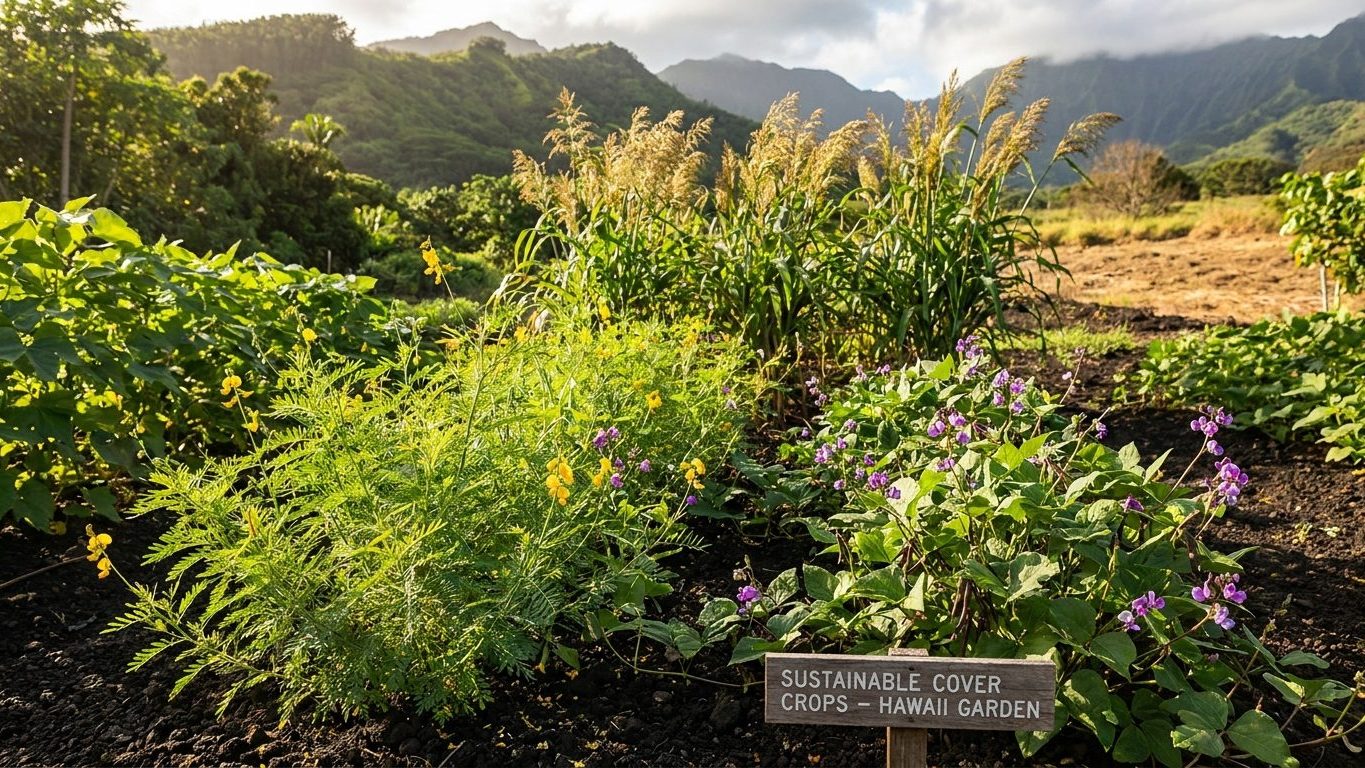

The best Cover Crops for Maryland split by season and soil goal: cereal rye for reliable winter-long ground cover, hairy vetch or crimson clover for a nitrogen credit ahead of a summer crop, and forage radish or oats where a clean, workable seedbed by spring matters more than winter survival. Which one wins in your yard depends on where in the state you garden and how late you get seed in the ground.
The short answer for Maryland
Start with the two numbers that actually decide this: a frost-free window that runs from roughly April 3-16 in spring to October 26-November 5 in fall, and a coldest-month mean minimum of 25.4°F at the Baltimore reference station. That second figure matters more than most gardeners realize. It is not the record low, it is the average nightly floor in January, and it is the line that separates a cover crop that overwinters from one that gets killed on purpose.
Cereal rye survives that floor without effort. Its cold tolerance runs far below 25.4°F, so it keeps growing (slowly) through a Maryland winter and gives you the most biomass per pound of seed of any cover crop grown here. If your goal is erosion control on a bare fall garden bed, or a thick mat to roller-crimp before a spring planting, rye is the default answer, not a compromise.
Hairy vetch is the second reliable choice, planted in the same September-to-early-October window as rye, because it needs weeks of fall growth before cold slows it down. It is hardy enough for the Baltimore-area winter and delivers a real nitrogen credit the following spring when it is turned under near full bloom.
Crimson clover sits closer to the edge. It handles a mild winter fine but is less cold-hardy than vetch, which matters once you leave the Baltimore-Washington corridor for anywhere colder (more on that below).
Forage radish and oats are the deliberate opposite strategy: planted in August or early September, they grow fast, then die outright once temperatures drop into the teens or lower. In Maryland, with a coldest-month mean minimum sitting right around 25.4°F, individual cold nights routinely dip well below that average, which is exactly what finishes off oats and radish. That is not a failure, it is the plan. You get weed suppression and, with radish, deep tillage-free compaction relief, then a clean bed by late winter with nothing left to terminate.
For a Maryland garden with no other information, the working answer is: rye or vetch if you want the cover crop to still be alive in March, oats or radish if you want it gone on its own by January.
What will not work here
Berseem clover is the clearest example of a plant that simply does not fit Maryland winters as a season-long cover. It is not rated hardy against a mean January minimum anywhere near 25.4°F; it wants to die in the mid-20s, which is close to what Baltimore-area soil sees on an ordinary cold night, not an extreme one. Grown as a summer cover it works fine. Grown as a winter-long stand expecting spring regrowth, it is the wrong plant, and no amount of mulching fixes a hardiness mismatch.
Warm-season summer covers that need a long, uninterrupted stretch of heat, sorghum-sudangrass grown for a full biomass cycle, or multiple successive buckwheat plantings timed for seed set, run into the other constraint: a frost-free season of roughly six and a half months, bookended by frost dates that can arrive as early as October 26 in a cooler year. Plant one of these too late, aiming for a second cutting before the first fall frost date range even begins, and you are racing a calendar that does not have the slack for it.
Timing failures on the legume side show up differently. Hairy vetch and crimson clover both need real fall growth, several weeks of root and canopy development, before cold weather slows them to a crawl. Seed either one in late October, after the earlier end of the fall frost window has likely already passed, and you get a thin, underdeveloped stand that limps through winter and delivers little nitrogen in spring. The nitrogen credit that makes vetch worth growing depends on that fall head start; skip it and you have planted a much weaker cover crop for the same seed cost.
Maryland’s humid Mid-Atlantic summers also punish crops sown too thick. Dense stands of clover or buckwheat, seeded at rates meant for a drier climate, hold moisture in the canopy and invite foliar fungal disease before they ever reach the stage they were planted for. Following label seeding rates here is not a suggestion, it is what keeps a stand alive long enough to do its job.
What changes across Maryland
Maryland is not one growing region wearing a state name. The USDA hardiness zone range for the state runs from 5b to 8a, one of the widest spreads for a state this size, and that gap changes which cover crop choices are safe defaults versus which ones are gambles.
The frost date figures above carry their own caution for the same reason: they describe the Baltimore-area station, and the brief that supplies them flags explicitly that western Maryland, Garrett and Allegany counties, runs weeks later on both ends of the frost calendar because of elevation, while the Eastern Shore runs milder. A reader gardening near the mountains is working with a shorter frost-free window than the April-to-November range above suggests, and a colder January floor than 25.4°F. A reader on the Eastern Shore has room on both sides of that window.
What that means in practice: crimson clover, already the least cold-hardy of the legumes discussed above, is a reasonably safe bet on the Eastern Shore or in the Baltimore-Washington corridor, but a riskier one in the western counties, where hairy vetch’s deeper cold tolerance is the safer legume choice. Fall planting dates shift the same direction, earlier in the mountains to get a cover crop established before an earlier frost, later on the Shore where there is more fall left to work with.
There is no single planting date or single “safe” legume that covers all of Maryland honestly. The zone range alone, 5b to 8a, is the flag that a state-level answer is a starting point, not a final one, and the next section is about narrowing it to somewhere closer to your own county.
Where to check this for your own county
The University of Maryland Extension, at extension.umd.edu, is the source that replaces this page’s statewide averages with numbers specific to where you actually garden. That is the whole point of going there: this page describes Maryland in general, a county page describes your frost pattern, your soil, and the varieties that have actually been trialled nearby.
Two things are worth looking for specifically once you’re on the county page. First, a local planting calendar for cover crops, which will narrow the broad April 3-16 and October 26-November 5 frost windows cited above down to dates that reflect your county’s actual elevation and distance from water, rather than the Baltimore reference station this page relies on. Second, any variety trial results or extension bulletins naming specific cereal rye, vetch, or clover varieties that performed well in your part of the state. Extension programs run these trials precisely because a variety that thrives in one county’s soil and microclimate can underperform in another, even within the same hardiness zone.
A county-level recommendation from your local extension office will beat anything on this page, every time. This article works from statewide climate normals and general species behavior; a county extension agent works from what has actually grown in soil like yours, in weather patterns like yours, over multiple seasons. Treat this page as the broad framework and the extension office as the correction for your specific ground.
Checking this against your own garden
Every date and temperature figure above is a regional average, and your own garden will confirm or contradict it faster than any calendar can. Three things to watch, none of them requiring equipment beyond your own hands and eyes.
Feel the soil itself before you trust a planting date. Cover crop seed, cereal rye and oats especially, germinates on soil temperature, not on the calendar. If the soil still feels cold and heavy in your hand in early September, when a regional planting guide says you should be seeding, your particular spot (shaded, low-lying, poorly drained) is running behind the average, and pushing planting back a week or two will serve you better than following a date blindly.
Watch how your winter-hardy stand looks after the coldest stretch of the season. If cereal rye or hairy vetch shows browned, dead patches after a hard cold snap while a neighbor’s stand a few miles away came through green, that is your microclimate telling you it runs colder than the county average, a useful thing to know before you choose a legume next fall.
Watch for the first flush of new growth and true leaves in spring, on both the cover crop and any early weeds nearby. That flush, not a date on a calendar, is the signal that soil has warmed enough for active root growth to resume, which is the real cue for terminating a winter cover crop before it competes too hard with whatever you plant next. Your own soil, watched over a season, will tell you more than any statewide average ever could.