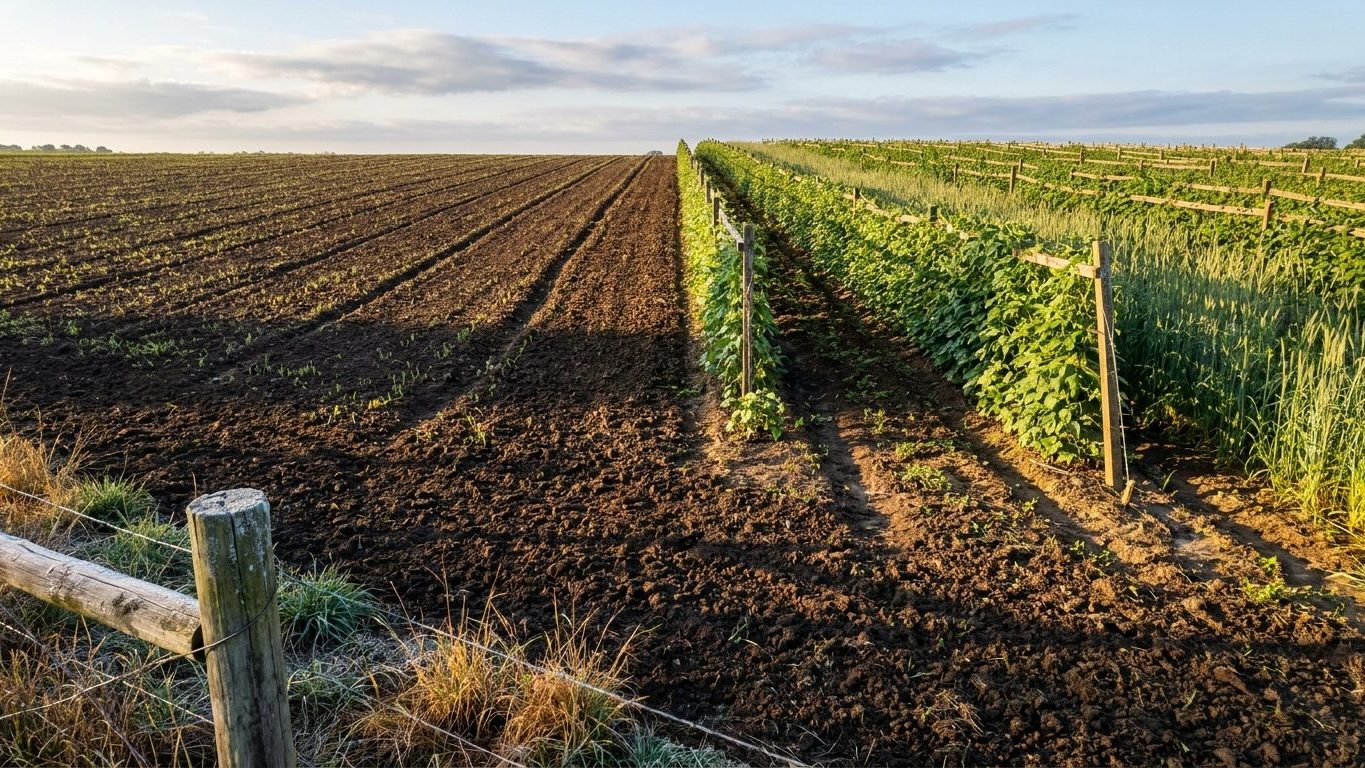

Cover crop sowing in Mississippi follows two frost bands, not one calendar date. Cool-season mixes go in during fall, ahead of the first freeze. Warm-season ones go in after the last freeze of spring. Both bands below come from the Jackson reference station, which runs milder than most home gardens in the state, so the sections that follow also show how to shift them.
The short answer for Mississippi
Sow cool-season cover crops in fall, before the first freeze arrives between November 7 and November 22. Sow warm-season ones in spring or summer, once the last freeze has passed between March 6 and March 22. Those dates are probabilities, not deadlines: the NOAA 1991-2020 Climate Normals mark the stretch where the chance of a 32°F freeze sits between 30 and 70 percent.
Read them this way. In spring, March 6 to March 22 is where the odds of one more 32°F freeze fall from 70 percent to 30 percent. In fall, November 7 to November 22 is where the odds of the first one climb from 30 to 70 percent. Inside either band, you are gambling with weighted dice. The sensible move is to treat the late end of the spring band as your earliest comfortable day for frost-tender seed, and the early end of the fall band as the day a cool-season stand should already be up and growing.
| Cover crop type | Anchored to | Sowing window at the Jackson reference station |
|---|---|---|
| Cool-season (cereal grains, clovers, vetches) | First fall frost, November 7 to November 22 | Fall, early enough to be established before that band opens |
| Warm-season (cowpeas, buckwheat, sorghum-sudangrass) | Last spring frost, March 6 to March 22 | After March 22, through summer |
One caution matters more than the table. These figures come from an airport weather station. Suburban and rural gardens typically see the last spring frost later and the first fall frost earlier, often by one to two weeks, and more at elevation. So outside Jackson, move cool-season sowing earlier and warm-season sowing later. For species choices inside each type, see The Best Cover Crops for Mississippi, and for the broader picture, Cover Crops for Mississippi Gardens.
The winter figure adds context. The mean daily minimum of the coldest month at Jackson is 36.6°F. Average winter nights stay above freezing, which means a fall-sown stand keeps growing through much of the cold season, and the freezes arrive as individual events rather than a long lockdown.
What will not work here
Sowing cool-season seed after the fall band has closed is the commonest failure. A late November sowing lands inside or past the November 7 to November 22 stretch at the reference station, and a week or two earlier than that in a cooler county. The seedlings have a few weeks of growth before the cold slows them, the roots stay shallow, and the stand comes out thin and patchy by spring.
Counting on winterkill is the second. Gardeners in colder states sow a cover crop that freezes dead and leaves a tidy mulch. With a coldest-month mean minimum of 36.6°F, that outcome is not something to bank on here. A frost-tender cover may be nipped by a freeze and then recover, or a hardy one may run into spring and need cutting or tilling on your schedule. Plan the termination by hand, not by weather.
Sowing warm-season seed in early March is the third. The spring band runs March 6 to March 22, which means a freeze is still a live possibility for much of that stretch, and later in many rural gardens. Cowpea seedlings caught by a 32°F night are gone, and you have paid for seed and labor to learn the lesson.
Borrowed calendars are the quietest failure. Advice written for a short-season state squeezes sowing into a narrow window. Mississippi’s gap between the late end of the spring band and the early end of the fall band stretches well past seven months, so the mistake runs the other way: beds sit bare all summer because someone assumed nothing fits. A warm-season cover fits there. This page does not carry frost dates for any neighboring state, so do not patch the gaps with theirs.
Humidity is the last piece. This page has no rainfall or humidity figures, so take this as a rule of thumb rather than a measurement. Mississippi summers are hot and humid, and a very dense summer stand holds moisture in its canopy and tangles as it matures, which makes it harder to cut cleanly. Sow at the rate on the seed label, not heavier.
What changes across Mississippi
The state is not one garden. Its USDA hardiness zones run from 7b to 9a, according to the USDA Plant Hardiness Zone Map 2023, which is built on 1991-2020 normals. That is four half-zone steps, and since each step is 5°F of average annual extreme minimum temperature, the coolest and mildest corners differ by about 15°F. There is no single answer for the state, only a spread.
If you garden in the north or on higher ground
Treat the Jackson dates as optimistic. The last spring frost comes later where you are and the first fall frost comes earlier, which compresses both windows. Cool-season sowing should move earlier, so seedlings are established before the first freeze reaches your garden. Warm-season sowing should move later, past the end of the March 6 to March 22 band by however long your own frosts linger. A garden at elevation can shift further than the one-to-two-week figure suggests.
If you garden toward the Gulf
The pattern reverses: milder winters tend to widen the fall sowing window and bring the spring one forward. This page, however, does not have station figures for the Gulf end of the state, so it will not hand you dates it cannot support. Use the Jackson bands as a starting point and confirm locally.
The zone system carries a limit worth knowing. It rests on a single variable, the average annual extreme minimum, so it says how cold winters get, not when the last frost falls or how hot summers run. Look up your own location on the USDA Plant Hardiness Zone Map and read the result as a hint about winter cold, not as a sowing date.
Where to check this for your own county
Your state extension service holds the most local answer. For Mississippi that is Mississippi State University Extension, the land-grant extension service, and its county offices are staffed by people who watch the same soils and weather you do.
Two things are worth looking for. The first is the local planting calendar for your county, which will give frost dates and sowing windows tuned closer to where you actually garden than any airport station. The second is the list of varieties trialled in your county or the nearest one. A trial result tells you which cover crop survived, grew and terminated well in your kind of soil, and that is information a state-level page cannot give you.
A county recommendation beats a state one, plainly. This page is the state one: it leans on a single reference station, it covers a range of zones, and it cannot see your hillside or your drainage. If the county calendar and this page disagree, follow the county. If you cannot find a county-specific calendar, call or visit the county office and ask two questions: when do local growers sow cool-season cover in fall, and what has done well in trials nearby.
Checking this against your own garden
Your own observations outrank every date on this page. Three are worth watching, and none needs an instrument.
- Soil warmth by feel. Dig a handful from about 2 inches down in late March. If it feels cold and clammy in your palm, hold warm-season seed back. A bed that warms early is usually sunny and well drained, while one that stays cold is often low, shaded or heavy clay.
- The first male flowers. On squash or cucumbers, male blooms appear before female ones. Their arrival tells you how fast your garden is actually warming compared with the calendar, and a bed that flowers well ahead of a neighbor’s is a warm pocket.
- The first true leaves. Sow a small test patch of your cover mix and watch for the first true leaves, the ones after the seed leaves. If a fall patch reaches that stage quickly, your window is open. If it crawls, you are sowing too late for your microclimate.
Write the dates down for a season or two. A notebook of when you saw the last frost on your lawn and when seedlings reached true leaves will, within a couple of years, be more useful than any reference-station figure.
Some gardeners also time this by the Moon: when to plant cover crops by the moon, as almanac tradition rather than fact.
Common questions
Can I still sow cool-season cover crops after the first frost?
You can, and seed may still germinate, since average winter nights at Jackson stay above freezing at a mean minimum of 36.6°F. A late sowing, though, produces a thin stand with shallow roots. Earlier is better, and in a cooler county the window closes sooner.
Is March too early to sow summer cover crops?
Early March falls inside the March 6 to March 22 band, where a 32°F freeze is still possible. Wait until the band has passed at the reference station, and later still in a rural or higher-elevation garden.
Do the Jackson dates apply to my county?
Treat them as a starting point only. They describe an airport station, and suburban and rural gardens typically see the last spring frost later and the first fall frost earlier, often by one to two weeks. Your county extension office has the local version.
Does my hardiness zone tell me when to sow?
No. The USDA system uses one variable, the average annual extreme minimum temperature. It tells you how cold winters get, not when frost arrives. Mississippi spans 7b to 9a, so sowing dates are set by frost bands, not by zone number.