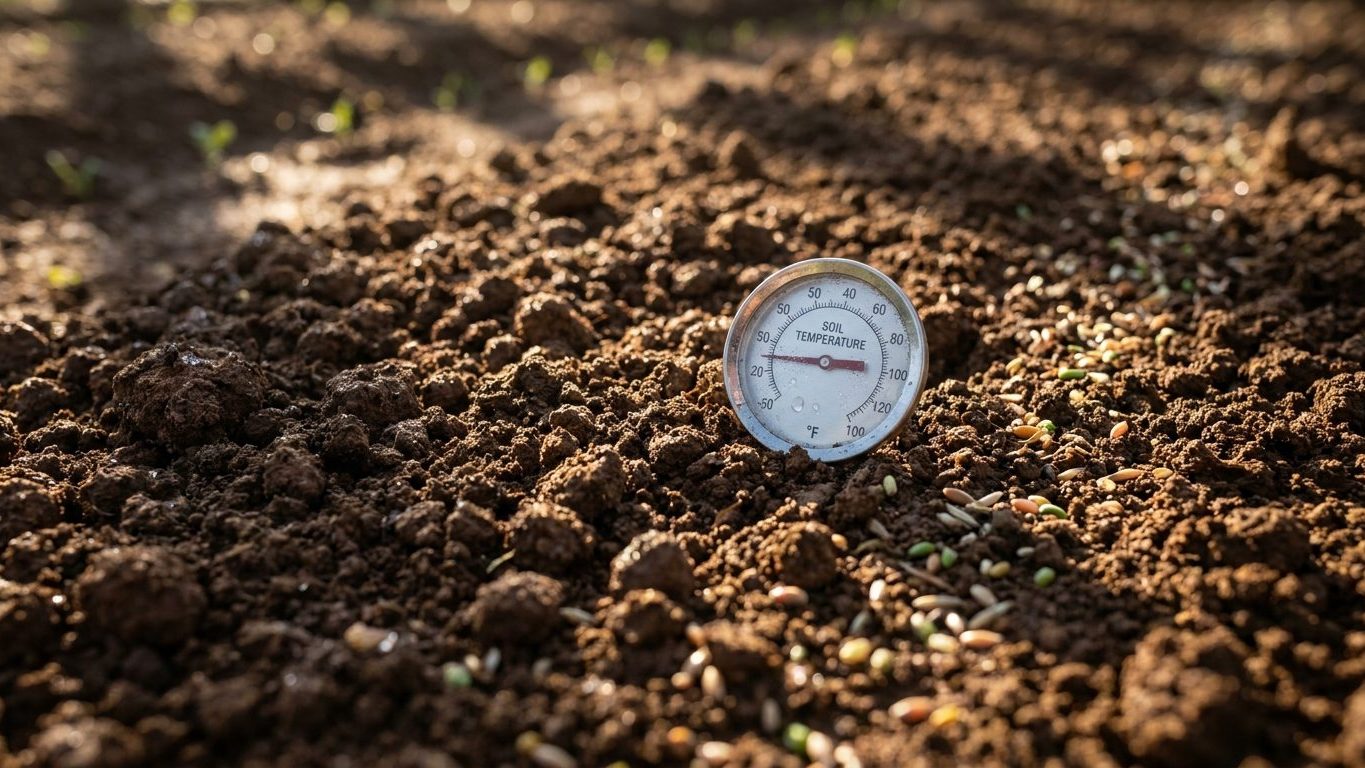

Mississippi gardeners can seed a fall cover crop through October in most of the state and expect a full winter season before spring planting begins, thanks to a long frost-free window and mild winter lows. The right timing and species depend on your local frost dates, your county’s typical soil temperature, and whether you want a crop that survives winter or one that dies back on its own.
When the soil is warm enough in Mississippi
The question gardeners actually need answered isn’t “when does frost end” but “when is the soil warm enough to sow.” Those are two different clocks, and mixing them up wastes seed. At the Jackson reference station, NOAA’s 1991-2020 climate normals put the last spring frost somewhere between March 6 and March 22, a 30-to-70 percent probability band rather than a fixed date. Frost risk fading doesn’t mean the soil has caught up. Bare ground takes days, sometimes weeks, to shed the chill that lingers after the air stops freezing, especially in clay-heavy soils common across the state’s interior.
That gap matters most for warm-season cover crops like buckwheat or cowpea, which rot in cold, wet ground even if the calendar says frost is unlikely. Cool-season species (cereal rye, oats, crimson clover) tolerate a cooler seedbed and are usually the better bet for anyone sowing near that early-March window. Whichever direction you go, treat the frost date as a probability, not a promise. A late frost after the “safe” window isn’t rare, and a cover crop seeded a week early in a wet spring often struggles more than one seeded a week late.
Seeding rate is where a lot of gardeners get tripped up by generic advice. Rate depends on the species you choose, whether you’re broadcasting or drilling, and the seed source’s own germination numbers, so there’s no single figure that applies across a state this size. Your county office of the Mississippi State University Extension Service can hand you a rate calibrated to your soil and method, and that’s worth the phone call before you buy seed.
Termination is the other piece people skip past. This isn’t a herbicide conversation. Mechanical methods, mowing, crimping, cutting, or simply letting a hard frost do the work, are how a cover crop gets turned into mulch here. Cereal rye crimps cleanly once it heads out in spring; clover and vetch usually need mowing before they set seed and turn into next year’s weed problem. Whatever species you plant, know your termination method before you plant it, not after.
How long the season lasts here
Stack the two frost dates from the Jackson station together and you get a frost-free stretch that runs, conservatively, from around March 22 to November 7, roughly 230 days. Push the estimate to the outer edges of each range, from the earliest spring frost date (March 6) to the latest fall one (November 22), and the window stretches closer to 260 days. Either way, that’s a long growing season by national standards, and it changes what’s worth attempting with cover crops here.
A window this long allows something a lot of colder states can’t manage: a second sowing in the same calendar year. Gardeners further north often get one shot, a fall cover crop that has to survive winter and get terminated before spring planting. In Mississippi, there’s frequently enough season left after a summer cash crop comes out to establish a short-cycle cover like buckwheat or cowpea in late summer, terminate it, and still sow a longer-season winter cover before the first fall frost risk arrives in early November.
That flexibility also changes the transplanting calculus. If you’re moving seedlings into a bed that just hosted a cover crop, a long season gives you slack to let the cover crop finish its job (building organic matter, breaking up compaction) rather than rushing termination to hit a tight transplant date. Checking root development before you pull a cover crop matters more in a long season, because there’s less pressure to cut it short.
For gardeners wanting to actually plan out a two-crop or three-crop cover rotation within that 230-to-260-day window, our succession sowing guide walks through how to stagger species so one crop’s termination lines up with the next one’s planting date.
Heat and water in Mississippi
For most vegetable crops the growing-season story is about summer heat and rainfall. For cover crops, the story flips: the real decision point is winter. The first fall frost at the Jackson station, arriving somewhere between November 7 and November 22, sets the last realistic sowing date for a cover crop meant to establish before cold weather slows growth. Miss that window and a fall-sown crop may not get enough top growth to survive winter competition from weeds.
What happens after that sowing date depends on how cold the coldest month actually gets, and that’s where Mississippi’s climate does something distinctive. The mean daily minimum for the coldest month at the Jackson reference station sits at 36.6°F, just above freezing on an average night. That’s mild. It’s mild enough that species gardeners in colder states rely on to winterkill cleanly, oats being the classic example, often don’t die back here at all. Instead of decomposing into a tidy mulch by February, oats can limp through a Mississippi winter and green back up in spring, turning what was supposed to be a self-terminating cover crop into a plant you now have to mow or till by hand.
That single fact (36.6°F) is the one that should drive species choice more than anything else on this page. Cereal rye, by contrast, tolerates real cold and also survives Mississippi’s mild winters just fine, but it’s built to be terminated deliberately (mowing or crimping at the right growth stage) rather than counted on to die from cold. Crimson clover behaves similarly across the USDA hardiness zone range that spans this state, 7b in the cooler northern counties up to 9a along the Gulf Coast; it persists through winter almost everywhere in Mississippi and needs an intentional cutback in spring.
The practical upshot: don’t plan a Mississippi cover crop rotation around the assumption that cold will do the termination work for you. In much of this state, it won’t.
Which cover crops suit Mississippi
Given a long frost-free window, mild winter minimums, and the mismatch between “hardiness zone” and “will it actually winterkill,” the species that make sense here share a few traits. Cool-season legumes and small grains that tolerate mild winters without fully dying back, think cereal rye, crimson clover, hairy vetch, are reliable choices precisely because you plan to terminate them mechanically rather than count on frost to do it. For the shorter summer windows between cash crops, fast-cycling species like buckwheat or cowpea fit the 60-to-90-day gaps that a 230-plus day season creates.
Humidity is the other filter. A state with mild, wet winters and hot, muggy summers favors species and planting timings that keep airflow around the crop and avoid prolonged leaf wetness, since fungal pressure builds fast in stagnant, damp conditions. This isn’t a reason to avoid legumes broadly, but it is a reason to prioritize disease tolerance and to terminate cover crops before they mat down into a humid, disease-friendly layer against the soil.
What this page won’t do is name a specific variety. That’s a deliberate choice, not an oversight. Cultivar performance for disease resistance, winter survival, and biomass production varies by seed lot and by the specific trials run in a given region, and a name that performs well in the Delta doesn’t necessarily perform the same way on the Gulf Coast or in the hill country further north. The Mississippi State University Extension Service runs and tracks those regional variety trials, and its recommendations are calibrated to actual local conditions in a way a general guide never can be. The same goes for seeding rates and any nitrogen contribution from a legume cover crop: both depend on species, stand density, and how much biomass you let build before termination, numbers your local extension office can size to your garden rather than a statewide average.
The species-level reasoning here (long season, mild winter, humid pressure) gets you to the right shortlist. The county-level detail that turns that shortlist into a planting plan is a phone call away.