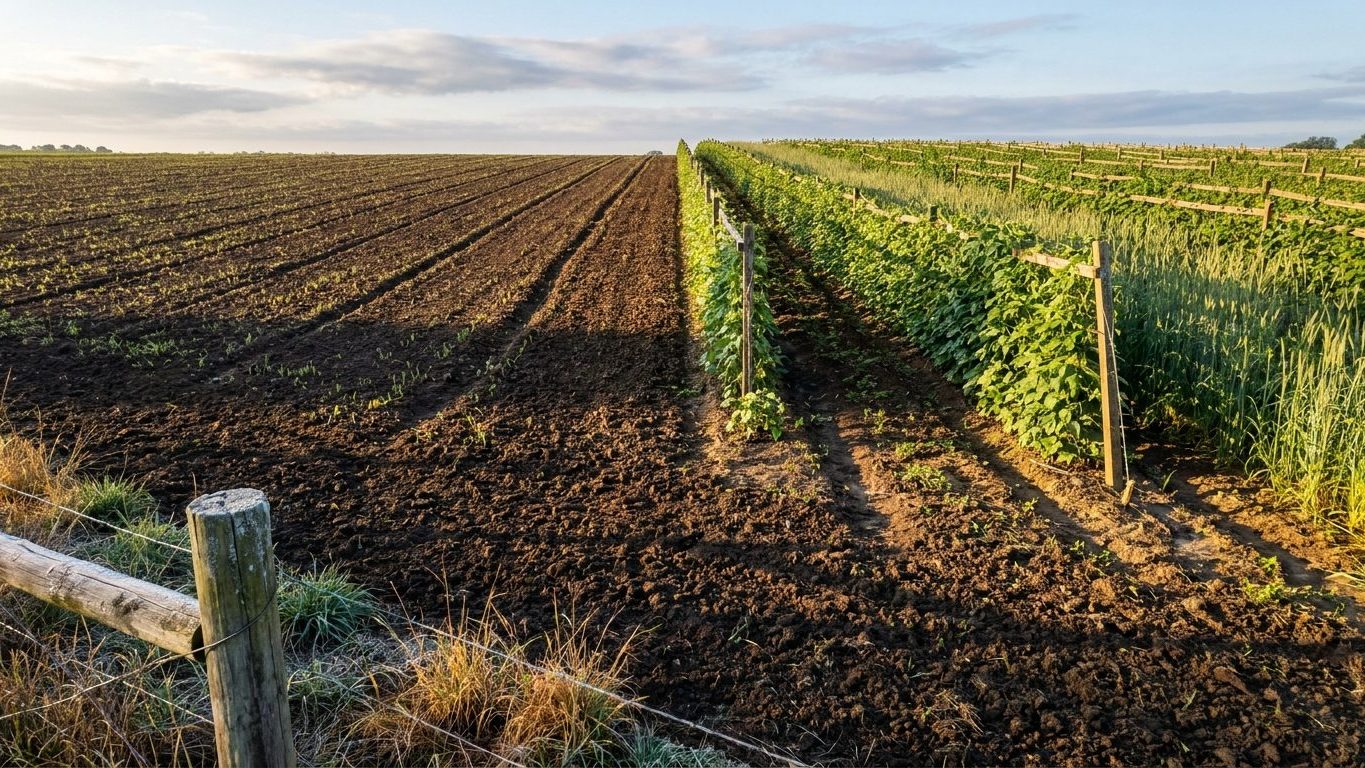

Fall cover crops in Nebraska go in the ground with enough runway to root before the first fall frost, which lands October 15 to 26 at the reference station. Spring-sown covers wait until soil dries out after the last spring frost window, April 12 to 23. Everything else on this page explains why those two windows aren’t the whole story.
The short answer for Nebraska
Cereal rye, triticale, and winter wheat, the workhorses of Nebraska cover cropping, get drilled after cash-crop harvest and before that October 15 to 26 frost date. That window isn’t a hard cutoff; it’s the range where the probability of a 32°F freeze sits between 30% and 70%, based on NOAA’s 1991-2020 climate normals for the Omaha airport station. Miss it by a lot and you’re seeding into ground that’s already shutting down for the year.
Spring-established covers, oats, field peas, and some brassica mixes used for quick soil-building ahead of a summer crop, follow the mirror-image logic. April 12 to 23 is the same kind of probability band for the last spring freeze, not a guarantee. A grower drilling oats on April 10 is betting against roughly a 30-70% chance of frost still showing up. Oats tolerate a light frost once emerged; peas are less forgiving.
Why the frost dates matter more than the calendar page
What actually decides whether a fall-seeded cover crop survives winter isn’t the sowing date alone, it’s the coldest month’s mean daily minimum, which sits at 15.2°F at the Omaha reference station. That number is the one that separates a winter-hardy stand of cereal rye or hairy vetch, which shrugs off that kind of cold once established, from a marginal legume that gets seeded too late, never builds enough root mass, and dies in January regardless of how carefully the sowing date was chosen.
So the real answer has two layers. Sowing date gets the crop up and growing. Cold tolerance, tied to that 15.2°F figure, decides whether it’s still alive in March. A cover crop can be planted at exactly the right time and still fail if the species itself isn’t rated for a Nebraska winter.
This page gives the state-level version of both windows. A grower’s own county, especially one at different elevation or further from the reference station, can shift these dates by a week or more in either direction, which the next sections address directly.
What will not work here
Slow-establishing cover crops are the first casualty of a Nebraska calendar built around an October 15 to 26 frost. A cover crop that needs 60 to 70 days of warm growth to reach a meaningful root system, planted after a late soybean or corn harvest in late September, simply runs out of daylight and warmth before that frost window arrives. The plant isn’t dead from cold; it’s dead from never having had the chance to grow. This is the single biggest planning mistake on Nebraska cover crop pages that borrow a longer-season state’s timeline.
Anything marketed as needing regular irrigation to establish is a second mismatch. Cover crops in Nebraska are almost always seeded dry, into stubble, with no supplemental water plan. A species that germinates reliably only with consistent surface moisture, fine in a state with a longer wet shoulder season, faces patchy, uneven emergence here when August and September turn dry, which they frequently do across the state’s western two-thirds.
The winter-kill trap
The 15.2°F coldest-month minimum is the number that exposes species sold as “winter cover crops” without a hardiness rating attached. Tillage radish and most brassica mixes are winter-killed by design, useful for a grower who wants residue gone by spring, but a problem for anyone expecting a living, growing stand in February. Sown too early relative to that October frost window, radish bolts and goes to seed before winter even arrives, creating a volunteer weed problem the following spring instead of the soil-building effect it was meant to provide.
The reverse mistake shows up with non-hardy vetch varieties or spring-type cereals seeded in fall, expecting them to overwinter like cereal rye. They can’t survive a mean minimum of 15.2°F in January, full stop. No amount of adjusting the sowing date compensates for choosing a variety that was never rated for this cold. That distinction, species-level hardiness against a temperature threshold rather than a calendar date, is where most cover crop plans in this state actually break down.
What changes across Nebraska
Nebraska’s USDA hardiness zone range, 4a to 5b, is a wide spread for a single state, and it means there’s no single sowing date that holds from the Panhandle to the Missouri River. A zone 4a location and a zone 5b location can differ by roughly 15 degrees in average annual extreme minimum temperature, which is exactly the kind of gap that changes whether a marginally hardy legume overwinters at all.
The practical shift for a grower in the colder end of that range is straightforward: push fall sowing earlier relative to the frost window described above, because a shorter effective growing season means less time between harvest and hard freeze. A grower toward the warmer end, in the 5b territory, has more room to wait, and can sometimes get a second cutting or extra growth out of a cover crop before winter shuts it down.
Elevation compounds this inside the same hardiness band. Higher ground, more common in the western part of the state, tends to see frost earlier in fall and later in spring than the river-valley locations, independent of what the broad zone number suggests. Two farms in the same USDA zone can still have noticeably different practical windows once elevation and local topography are factored in.
None of this tells an individual reader which end of the 4a-5b range their own ground falls into. That’s a question for the USDA Plant Hardiness Zone Map, searchable by ZIP code, not for a state-level article. What this section can say with confidence is that a Nebraska-wide sowing recommendation is, by definition, a compromise between two genuinely different climates sharing one state line.
Where to check this for your own county
Nebraska Extension, the state’s land-grant university outreach service, publishes county-level guidance that this page doesn’t have and shouldn’t pretend to. The service is reachable at extension.unl.edu, and it’s the right next stop for anyone trying to move from a state-wide window to a date that fits their own soil and elevation.
Two things are worth looking for specifically once there. First, a local planting calendar, if one exists for the reader’s county or region within the state, will reflect the actual frost pattern of that location rather than the Omaha reference station used throughout this page. Second, look for cover crop variety trial results run by Nebraska Extension or the University of Nebraska-Lincoln agronomy program; these trials test specific cereal rye, triticale, and legume varieties under real Nebraska conditions and report which ones actually survived the winter and produced usable biomass in that county, not just which ones are marketed as hardy.
A county-specific recommendation beats a state-wide one every time, for a simple reason: it was built from data collected closer to the reader’s own field. This page works from a single reference station’s frost probabilities and a state-wide hardiness range, both useful for planning purposes but neither substitute for local trial data. Nebraska Extension’s county offices, staffed by agents who work with growers in that specific area year after year, are the source built to close that gap. A phone call or visit to the local office often surfaces information, like which cover crop mix performed best in a nearby field trial last season, that never makes it into a general publication at all.
Checking this against your own garden
Every date on this page is a starting estimate, not a verdict, and the most reliable correction comes from what’s actually happening in the soil. Soil warmth checked by hand, pushing a few fingers into the top two inches of ground, tells a grower whether the ground has actually woken up for spring sowing or is still holding winter cold regardless of what the April 12 to 23 window suggests. Cold, damp soil that feels noticeably colder than the surrounding air means germination will be slow even if the frost risk has technically passed.
Germination speed and evenness after sowing is the second signal worth watching closely. A fall-seeded stand of cereal rye or oats that comes up thick and uniform within a week or so of drilling suggests soil moisture and temperature were both in a good range at planting; patchy, staggered emergence spread over two or three weeks is a sign the sowing date landed on the early or dry side of what that particular field needed that year.
First true leaves on the emerged seedlings are the third check. A cover crop that reaches its first true leaf stage quickly and looks vigorous, rather than sitting at the seedling stage for an extended stretch, is telling the grower that the timing matched the season this particular year. A stand that lingers at the cotyledon stage for weeks, even after emerging on schedule, often points to a cooler-than-normal microclimate on that specific field, the kind of local variation no state-wide frost date can fully capture.
Some gardeners also time this by the Moon: when to plant cover crops by the moon, as almanac tradition rather than fact.