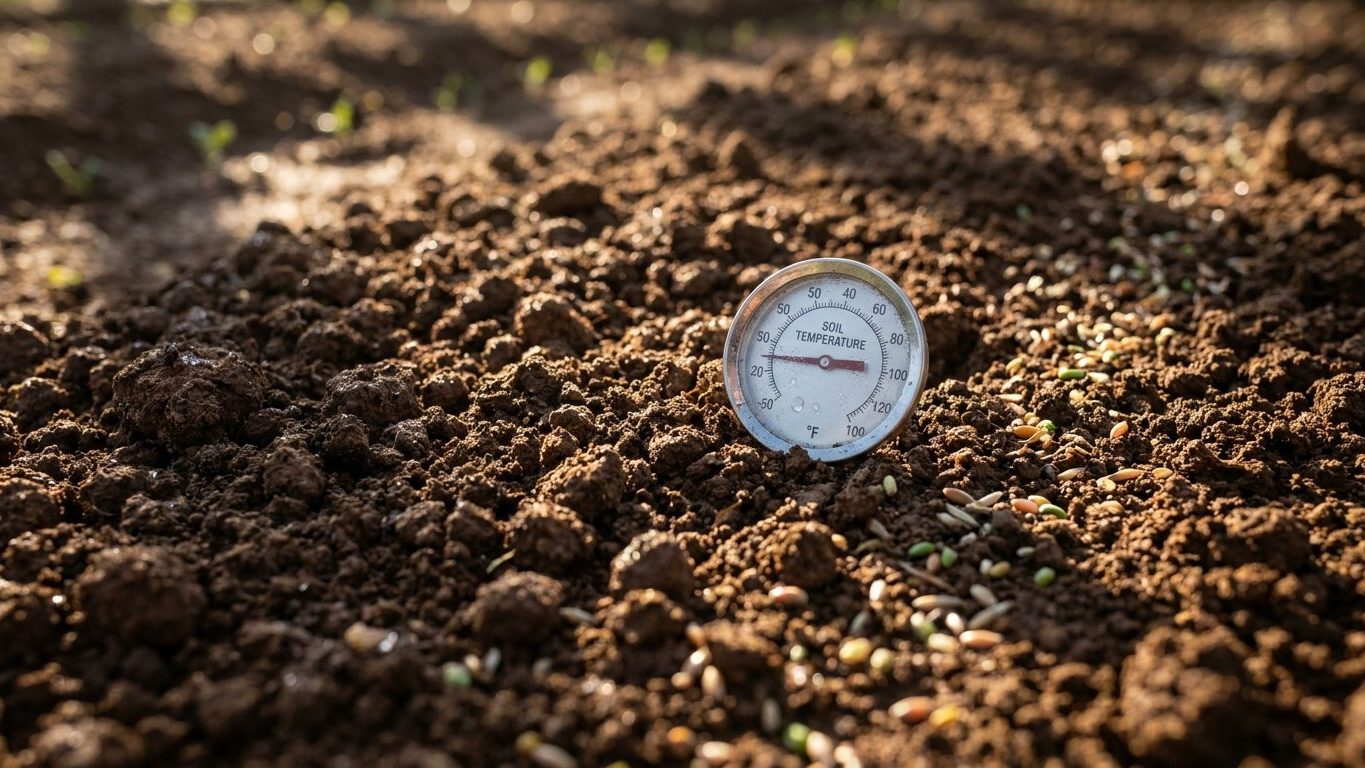

The short answer: wait until soil temperatures climb past the mid-50s, which in most of Nebraska happens two to three weeks after the last spring frost. At the Omaha reference station that frost falls between April 12 and April 23, and the state’s hardiness zones run from 4a to 5b, so a cold snap in early May is still fair game.
When the soil is warm enough in Nebraska
Frost dates get all the attention, but they’re a stand-in for the number that actually matters: soil temperature. NOAA’s 1991-2020 Climate Normals put the last spring frost at the Omaha station (USW00014942) somewhere between April 12 and April 23, a 30-70% probability band, not a hard line. Air can clear of frost risk while the top few inches of dirt are still cold and slow to germinate seed. That gap is why seasoned gardeners in eastern Nebraska usually wait until early to mid-May before drilling a cover crop, even though the calendar says frost danger has passed weeks earlier.
Treat that frost window as a probability, not a promise. Some years the soil warms fast after a mild April; other years a wet, cool spring keeps it sluggish into late May. Checking soil temperature directly, with an inexpensive probe pushed a few inches down, beats guessing from the calendar.
Species choice shapes the timing more than any single date does. Cool-season grasses like oats or cereal rye tolerate cooler soil and can go in earlier, while warm-season legumes and some brassicas prefer soil that’s already trending toward 60 degrees. Field peas and clovers sit in between, tolerant of a chilly start but not thriving until the soil has properly warmed.
Seeding rate is not something to guess at here. It shifts with the species, the method (broadcast versus drilled), and even the seed source, and a rate that’s off by half can mean a thin, weedy stand or a crop so dense it smothers itself. Nebraska Extension (extension.unl.edu) publishes current rate tables for the state and is the right place to check before buying seed, not a national chart written for a different climate.
Termination matters just as much as planting date, and this is where a mechanical approach earns its keep. Mowing a stand before it sets seed, crimping it flat once it flowers, or simply letting a hard frost do the work all avoid the need for any chemical termination step. In Nebraska’s climate, a well-timed fall frost or a late-winter mow often does the job without a single trip through the garden with a sprayer.
How long the season lasts here
Subtracting the two frost windows gives a frost-free season of roughly 186 days at the Omaha reference station, using either the early end of both ranges (April 12 to October 15) or the late end (April 23 to October 26). Call it a six-month window, which puts Nebraska in the middle of the pack nationally, longer than the northern Plains, shorter than most of the South.
That length is generous enough to support more than one cover crop pass in a single year, at least in the eastern part of the state where the growing season runs closest to that 186-day figure. A gardener can sow a fast cool-season cover crop in early spring, terminate it by late May ahead of tomatoes or squash, then bring in a second cover crop planting after the summer harvest clears out in September, well before that October frost window closes in.
Western Nebraska and the Panhandle, sitting in the colder end of the 4a-5b hardiness range, likely see a shorter effective window than the Omaha figures suggest, since elevation and distance from the moderating influence near the Missouri River both push frost dates earlier in fall and later in spring. A gardener in that part of the state should treat the 186-day figure as an upper bound, not a given.
A six-month season also changes whether transplanting cover crop starts is worth the trouble. With this much time on the calendar, direct-seeding almost always makes more sense, since there’s little urgency to shave a few weeks off by starting plants indoors. That calculus flips in places with a much shorter frost-free window, where every week counts and a root check under cover can buy real time. For the mechanics of stacking a spring planting, a summer cash crop, and a fall cover crop into one season, the site’s succession sowing guide walks through how to sequence sowings without leaving the soil bare between them.
Heat and water in Nebraska
Nebraska summers push well past 90 degrees across most of the state, but for cover crop planning that number matters less than what happens after the heat breaks. The clock that decides success here starts ticking in fall, not July.
The first fall frost, arriving between October 15 and October 26 at the Omaha station, sets the last realistic date to get a cover crop established before growth stalls. Miss that window and a fall-sown crop won’t build enough biomass to matter before winter shuts things down. That’s the more useful number for a Nebraska gardener than any midsummer heat count, because cover crops are typically working the shoulder seasons, not competing with tomatoes for July sun.
The coldest month’s mean daily minimum, 15.2°F at the Omaha reference station, is the figure that actually separates one cover crop from another here. That’s cold enough to reliably winterkill oats, which means a fall-sown stand of oats collapses into a dead mulch on its own by spring, no mowing or crimping required. In a milder territory, where the coldest month stays well above freezing, oats can survive winter and start growing again, turning what was supposed to be a tidy, self-terminating cover crop into a volunteer weed problem the following season. Nebraska’s cold cuts the other way: oats become one of the easiest, lowest-maintenance choices available precisely because the winter does the termination work for free.
Cereal rye behaves differently. It’s bred to survive cold that kills oats outright, which is useful when a gardener wants living ground cover through winter, but it means rye needs an active termination step in spring, mowing or crimping before it heads out, rather than dying back on its own. The choice between the two isn’t about which is “better” so much as which behavior fits the plan: dead mulch by April, or living cover that needs a spring intervention.
Hardiness zone 4a-5b spans a real range across the state. Omaha sits toward the milder 5b end; the western Panhandle trends closer to 4a. A gardener out west should expect the coldest month figure to run colder than Omaha’s 15.2°F, which only reinforces the oats-as-mulch strategy rather than undermining it.
Which cover crops suit Nebraska
Reasoning by type, rather than by brand-name mix, keeps the decision grounded in what Nebraska’s climate actually does to a plant. Three broad categories cover most of what gardeners plant here.
| Category | Winter behavior in Nebraska | Typical termination |
|---|---|---|
| Cool-season grasses (oats, cereal rye) | Oats winterkill reliably; rye survives and resumes growth in spring | Oats: none needed, frost does it. Rye: mow or crimp before seed head forms |
| Legumes (clovers, field peas, vetches) | Winter survival varies by species; some die back, some overwinter | Mow or cut before flowering sets seed |
| Brassicas (radish, turnip) | Killed by hard freeze, roots decompose in place | Frost handles most of it; residue breaks down over winter |
A short frost-free season, especially in the western part of the state, favors the earliest-maturing options within each category, since there’s less margin for a slow starter to build meaningful biomass before frost. Where humidity lingers longer, disease resistance becomes the first filter, since damp foliage sitting late into fall invites the mildew and rot that a drier stretch would avoid.
Naming a specific cultivar here would do more harm than good. Seed companies trial varieties against local disease pressure, local frost timing, and local soil, and the results shift from one county to the next even within a single state. Nebraska Extension (extension.unl.edu) runs and publishes those local trials, and their current variety recommendations reflect actual performance in Nebraska conditions this year, not a generic list written for the country as a whole. Seeding rates deserve the same treatment: they change with species, planting method, and seed source, and Extension’s current tables are the only reliable number to work from.
Termination stays mechanical across every category on this list. A mower, a crimper, or a well-timed frost handles the job without introducing a chemical step into a garden bed that’s about to grow food.