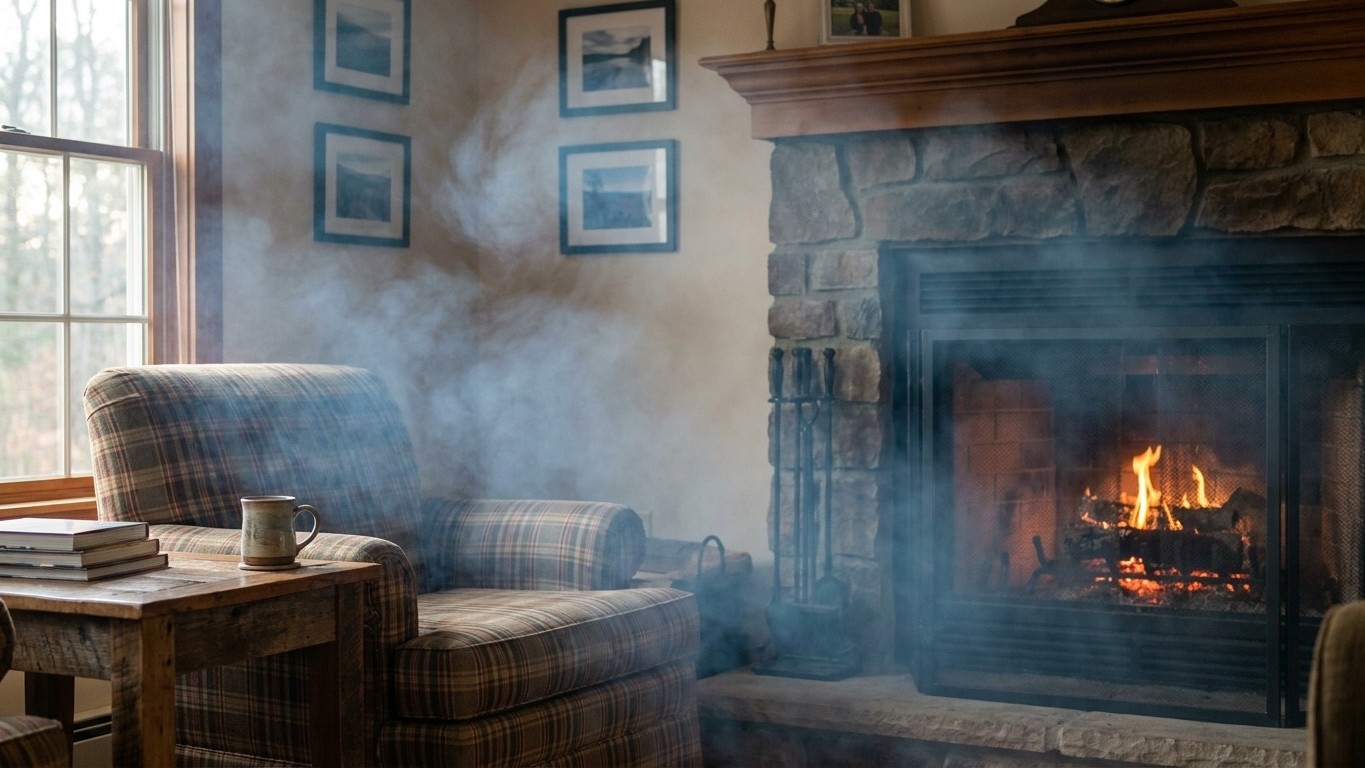

Smoke billowing back into your living room usually means one of three things: the flue is colder than the air rising through it, your house is pulling more air out than the chimney can supply, or the wood itself is too wet to burn clean. Fix the airflow problem first, then look at the fuel.
The Physics Behind a Smoky Room

A chimney works because warm air rises. Hot gases from the fire are lighter than the cooler air outside, so they get pushed up and out through the flue. That upward pull is called draft. When draft is weak, absent, or reversed, smoke has nowhere to go but back into the house.
Several conditions can kill draft on any given night, even in a chimney that’s worked fine for years.
Cold Flue, Cold Air
On a cold morning, the air sitting inside an unused flue is roughly the same temperature as the outside air. Since it’s not moving, it acts like a plug. Light a fire underneath that cold column, and the smoke has to fight its way past inches of dead air before it starts rising properly. This is why a fire that smokes for the first five minutes often clears up once the flue heats through.
A masonry chimney on an exterior wall is especially prone to this. The bricks radiate heat outward instead of holding it, so the flue stays cold longer than an interior chimney would. Homes in colder states like Minnesota, Vermont, or Montana see this constantly during the first hard freeze of the season.
Negative Pressure Inside the House
Modern homes are sealed tighter than they used to be. Weatherstripping, spray foam insulation, and upgraded windows all cut down on drafts, which is great for heating bills but bad news for fireplaces. When a bathroom fan, kitchen range hood, or clothes dryer runs at the same time as the fire, it can pull air out of the house faster than it leaks back in. That creates negative pressure, and the chimney becomes the path of least resistance for outside air trying to get back in. Smoke gets pushed down the flue instead of drawn up it.
This is one of the most common causes of chronic smoke problems, and it’s often mistaken for a “bad chimney” when the chimney itself is doing nothing wrong.
Wet Wood Makes Every Problem Worse
Even with perfect draft, firewood that hasn’t dried out enough will smoke heavily and make the room hazy. Freshly cut wood, sometimes called “green” wood, can hold 40 to 50 percent moisture by weight. Wood that’s been properly seasoned for six to twelve months typically drops to around 20 percent or less, which is the threshold most stove and chimney manufacturers recommend.
Burning wet wood does two things at once. It cools the fire down because energy gets spent boiling off water instead of producing heat, and it creates more smoke and creosote because combustion is incomplete. Cooler smoke rises more slowly, which means it’s more likely to stall in a cold flue or get pushed back by a gust of wind or a running exhaust fan. A moisture meter, available at most hardware stores for under twenty dollars, takes the guesswork out of this. Split a piece of wood and test the freshly exposed face, since surface readings on weathered wood can be misleading.
The Environmental Protection Agency’s Burn Wise program notes that burning dry, seasoned wood cuts smoke output significantly compared to burning wet wood, which matters both for indoor air quality and for how much creosote builds up in the flue over a season. More on that program is available at epa.gov/burnwise.
Chimney and Damper Issues Worth Ruling Out
If the flue is warm and the wood is dry and smoke is still coming into the room, the chimney itself may be the bottleneck.
A Damper That Isn’t Fully Open
It sounds obvious, but a partially closed damper is one of the most frequent causes of smoky rooms. Some dampers have a lever that can shift slightly from vibration or age, so what feels fully open might only be open two-thirds of the way. Reach up with a flashlight before lighting the fire and confirm the damper plate is swung completely clear of the flue opening.
Creosote and Soot Buildup
A flue that’s narrowed by creosote deposits restricts airflow the same way a clogged straw restricts a drink. The Chimney Safety Institute of America recommends an annual inspection, and more frequent cleaning for households that burn wood regularly through the winter. Heavy creosote buildup isn’t just a smoke problem, it’s also the leading cause of chimney fires, so this isn’t something to put off. Details on inspection standards are available through csia.org.
Flue Size and Chimney Height
Older homes sometimes have chimneys that were sized for a different fireplace insert or stove than what’s currently installed. A flue that’s too large for the firebox cools the smoke too quickly as it rises, weakening draft. A flue that’s too short, or one that sits lower than nearby rooflines or trees, can also struggle because wind turbulence around the house pushes air back down instead of letting it flow past cleanly. The general rule of thumb from chimney professionals is that the top of the flue should extend at least three feet above the roof penetration and two feet higher than anything within ten feet of it.
Quick Fixes to Try Before the Next Fire
Most smoke problems can be reduced with small changes rather than a full chimney rebuild.
- Warm the flue first by holding a rolled newspaper or fire starter lit near the damper opening for thirty seconds before lighting the main fire
- Crack a nearby window an inch or two to equalize pressure, especially if exhaust fans are running elsewhere in the house
- Turn off bathroom fans, range hoods, and the clothes dryer while the fire is getting established
- Switch to wood that’s been split and covered for at least six months, checked with a moisture meter reading under 20 percent
- Have the damper checked or replaced if it doesn’t open fully or seal tightly when closed
These steps address the two most common culprits, cold draft and negative pressure, without requiring any construction work.
When the Problem Points to Something Bigger
Smoke that comes in every single time, regardless of wood quality or window cracking, usually means there’s a structural or mechanical issue that needs a professional look. That could be a flue liner that’s cracked or improperly sized, a chimney cap that’s blocked by debris or a bird’s nest, or a house that’s been sealed so tightly during a renovation that no amount of window-cracking solves the pressure imbalance.
A certified chimney sweep can run a smoke test to see exactly where draft is failing, and can measure the flue against the firebox to confirm they’re properly matched. This isn’t a job for guesswork, since a chimney that vents poorly is also one that’s more likely to leak carbon monoxide back into the house rather than just visible smoke.
One detail that surprises a lot of homeowners: a chimney that worked fine for fifteen years can suddenly start smoking after a nearby tree grows tall enough to disrupt wind patterns around the roofline, or after a neighboring addition changes how wind moves across the property. Draft problems aren’t always about the chimney changing. Sometimes it’s everything around the chimney that changed instead.