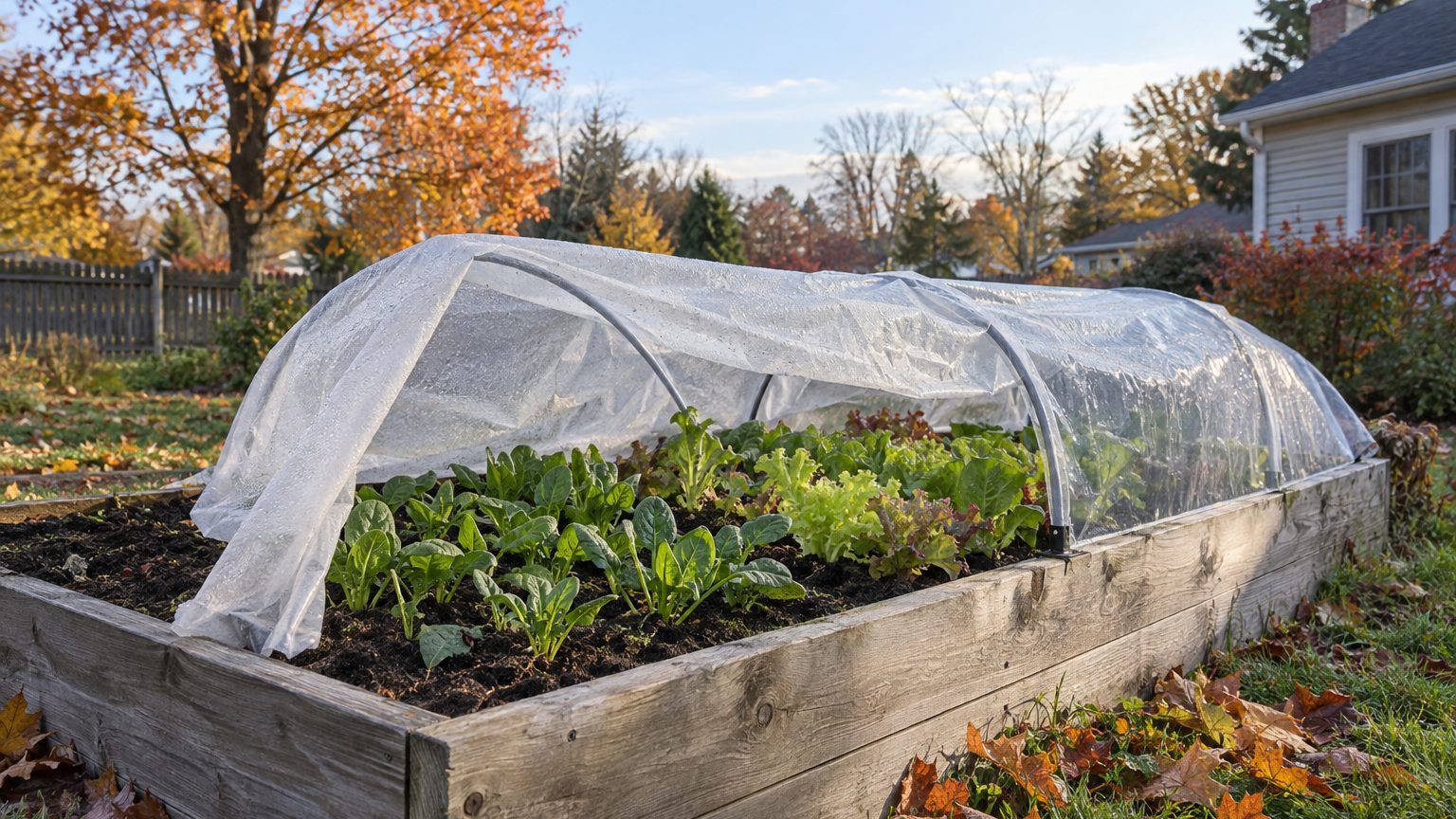

At Cheyenne, the 1991-2020 NOAA normals put the last spring freeze between May 7 and May 18 and the first fall freeze between September 24 and October 5. Wyoming gardeners work with a short frost-free window, and frost can turn up in any month at higher elevations. Covers stretch both ends of that window. They do not remove the limit.
When the soil is warm enough in Wyoming
The frost date is only the starting gun
Start with the date everyone asks about. At Cheyenne (NOAA station USW00024018), the 1991-2020 Climate Normals place the last spring 32F freeze between May 7 and May 18, using the 30-70% probability band. That is a probability, not a promise: some years the last freeze comes earlier, some years later.
The bigger catch is that frost is a proxy. A bed does not wake up the day the freeze risk ends. Soil holds the cold of winter long after the air turns mild, and it warms more slowly than the air does. Seeds sown into cold ground sit idle, rot, or sprout weakly. So the useful question is not “has the last frost passed?” but “has the soil reached what this crop needs?” The seed packet lists a minimum soil temperature, and a cheap soil thermometer pushed in at planting depth on a morning reading settles the matter better than any calendar.
What a cover does to the soil clock
Season extension works by moving the soil’s schedule forward. Sunlight warms the ground, and the ground gives that heat back slowly through the night. A cover (floating fabric, a low tunnel, a cold frame) keeps that radiated heat from escaping and holds the air still around the plants. Add a second layer, such as fabric inside a tunnel, and you trap a little more. Laying a cover over a bed a week or two before planting lets the soil warm ahead of the seedlings.
The gain is real, but it varies. It depends on the material, the night, the wind, and whether the ground was already warm when the sun went down. A clear, still, cold night in May can still beat a cover. Treat a cover as something that shifts the limit a little, not as frost protection you can stop watching.
A closed structure brings a second hazard. A cold frame shut tight in spring sun can cook its contents within an hour, even when the air outside is cold. Ventilation is how you keep the crop alive, so prop the lid open on any sunny morning and close it again as the light fades. Everything here is passive. No heater, lamp, or flame belongs inside a covered structure, because the fire and carbon monoxide risks are real.
Cheyenne sits at roughly 6,000 feet, and frost is possible in any month at higher elevations. Mountain valleys and basins in other parts of the state run on different clocks, so use these dates as a reference point rather than a rule for your own yard.
How long the season lasts here
Both frost dates come from the same Cheyenne station, so the subtraction is honest. From the latest spring date (May 18) to the earliest fall date (September 24) is 129 days. From the earliest spring date (May 7) to the latest fall date (October 5) is 151 days. NOAA’s own note describes roughly 130 frost-free days at 6,000 feet, which sits at the short end of that spread.
| Event at Cheyenne | Date range (30-70% band) |
|---|---|
| Last spring 32F freeze | May 7 to May 18 |
| First fall 32F freeze | September 24 to October 5 |
| Window between the earliest-ending and latest-starting pairings | 129 to 151 days |
The number matters less than what it allows. A window near 130 days does not leave much room for a second round of anything slow. It makes the first sowing the only sowing for most warm-season crops, and a late start or a lost bed cannot be redone. That changes the transplanting math too. A transplant that has to recover from a root check eats days you do not have, so it pays only when the head start it gives is bigger than the setback. Tomatoes started indoors usually clear that bar. Crops that sulk after being moved often do not.
Cool-season crops are the ones that reward a second sowing. Quick greens and roots can go in again in midsummer and finish before the fall freeze, especially with a fabric cover tossed on for the cold nights at the end. Count days to maturity from the day you plant, not from the last frost, and compare it with the days left before the first freeze. Light is thinner in October, so growth slows well before the freeze arrives. Subtract a margin. The overview of what a cover buys and what it cannot explains how to treat that margin, and the succession sowing guide on this site shows how to space the rounds.
Gardeners comparing territories may find it useful to read how the same question plays out in the Connecticut and Nebraska pages. Each starts from its own station and its own dates.
Heat and water in Wyoming
Guessing would mislead, and the hot-climate advice (shade cloth for scorching afternoons, deep watering schedules) is not what drives decisions on the high plains. Here the governing facts are cold and light.
Light runs out before warmth does
Cheyenne sits at 41.15 degrees north. That is the latitude of the reference city, not of the whole state, which spans several degrees. A gardener near the northern or southern edge should check their own latitude, because the dates below shift with it. Day length, not warmth, is what tells an onion to stop making leaves and start making a bulb, and it is also what tells every crop when growth slows. As autumn deepens, daylight falls below what plants need to put on new growth. After that date, a cover holds a crop alive rather than growing it. Lettuce under fabric in December is being stored, not raised. The farther north you are, the earlier that date arrives, so sowings meant for fall harvest have to be planted early enough to reach size while light is still generous.
The coldest month picks the cover
The mean daily minimum of the coldest month at Cheyenne is 18.1 F (NOAA 1991-2020 normals). That is an average, so some nights run colder. It is also a different measure from the USDA Plant Hardiness Zone Map 2023, which spans zones 3a to 6a across Wyoming and rests on one variable, the average annual extreme minimum. The zone range tells you what perennials survive. The monthly minimum tells you what a cover has to face.
Light fabric is enough for a shoulder-season frost, the kind that shows up in September or May. A winter month with nights averaging 18.1 F asks for more: a framed structure, ideally with a second layer inside it. Even then the crop is held, not pushed. Wind is a fixture on the high plains, so anchor fabric along every edge and brace frames against gusts.
Water is the quiet issue. Fabric lets rain and irrigation through, and a closed frame does not, so watering under a frame is by hand. Where a cool, damp stretch settles in, mildew, slow ripening, and disease take over. Airflow under a cover then matters more than extra warmth.
Which season extension suit Wyoming
Choose by type, not by cultivar. A short season favors the earliest types: quick-maturing crops, cold-tolerant crops, and covers that go on early and come off late. At roughly 130 frost-free days, a slow variety is a bet you may lose in September.
Cool nights and a late spring point to fabric over hoops for spring starts and fall finishes, and a vented cold frame for hardening off or holding greens. For deep winter, only a framed structure with good airflow will do, and it holds plants rather than growing them. Where summer is hot in a given valley, favor types that allow airflow and shade at the root. Where it is damp, disease resistance becomes the first criterion for any crop under cover, because still, humid air is where mildew thrives. Whichever structure you pick, build in ventilation: prop it, vent it, open it every sunny day, because a sealed box overheats quickly.
Variety choice is left open, and that is on purpose. Which varieties do well depends on elevation, wind, and the local frost pattern, and a recommendation without local trial data is a guess. The varieties that matter are the ones that have been grown and compared in your area. For that, go to University of Wyoming Extension, which can point you to local results and to the office nearest you. Spend a few minutes there before ordering seed.
One practical habit helps whatever you choose. Keep a simple notebook of your own last spring frost and first fall frost for two or three seasons. Your yard’s pattern, shaped by slope, wind, and elevation, will be more useful than any station average.
Common questions
When can I plant outdoors in Cheyenne?
The NOAA normals put the last spring freeze between May 7 and May 18, but that is a probability band, and soil takes longer to warm than the air. Check soil temperature at planting depth against what the crop needs before you sow.
Is a cover enough to get through a Wyoming winter?
Light fabric is not. The coldest month at Cheyenne averages a daily minimum of 18.1 F, and a framed structure with extra layers is the realistic choice. Even that holds a crop alive rather than growing it, and no cover makes a crop frost-proof.
Do these dates apply across the state?
No. They belong to Cheyenne, at about 41.15 degrees north and roughly 6,000 feet. Frost is possible in any month at higher elevations, and the far north and south of the state behave differently, so check your own latitude and elevation.
Can I add a heater or lamp to a cold frame?
No. Season extension here is passive only, because heaters, lamps, and flames inside a covered structure carry fire and carbon monoxide risks. Ventilate on sunny days instead, since overheating is the more common way to lose the crop.