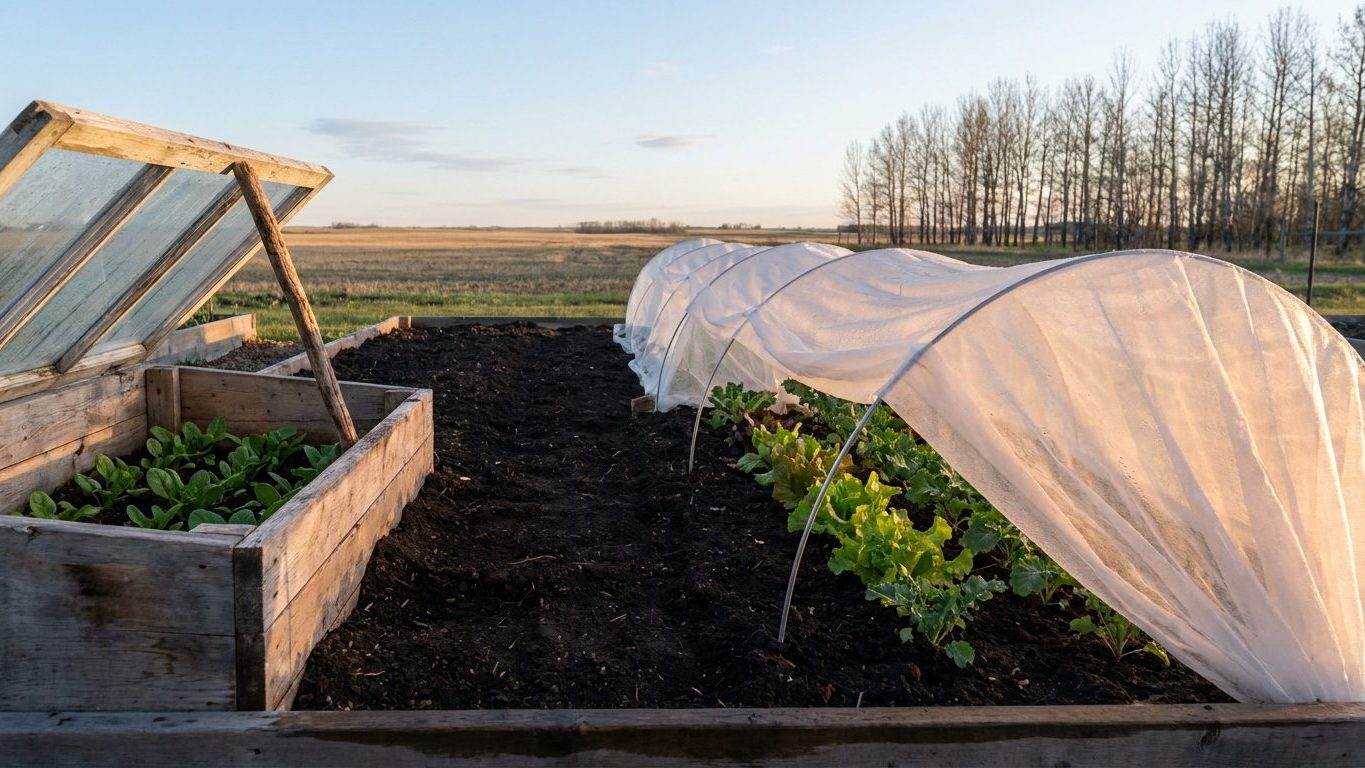

In Yukon, the extenders worth buying add warmth in June and hold off the first hard frost in late August. That means floating row cover, low tunnels, and a greenhouse or polytunnel for heat lovers. Cold frames and black mulch help in spring. Nothing short of a heated, lit greenhouse carries food through a Yukon winter. A short frost-free window and very long summer days explain most of the choices below.
The short answer for Yukon
Use a low tunnel covered with row cover or clear plastic for the main vegetable beds, and a greenhouse or polytunnel for tomatoes, cucumbers and anything else that needs sustained heat. Add a cold frame for hardening off seedlings and black plastic or dark mulch to warm the soil before planting. Row cover alone is enough for hardy crops such as lettuce, spinach, kale, radishes and peas. The extender has to match the crop, because a cover that rescues a lettuce bed will not ripen a tomato.
How long is the frost-free window in Whitehorse?
At the Whitehorse A weather station, the average last spring frost is June 5 and the average first fall frost is August 25, which leaves about 81 frost-free days between them. Both dates are averages, so in one year out of two the last spring frost falls later than June 5, and in one year out of two the first fall frost arrives earlier than August 25. Treat each as the middle of a window, never as a safe date. The Canadian normals behind them cover 1981-2010, a different span from the 1991-2020 normals used for US stations.
The latitude helps and hurts. Whitehorse sits at 60.71 degrees north, so summer days are very long and plants get light for many hours. Nights stay cool, though, and the frost dates sit close together. An extender does two jobs here: it pulls the start of the season earlier and pushes the end later.
Which season extender fits which job?
| Extender | Best use in Yukon | Main limit |
|---|---|---|
| Floating row cover | Early sowings of hardy greens, roots and peas; frost cover in late August | Adds only a few degrees; does little against a hard freeze |
| Low tunnel (hoops and plastic) | Warming beds before planting; carrying crops past the first frosts | Needs venting on sunny days; wind and snow can wreck it |
| Cold frame | Hardening off seedlings; early salad crops | Small; overheats quickly on bright days |
| Greenhouse or polytunnel | Tomatoes, cucumbers and other heat lovers | Cost, anchoring against wind, snow load |
| Black plastic or dark mulch | Warming cold soil before planting | Warms the ground only; does not stop air frost |
If you buy only one thing, buy row cover and a set of hoops. It is cheap, it works on almost every crop in the garden, and it covers both ends of the season. When the first frost approaches, the timing question becomes the one covered in When to Cover Your Garden in Yukon.
What will not work here

Waiting for June 5 and then planting tender crops in the open fails about half the time. That date is an average, so in half of all years a frost still arrives later. Tomato, squash and cucumber transplants set out bare on that day are gambling, and a tunnel or cover on hand is what turns the gamble into a reasonable bet.
Slow crops fail even with protection. About 81 frost-free days is not much, and a tunnel adds weeks at the margins, not months. A tomato variety that needs 90 days or more from transplanting will rarely ripen in the open ground. For direct-sown crops like squash, melons and sweet corn, the days on the seed packet count from sowing, and the long-season types are poor bets outdoors. Choose early varieties first, then add the extender. Extra cover will not rescue a variety that is simply too slow.
Clear plastic left closed through a Yukon summer is another failure. Days are long and the sun is strong, so a sealed tunnel or cold frame can cook seedlings within a few hours even when the air outside is cool. Vent in the morning, close in the evening. The same goes for covers left on squash and cucumbers once the flowers open, because pollinators cannot get in.
Winter harvests from unheated structures do not work either. The mean daily minimum of the coldest month at Whitehorse is -19.2 °C (-2.6 °F). A layer of row cover holds a few degrees, which makes little difference against that, and low winter sun gives plants almost nothing to grow on. Hardy crops can be stored or overwintered under deep snow or heavy mulch, but a plastic tunnel is not a winter garden.
Light-duty hardware also fails here. Thin row cover tears in steady wind unless it is pinned down along every edge. A hoop tunnel left up into the first heavy snow can collapse under the weight, so take the plastic off or reinforce the frame before then. For a broader look at how these tools fit together over a whole season, see Extending the Growing Season in Yukon.
What changes across Yukon
There is no single answer for the territory. The Whitehorse reference city falls in Canadian hardiness zone 1b, based on 1991-2020 normals from Natural Resources Canada. That is the Canadian system, built on seven climate variables, and it does not convert to a USDA zone. Natural Resources Canada itself says there are no simple conversions, and that Canadian zone 4a alone overlaps nine USDA zones, from 3a to 7a. So a Canadian zone number should never be set beside a US zone on the same scale.
Whitehorse is one city in a large territory, and every figure for it describes that station. Northern and upland districts run weeks behind it. A garden at higher elevation, or in a cold valley bottom where frost pools, may see its last spring frost later and its first fall frost earlier. The 81-day window shrinks there, and the tunnel or greenhouse moves from a helpful extra to the thing that makes tender crops possible.
To see where your own community falls, use the Natural Resources Canada plant hardiness map and look up your municipality.
Where to check this for your own county
Yukon does not have a county extension system like most US states. The nearest equivalents are federal and territorial agriculture offices, and Agriculture and Agri-Food Canada is the place to start. From there, look for the territorial agriculture branch and for any regional guidance on northern gardening.
Two things are worth finding. The first is a planting calendar written for your own community or nearest weather station, with frost dates and sowing windows for the crops you grow. The second is a list of varieties that have been trialled in northern conditions, ideally close to where you live, with notes on which ones ripened in a short season and under cover.
A local recommendation beats a territory-wide one every time. Guidance for the whole of Yukon, like what is written here, is a starting point built around one reference station. A grower in the next valley may deal with frost three weeks earlier, wind that shreds plastic, or a south-facing slope that warms fast. Local garden clubs and growers who have run tunnels for years in your own area often know these details better than any published calendar.
Checking this against your own garden
Your own observations outrank every date above. Three things are worth watching, and none needs equipment.
Soil warmth by feel. Push your fingers a few inches (about 5 cm) into the bed in the morning. If the soil feels cold and damp to the touch, seeds will sit and slow-growing transplants will stall. Do the same in a covered bed and an uncovered one. The difference tells you how much your cover or black mulch is really warming that spot, and whether a sheltered corner warms sooner than the open garden.
First true leaves. After the seed leaves open, the first true leaves signal that a seedling has settled in and is growing for itself. Sow a short row of lettuce or radishes under cover and another beside it in the open, and note how many days each takes to show true leaves. A wide gap means your tunnel is paying off. A small gap means the spot is already warm, or the cover is overheating.
The first flush of male flowers. On squash and cucumbers, male flowers open before female ones. When they appear, pollination is not far off, so open the sides of the tunnel or lift the cover during the day. How early they show up in your garden compared with a neighbour’s tells you a lot about your own microclimate.
Keep a notebook for a couple of seasons. Note the dates of the last spring frost you saw, the first fall frost, and where in the garden frost hit hardest. A low corner that frosts first and a south wall that stays frost-free later are part of your climate too, and no weather station will report them for you.
Common questions
What is the best season extender for a beginner in Yukon?
Floating row cover on simple hoops. It is inexpensive, protects against light frosts in both spring and fall, and suits most vegetables. Add a greenhouse or polytunnel later if you want to grow tomatoes or cucumbers.
Can I grow tomatoes outdoors in Yukon?
With about 81 frost-free days at the Whitehorse station, outdoor tomatoes are a stretch. Early varieties under a tunnel are possible, but a greenhouse or polytunnel gives far better odds. Choose varieties by their days from transplanting.
Can a cold frame or tunnel keep vegetables alive all winter?
No. The mean daily minimum of the coldest month at Whitehorse is -19.2 °C (-2.6 °F), which is far beyond what an unheated structure can handle. Use them to extend the season at either end instead.
When should I put the cover on in late summer?
The average first fall frost at Whitehorse is August 25, but in half of years it comes earlier. Keep the cover and hoops ready from mid-August and put the cover on when a clear, calm evening is forecast to drop close to freezing.