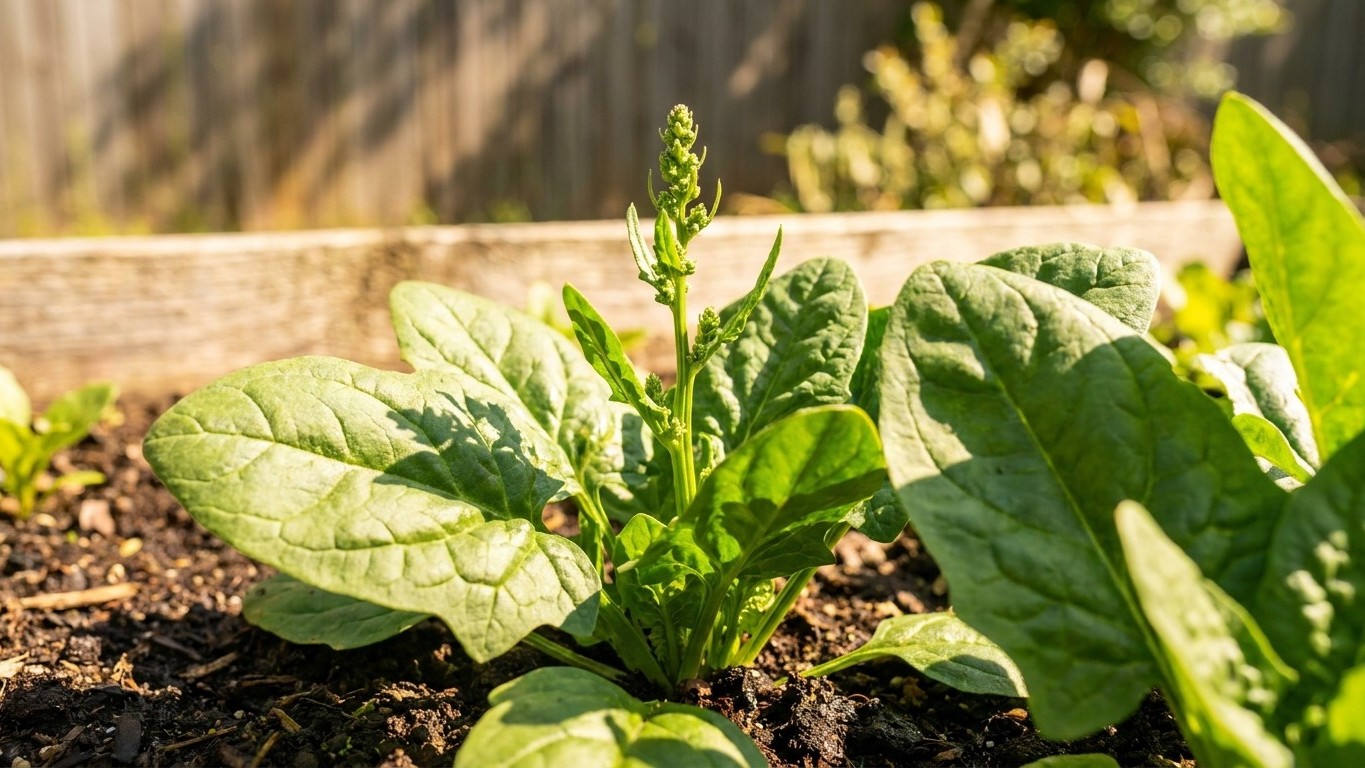

Three things eat the spinach calendar in New Hampshire: long days, warmth, and the first hard frost. In spring, rising day length and temperatures above 75 F end the crop. In autumn, warm soil blocks early sowing and frost closes the season. A cool summer doesn’t change any of this, because spinach reacts to the length of the day as well as to the weather.
The short answer
On the longest day of the year, the reference city behind these climate normals gets 15 h 10 of daylight. That number matters to spinach more than any thermometer reading, because long days alone push the plant to flower. Warmth adds to the push. The days start it.
Many New England gardeners assume a cool summer should stretch the season. It doesn’t. Day length is set by latitude, not by how mild July turns out, so a cool, damp June still delivers the same light as a scorching one. Utah State University Extension puts it plainly: spinach bolts during long days and warm temperatures, and it grows best where temperatures do not exceed 75 F. A bolted plant sends up a seed stalk, the leaves turn bitter, and the harvest is over. For the full picture of how early that can happen, see Will Spinach Bolt Early in New Hampshire?
So is the limit here the day length or the heat? Both, and in that order of stubbornness. Day length is the wall you can’t move. Heat is the second wall, and it sits closer than most people think. The reference station records an average of 10.9 days a year at 90 F or higher. That sounds gentle, and for tomatoes it is. For spinach it’s a misleading figure, because the ceiling is 75 F, not 90 F. The same 75 F number marks where growth stops being good and where bitterness takes over. A day can sit comfortably below 90 and still be too hot for a spinach bed.
The practical effect is a crop with two short windows and a gap between them. In spring the days lengthen toward that 15 h 10 peak, so every week of delay in sowing costs more than the week before it. In late summer the days are already shrinking from the peak, which helps, but the soil is still hot enough to cause trouble of its own. Both windows are narrower than the garden-catalog picture suggests, and the next two sections put dates on them.
One caution runs through everything below. The frost dates come from an airport weather station, not from your yard. Suburban and rural gardens in New Hampshire usually see the last spring frost later and the first fall frost earlier than the reference city, often by one to two weeks, and more at elevation. Check your own county before you commit seed to the ground. For the broader growing basics, start with Growing Spinach in New Hampshire.
How long the spring window really is
The rule of thumb is to sow spinach 2 to 3 weeks before the last frost. At the reference city, NOAA NCEI’s 1991-2020 normals put the last spring frost (the 30 to 70 percent probability band of 32 F freezes) at April 16 to April 27. Working through the arithmetic gives a usable spring that is shorter than it first looks.
- Find the sowing start. Count back 2 to 3 weeks from April 16 to April 27 and sowing opens somewhere between about March 26 and April 13, once the soil can be worked. A garden that runs one to two weeks later than the airport, which is common inland and uphill, starts correspondingly later.
- Spend the lead time. Those 2 to 3 weeks before the last frost are not harvest time. Seed is germinating and seedlings are putting on their first leaves, so a good part of the early window is used up before anything is ready to pick.
- Watch for the ceiling. Growth stops being good above 75 F. That is a temperature, never a calendar date. What you can count is the stretch between the last frost and the first run of afternoons past 75 F.
- Add the day-length clock. Even if the weather stays cool, days keep lengthening toward 15 h 10 at the solstice. The longer you wait to sow, the closer the plants get to the light that triggers flowering.
Put in plain words, the usable spring here is a matter of weeks, not months. It begins in the last days of March or in April and ends when warm afternoons arrive, with the lengthening days pressing from behind. The date when New Hampshire afternoons settle above 75 F varies, so no single number of weeks fits. It also moves from year to year and from valley to hilltop.
The squeeze falls unevenly. Elevation pushes the last frost later, which delays your first sowing, but it does nothing to the length of the day. A hill-town garden therefore loses time at the front of the window while the back of it stays fixed by the solstice light. The practical answer is to sow the moment the ground is workable, in short successive batches, rather than waiting for the calendar to feel like spring.
The autumn crop, and when the soil lets you sow
Autumn is the better season for spinach, and the autumn crop has two obstacles that bracket it. One blocks the start, the other the finish. The dates in between are what matter, and they are easier to count than the spring ones. The full sowing guide is in When to Sow Autumn Spinach in New Hampshire.
Warm soil blocks the start
Gardeners often assume cold stops a fall crop. Early in the season, warmth does. Spinach seed germination is reduced when the soil is above 80 F, and a bed that has baked through July can easily stay there into the weeks when you’d otherwise want to sow. Seed that goes into hot ground may sit, sprout poorly, or not come up at all. The window opens when the soil cools, not when the calendar says “fall.” Utah State University Extension is the authority here, and it gives no soil-temperature date for New Hampshire.
Shading the bed, watering it before sowing, and sowing in the evening are the usual ways to cool a bed down a little. None of them turns a hot bed into a cool one, so wait if the ground feels warm.
Frost closes the finish
The extension advice is to plant 50 to 75 days before the date you want to harvest. The source publishes no days-to-maturity figure for spinach, so that range is the only count available. Use the first fall frost as your realistic harvest deadline. At the reference city the 1991-2020 normals put it at October 13 to October 26.
Counting back gives the following:
- From October 13, 50 days back is about August 24, and 75 days back is about July 30.
- From October 26, 50 days back is about September 6, and 75 days back is about August 12.
The overall sowing window, then, runs from the end of July to early September, depending on how much time you give the crop and how late your frost comes. The early end collides with the warm soil described above, so the realistic sweet spot for most reference-city gardens sits in the later part of that range, once beds have cooled. Rural and suburban gardens that see frost one to two weeks sooner should shift every one of those dates earlier by the same amount, and hill gardens by more. That shift squeezes the window from both sides, since the earlier dates run straight into warm soil.
Common questions
Does a cool New Hampshire summer keep spinach from bolting?
Not reliably. Long days alone can trigger flowering, and the reference city gets 15 h 10 of daylight at the solstice no matter how cool the weather is. Coolness helps with the heat side of the problem, but it can’t cancel the day-length side.
Can I sow spinach in midsummer?
You can, but germination suffers when the soil is above 80 F. Count back 50 to 75 days from your target harvest, then wait until the bed has actually cooled before you sow.
How long does harvested spinach keep?
UC Davis Postharvest lists 32 F and 95 to 98 percent humidity as optimum, and says spinach will not maintain good quality for more than 2 weeks. That’s a ceiling, not a plan. At the 41 to 50 F that a home fridge often holds, wilting and yellowing come sooner. Keep it at the back of the bottom shelf, where it’s coldest, not in the door.
Which varieties are best for New Hampshire?
The Utah State University source names four: Bloomsdale, Melody, Teton and Olympia. It publishes no data about any of them, including bolting tolerance or days to maturity, so I can’t rank them. Sow a small test row of one or two and let your own beds tell you.